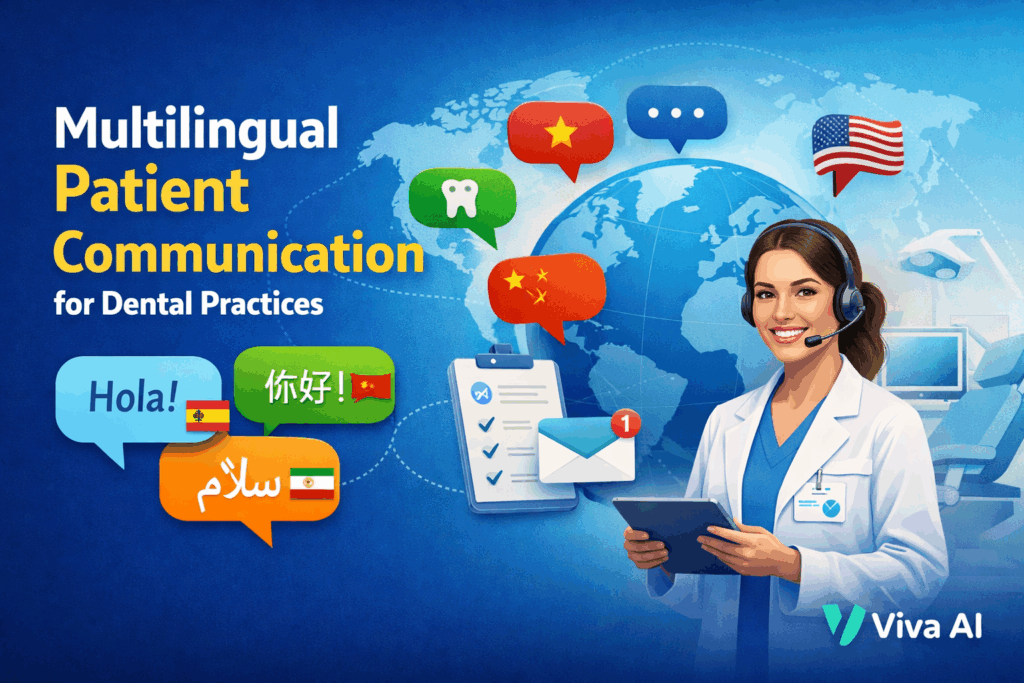
Dental practices serve increasingly diverse communities, but most patient communication systems still assume that every patient speaks English.
In reality, many patients prefer to communicate in Spanish, Mandarin, Vietnamese, Persian, Tagalog, Korean, and many other languages. When practices can’t easily communicate in a patient’s preferred language, it creates friction throughout the patient experience.
Patients may hesitate to respond to reminders, struggle to complete forms, or avoid contacting the office altogether.
Today we’re introducing a new capability in Viva AI designed to solve this problem: automatic patient language detection and multilingual communication for dental practices.
Practices can now automatically detect a patient’s preferred language and send reminders, forms, and campaigns in that language—without any manual setup.
Automatic Patient Language Detection
Viva AI now automatically detects the language a patient uses when they communicate with your practice.
For example, if a patient texts your office in Spanish or replies to a reminder in Portuguese, Viva identifies the language instantly and stores it as the patient’s preferred language.
From that moment on, the system can automatically communicate with that patient in their preferred language.
There is no need for the front desk to manually tag patients or configure translation workflows.
This makes multilingual communication seamless for practices while keeping the experience natural for patients.
Send Reminders, Forms, and Campaigns in the Patient’s Preferred Language
Once a patient’s language preference is detected, Viva AI can automatically send communications in that language across the entire patient journey.
This includes:
- Appointment reminders
- Recall reminders and hygiene campaigns
- Marketing campaigns
- Consent forms
- Medical and dental history forms
- Follow-up instructions
- Payment reminders and billing communication
Instead of sending the same English message to every patient, Viva adapts communication to the language each patient understands best.
For practices serving multilingual communities, this can dramatically improve response rates and patient engagement.
Multilingual Patient Campaigns for Dental Practices
This feature also extends to automated patient campaigns.
Practices can now send a single campaign that automatically adapts to each patient’s language preference.
For example, a hygiene recall campaign can send:
- English messages to English-speaking patients
- Spanish reminders to Spanish-speaking patients
- Persian reminders to Persian-speaking patients
—all from the same campaign workflow.
Your staff creates one campaign, and Viva handles the language adaptation automatically.
Why Multilingual Communication Matters for Dental Practices
Language barriers often create hidden operational challenges for dental practices.
Front desk teams may spend time translating messages, relying on family members to help interpret information, or struggling to explain forms and instructions.
Patients, on the other hand, may feel hesitant or confused when communication isn’t in their preferred language.
By automatically detecting language and adapting communication accordingly, Viva removes this friction.
Practices can communicate clearly with every patient while reducing the workload on their staff.
AI That Adapts to Patients
One of the core ideas behind Viva AI is simple: practice communication should adapt to patients—not the other way around.
Automatic language detection and multilingual campaigns are another step toward that goal.
As dental practices become more diverse and patient expectations evolve, communication systems need to be more flexible and intelligent.
With Viva AI, practices can now connect with patients in the language they’re most comfortable using—automatically.