AI is no longer an experiment in dentistry — it’s infrastructure.
By 2026, most dental practices will use some form of AI, especially for patient communication and front-desk operations. But as adoption grows, so does confusion. Many dentists are still asking the same questions:
- What can AI actually do for my practice today?
- What’s realistic vs. marketing hype?
- Will AI replace my front desk team — or help them?
This article breaks down what AI can and can’t do for your dental practice in 2026, with a specific focus on the AI dental receptionist — one of the fastest-growing and highest-impact uses of AI in dentistry.
Why AI Matters More Than Ever for Dental Practices
Dental practices are facing a perfect storm:
- Front-desk staffing shortages and burnout
- Missed calls turning into lost patients
- Rising patient expectations for instant responses
- Administrative work pulling teams away from care
AI didn’t become popular in dentistry because it’s trendy. It became necessary because traditional workflows no longer scale.
That’s where solutions like Viva’s AI Dental Receptionist come in — not to replace people, but to handle the volume, speed, and consistency that modern practices require.
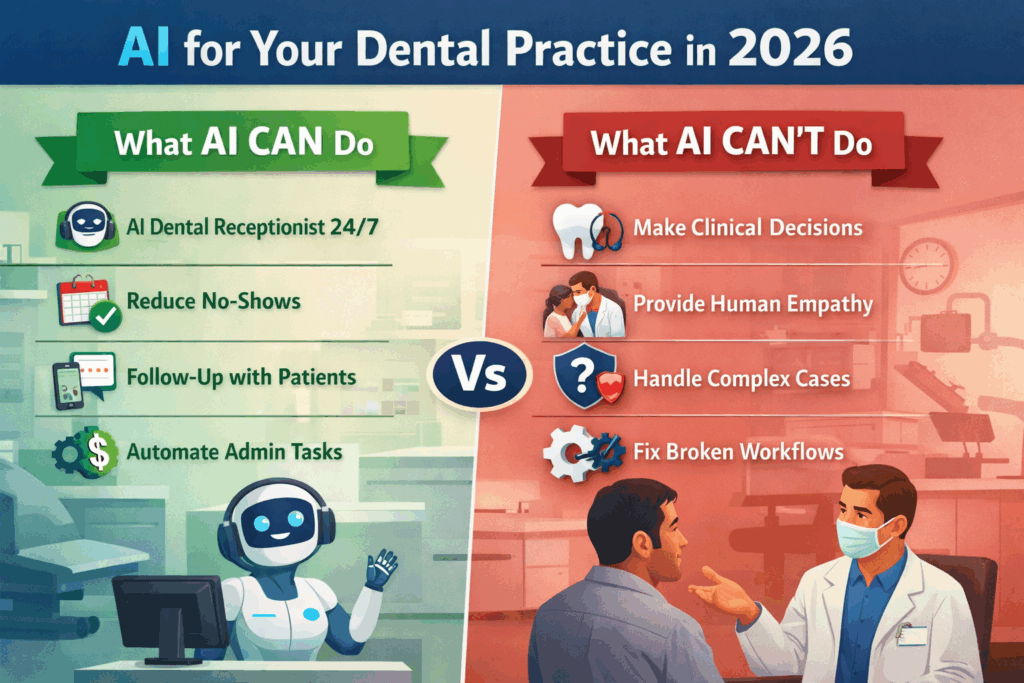
What AI Can Do for Your Dental Practice in 2026
1. AI Can Act as a 24/7 Dental Receptionist
The most proven and valuable role of AI in dentistry today is front-desk communication.
An AI dental receptionist can:
- Answer inbound phone calls instantly
- Respond to website chat and SMS inquiries
- Book, reschedule, and confirm appointments
- Answer common patient questions (insurance, services, hours, location)
- Capture new patient leads after hours
Unlike voicemail or basic chatbots, modern AI receptionists hold natural, human-like conversations and integrate directly with practice systems.
👉 Viva was built specifically for this use case. You can see how it works on the Viva AI Dental Receptionist page.
Why this matters:
Every missed call is a potential lost patient. AI ensures your practice never “closes” digitally.
2. AI Can Dramatically Reduce Missed Calls and No-Shows
By 2026, practices that rely solely on human staff to answer every call will be at a disadvantage.
AI helps by:
- Answering 100% of calls, even during peak hours
- Sending conversational appointment confirmations
- Allowing patients to reschedule without calling the office
- Following up automatically on missed calls and voicemails
This leads to:
- Fewer no-shows
- Higher schedule utilization
- Less front-desk stress
AI doesn’t replace your team — it backs them up when call volume spikes.
3. AI Can Improve Case Acceptance Through Better Follow-Up
AI doesn’t diagnose or treatment plan — but it does help patients understand.
AI can:
- Follow up after appointments with treatment explanations
- Answer common post-visit questions
- Reinforce why recommended treatment matters
- Provide consistent, judgment-free education
This aligns with Viva’s approach to improving communication and trust, which we’ve written about in How AI Meets Patients Where They Are.
When patients feel informed instead of rushed, they’re more likely to move forward with care.
4. AI Can Automate Repetitive Front-Desk Tasks
In 2026, AI is best used to eliminate low-value, high-volume work.
This includes:
- Intake and basic patient data collection
- Call routing and message triage
- Insurance eligibility checks (basic, non-clinical)
- Appointment reminders and confirmations
The result is not fewer staff — it’s staff doing higher-value work like patient experience and in-office care.
5. AI Can Help You Capture and Convert More New Patients
Speed wins in dental marketing.
AI helps practices:
- Respond instantly to new patient inquiries
- Qualify leads automatically
- Book appointments directly from ads or websites
- Follow up with patients who don’t book immediately
Instead of relying on staff availability, AI ensures every lead gets a response — every time.
What AI Can’t Do for Your Dental Practice in 2026
AI is powerful — but it has limits. Knowing them builds trust and prevents frustration.
1. AI Cannot Replace Dentists or Clinical Judgment
AI cannot:
- Diagnose conditions
- Create treatment plans
- Perform procedures
- Replace clinical decision-making
Any AI claiming to do this is either misleading or unsafe.
At Viva, AI is designed to support communication and operations, not clinical authority.
2. AI Cannot Replace Human Empathy in Critical Moments
AI can sound empathetic — but it isn’t human.
Patients still want:
- Reassurance from a real dentist
- Compassion during pain or fear
- Human discussion for complex decisions
That’s why the best AI systems know when to hand off to your team instead of forcing automation.
3. AI Cannot Handle Every Edge Case Perfectly
AI works best within defined boundaries.
It may struggle with:
- Complex insurance disputes
- Emotionally charged conversations
- Legal or ethical gray areas
This is why Viva emphasizes safe escalation to staff rather than full automation at all costs.
4. AI Cannot Fix Broken Workflows on Its Own
AI amplifies whatever system you already have.
If your practice has:
- Poor scheduling policies
- Confusing pricing
- Inconsistent communication
AI won’t magically fix that. It will simply execute faster.
Successful practices align workflows first, then layer AI on top.
The Right Way to Use an AI Dental Receptionist
By 2026, the most effective dental practices use AI as:
- A digital front desk
- A first responder for patient communication
- A backup for busy teams
- A conversion and retention engine
Not as a dentist.
Not as a full staff replacement.
Not as a one-click solution.
This philosophy is core to Viva’s platform and why practices choose us over generic chatbots or call systems.
How to Know If an AI Dental Receptionist Is Right for You
Ask yourself:
- Are we missing calls today?
- Are patients waiting on hold or leaving voicemails?
- Is our front desk overwhelmed?
- Do leads come in after hours?
If the answer is yes, an AI dental receptionist isn’t a “nice to have” — it’s infrastructure.
You can learn more about how Viva integrates with practice workflows in Our Integrations and product resources.
Final Takeaway: AI in Dentistry Is About Support, Not Replacement
In 2026, AI will not replace dentists or front desks — but it will replace inefficient workflows.
Practices that win with AI:
- Use it where it excels (speed, scale, consistency)
- Keep humans where they matter most (care, trust, expertise)
- Treat AI like a team member, not a gimmick
The future of dentistry isn’t human or AI.
It’s human plus AI — done right.