
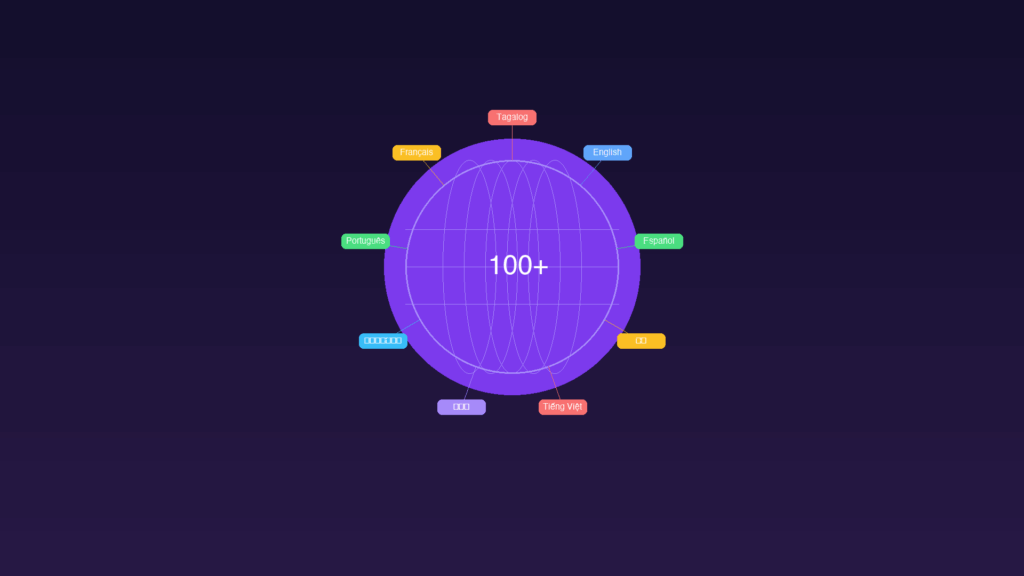
100+ Languages, Zero Configuration: How Viva Solves the Multilingual DSO Challenge
If your DSO operates in any major US metro market — Texas, California, Florida, New York, Arizona — you’re serving a genuinely multilingual patient population. Maybe it’s Spanish. Maybe it’s Mandarin or Vietnamese or Tagalog. Maybe it’s a mix across your locations.
And if your AI receptionist only speaks English and Spanish, you’re systematically excluding or underserving patients in those languages.
We built Viva’s multilingual capabilities because we realized early on that limiting language support is a revenue limiting decision disguised as a technical limitation. It’s not technical. It’s a product choice.
The Market Reality of Multilingual Dentistry
Let’s look at actual census data for major DSO markets:
- Texas: 28% of the population speaks Spanish at home. Another 2–3% speaks Asian languages. Total non-English: 32%+
- California: 44% of the population speaks a language other than English at home. Spanish accounts for 28%, Asian languages for 8%. Total non-English: 44%
- Florida: 28% speak Spanish at home. Another 3–4% speak Creole, Portuguese, or other languages. Total non-English: 32%+
- New York: 28% speak a language other than English at home. Spanish is 13%, but Chinese, Korean, Italian, and Russian combined account for another 8%. Total non-English: 28%
These aren’t small populations. In Texas, if you operate 20 locations and have 2,000 active patients per location, about 12,000 of your patients primarily speak Spanish. Another 1,200 speak an Asian language. That’s 13,200 patients you’re potentially underserving if your AI only speaks English and Spanish.
Now think about the patient journey. A Spanish-only patient calls your office. If your AI only speaks English, what happens? Either they get offered an English-language service and struggle to communicate, or they’re immediately transferred to a human coordinator. That defeats the purpose of AI — to handle the volume and reduce coordinator overhead.
A patient who speaks Mandarin calls your office in California. If your AI doesn’t speak Mandarin, they’re definitely being transferred. Your coordinator now has to handle a language barrier plus the normal coordination work. That’s stressful for your staff. It’s frustrating for the patient. And it’s leaving value on the table.
What Most AI Companies Do
The market standard is 1–2 languages. English, and maybe Spanish. A few vendors have added a third language. The reason is simple: training models for language is expensive. Each language requires native-speaker validation. It requires cultural and idiomatic understanding. It requires testing to make sure the AI doesn’t make embarrassing mistakes.
So most vendors pick the largest addressable market (English) and the second-largest (Spanish) and call it done. They tell themselves — and their customers — that “most patients speak English anyway.”
That’s technically true. It’s also how you miss 30% of your potential patient base.
How We Built 100+ Language Support
We knew from the start that Viva needed to serve the actual patient populations that DSOs have, not the languages that are easiest to build for.
We started by mapping patient demographics against DSO locations. Where are the highest concentrations of non-English speakers? Which languages matter most in each region? What are the secondary languages that don’t get mentioned in census data but show up in real patient populations?
Then we made a technical bet: instead of hand-curating language support, we’d build the underlying systems to support automatic language detection and generation across a wide range of languages simultaneously.
Here’s how it works:
Automatic language detection happens in real-time. A patient calls and speaks in Mandarin. The system detects Mandarin. Internally, it’s running Mandarin language models. The patient never has to select a language. They never hear “Press 1 for English, 2 for Spanish.” They just call and speak.
Persistent language preference means that if a patient calls once in Spanish, their profile is tagged with Spanish as their preference. The next time they call — even six months later, even from a different location in your DSO — the system starts in Spanish by default. They don’t have to repeat their language preference.
100+ languages supported because we built the architecture to handle language diversity at scale. We’re not picking 5 languages and optimizing those. We’re supporting any language where we have sufficient training data.
The current list includes: English, Spanish, Mandarin, Cantonese, Vietnamese, Korean, Tagalog, Japanese, Thai, Hindi, Bengali, Telugu, Tamil, Marathi, Gujarati, Arabic, Hebrew, Persian, Turkish, Polish, Russian, Ukrainian, Portuguese, French, German, Italian, Dutch, Swedish, Danish, Norwegian, Finnish, Czech, Hungarian, Romanian, Greek, Serbian, Croatian, Bulgarian, and dozens more.
We continue adding languages based on patient population data from our DSO customers.
Why This Matters for DSO Operations
Revenue Recovery
A patient who feels comfortable communicating in their primary language is more likely to schedule an appointment. They’re less likely to be confused by the interaction. They’re less likely to call back because they didn’t understand something. A DSO with genuine multilingual support captures patient interactions that English-only or English+Spanish systems miss entirely.
For a 20-location DSO in a multilingual market, supporting 20+ languages instead of 2 can increase effective patient capture by 15–20%. That translates to dozens of additional appointments per month across your locations — easily $100,000+ annually in incremental revenue.
Coordinator Burden Reduction
When a patient can have a full conversation in their primary language with the AI, your coordinators don’t have to step in as translators. That’s huge. A coordinator shouldn’t have to manage a complex insurance conversation in Spanish when they speak Spanish as a second language. An automated AI can handle it accurately.
This also means your coordinator hiring pool isn’t limited to multilingual staff. You can hire excellent coordinators who speak only English because the AI handles the linguistic diversity.
Patient Experience and Loyalty
A patient who can communicate in their primary language feels genuinely welcomed. That’s not just customer service — that’s making someone feel like they belong. For immigrant communities and people who don’t speak English fluently, that feeling matters enormously. It affects whether they return. It affects whether they refer their family and friends. And as emotional intelligence in patient communication becomes a competitive differentiator, multilingual capabilities become even more critical.
The Technical Reality We’re Honest About
We want to be clear about what we can and can’t do. Viva supports 100+ languages at the conversational level. But not all languages are equal. English and Spanish models are more refined because we have more training data. Rarer languages have solid baseline support but might make occasional errors or sound slightly more robotic.
We also acknowledge that some cultural contexts require human judgment. A patient calling about a sensitive health issue or a complex situation might benefit from a human coordinator who understands their culture and language. Our system is designed to recognize when to hand off to a human, not to force every interaction through AI.
What we won’t do is pretend that language is solved by slapping Google Translate on top of English conversations. That’s terrible. We’ve trained purpose-built models for each language, with native speakers validating output and cultural appropriateness.
The Competitive Disadvantage of Limited Language Support
If you’re a DSO executive evaluating AI and a vendor only supports 1–2 languages, understand what you’re accepting: you’re consciously limiting your patient population. You’re saying that 20–40% of your potential patient base will have a worse experience with your AI than English speakers.
That might be fine if you operate in a homogeneous market where 95% of patients speak English. But if you’re in California, Texas, or Florida, you’re leaving significant revenue on the table.
The vendor might justify this by saying “we’re focused on quality over quantity” or “most patients speak English anyway.” What they really mean is “we haven’t invested in multilingual infrastructure because it’s expensive and complex.”
That’s a valid engineering constraint. But it’s a competitive disadvantage for you. And when comparing platforms, limited language support becomes a critical differentiator if your patient base is diverse.
What Good Multilingual Support Looks Like
When you’re evaluating AI vendors, ask for a live demonstration in a language other than English. Don’t let them show you a script. Actually hear the system in Spanish, Mandarin, Vietnamese, whatever language represents 10%+ of your patient population.
Listen for:
- Does the AI understand and respond naturally, or does it sound robotic?
- Does the AI use culturally appropriate language, or is it technically correct but awkward?
- Can the AI understand accented speech, or only “perfect” pronunciation?
- When the patient switches languages mid-conversation, does the AI handle it gracefully?
- If the patient asks something in a language the AI doesn’t support, what happens? Does it gracefully offer an English-speaking coordinator?
Most vendors will fail this test. They’ll have one or two languages that sound natural. Everything else will sound like Google Translate read by a robot.
Good multilingual support means that a patient in any supported language gets a conversational experience that’s as natural as a native English speaker gets.
The Future of Multilingual DSOs
We’re watching how demographics shift in dental markets. The patient populations that DSOs serve are becoming more linguistically diverse, not less. Spanish-speaking patients are growing. Asian immigrant communities are growing. Multilingual fluency will become table stakes.
A DSO that invests in genuine multilingual AI infrastructure now is building for that future. A DSO that limits itself to 2 languages is slowly excluding more and more of its addressable market. And when you’re managing compliance across different languages and markets, you need infrastructure that’s purpose-built for multilingual, multi-regional operations.
If you’re a VP of Operations at a DSO in a multilingual market, ask your AI vendor: How many languages do you actually support? How do you detect language? What happens if a patient speaks a language you don’t support? Do you have any plans to expand language support?
The answers tell you whether the vendor is building for the future of dentistry or the past.