California isn’t just a state—it’s an economy. The dental market here is mature, competitive, and complex in ways that don’t exist elsewhere. You’re managing locations in San Francisco where tech workers expect omnichannel communication. You’re serving communities in the Central Valley where farming families need appointment flexibility and Spanish-language access. You’re operating in San Diego where you’re competing with practices that have unlimited marketing budgets.
And underneath all of it, you’re managing the most linguistically diverse patient base in America.
California’s DSO Competitive Reality: Comprehensive Landscape
California hosts the largest and most mature DSO market in America, with heavyweight nationals and innovative regional players competing for dominance across Bay Area, Southern California, and Central Valley markets. Here’s what the competitive landscape actually looks like:
National DSOs with Massive California Presence
- Pacific Dental Services (HQ: Irvine, CA) — Approximately 900+ locations across 25 states; 250+ locations in California. One of America’s largest DSOs with multiple brand portfolios including Bright Now!, Monarch Dental, and Dental365. Heavy concentration in Southern California and Bay Area.
- Heartland Dental (HQ: Effingham, IL) — Over 1,900 affiliated locations nationally; 180+ locations across California metros including Los Angeles, San Francisco, San Diego, and Sacramento. General practice focus with dentist partnership model.
- Smile Brands (HQ: Irvine, CA) — Approximately 700+ locations nationwide; 200+ in California under multiple brands (Bright Now!, Monarch Dental, and family practices). Large Southern California and Bay Area presence.
- Aspen Dental (HQ: Chicago, IL) — Over 1,100 locations; 70+ in California with expanding de novo development strategy in underserved communities. Rapid growth in inland regions.
- Dental Care Alliance (HQ: Sarasota, FL) — Approximately 400+ locations across 25 states; 40+ locations in California, particularly in Northern California and Bay Area regions.
California-Based Regional Giants and Emerging Leaders
- Western Dental (HQ: Orange, CA) — 300+ California locations, entirely state-focused. One of California’s oldest and most established DSOs. Emphasis on accessible care across diverse communities, strong presence in Southern California and Central Valley.
- InterDent (HQ: El Segundo, CA) — Approximately 160+ locations primarily in California. Regional powerhouse with focus on general dentistry and efficiency. Strong Southern California and Bay Area presence.
- Gentle Dental — Regional California DSO with 25+ locations, particularly in Northern California and Bay Area. Emphasis on family dentistry and community integration.
- Straine Dental Management (Sacramento, CA) — One of the fastest-growing California-based DSOs. Recognized for rapid expansion and operational innovation. 30+ locations across Northern and Central California.
- The Smilist Dental (California-based) — Emerging DSO with 15+ locations, focus on cosmetic and general dentistry, particularly in Los Angeles and surrounding areas.
Specialty-Focused and Emerging Models
- ClearChoice — Specialty DSO focused on implant dentistry and full-mouth restoration. 80+ centers across America with 12+ in California including major metro locations.
- Imagen Dental Partners (HQ: Scottsdale, AZ, with California presence) — Growing multi-specialty DSO with 35+ locations including 15+ in California. Focus on comprehensive dental care and specialty services.
- Sage Dental (HQ: Boca Raton, FL, with California operations) — 150+ locations across multiple states with 18+ in California. Multi-specialty model including general, orthodontics, and oral surgery.
For all of these organizations—from mega-chain Heartland to innovative regional players—the core operational challenge remains constant: how do you serve the most linguistically diverse patient base in America while maintaining consistency across dozens or hundreds of locations?
California’s Actual Language Landscape
When people say “California is diverse,” they’re understating it. About 44% of Californians speak a language other than English at home. But that number doesn’t capture what’s actually happening in your operaton.
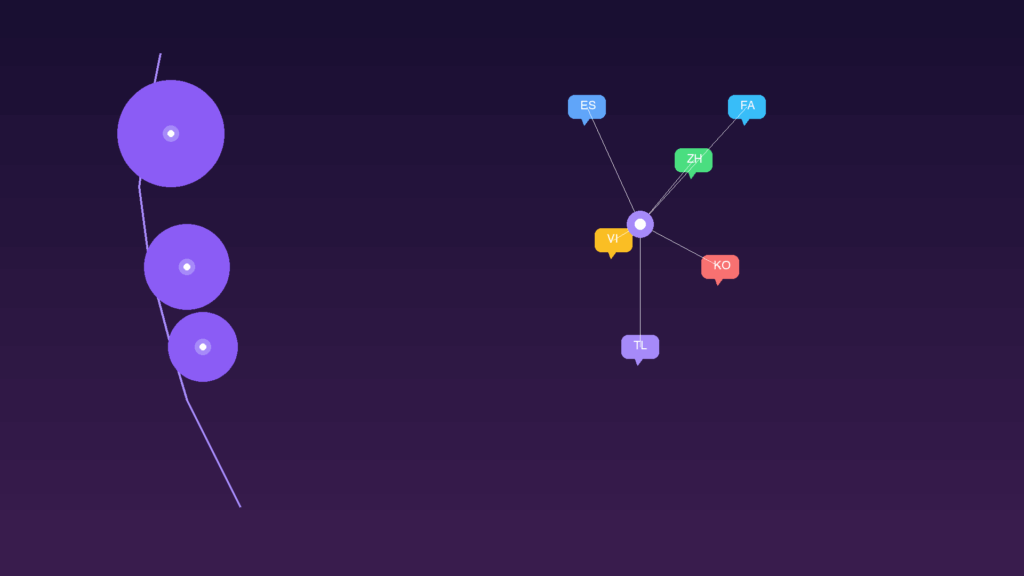
In the Bay Area, you’re managing English, Spanish, Mandarin Chinese, Cantonese, Vietnamese, Korean, Tagalog, Hindi, and Russian in overlapping communities. In Los Angeles, add Portuguese (Brazilian immigrants), Armenian, Thai, and Persian. In San Diego, it’s concentrated on Spanish, but deep. In the Central Valley agricultural regions, Spanish dominates, but Hmong, Punjabi, and Hmong communities are substantial.
This isn’t a “one receptionist speaks Spanish and one speaks English” problem. It’s a “your practice in Fremont needs to be fluent in 8 languages” problem. Your practice in Fresno needs to operate seamlessly in Spanish and English. Your practice in West LA needs to handle Mandarin calls at the same service level as English.
Most DSO leadership teams we talk to in California admit: they’re not solving this well. They’re hiring bilingually and hoping it’s enough. It’s not.
California’s Regulatory Reality and the Cost of Non-Compliance
California doesn’t just have a privacy law—it has CCPA (California Consumer Privacy Act) and CPRA (California Privacy Rights Act), and they’re tougher than HIPAA in some ways. Your patient data is protected under healthcare law, but California adds a layer: patients have the right to know what data you’re collecting, how you’re using it, and who you’re sharing it with. If you’re using an AI receptionist system, you need to be clear with patients about that. You need to ensure the system isn’t collecting data beyond what’s necessary. You need an audit trail that satisfies California’s auditors, not just your practice management system’s auditors.
The cost of getting this wrong is real. California penalties start at $2,500 per violation and go up from there. For a 30-location DSO, even one data handling error scales quickly.
What this means: your AI receptionist needs to be built for California compliance from the ground up. Not bolted on. Not “mostly fine.” Built. If your system is a consumer chatbot adapted for healthcare, you’re creating liability, not reducing it. If your system was built for a different regulatory environment, you’re gambling.
An AI system that holds SOC2 Type II certification and is purpose-built for healthcare isn’t just better—it’s the difference between operating legally in California and operating with legal tail risk.
The Multilingual Operational Math
Let’s ground this in what actually happens at your locations.
A Bay Area practice gets 40 inbound calls per day. Roughly 35-40% are from non-English speakers. If you have one full-time receptionist who’s bilingual (English/Spanish) and one who’s English-only, you’re rotating patients through whoever is available. The Spanish speaker gets overloaded with Spanish calls; the English speaker handles the rest. Neither is optimal.
But here’s the real cost: those 5-8 calls per day in Mandarin? They either go to voicemail or they take 20% longer to handle (because your staff is struggling). That’s 5-8 potential patients per day, every day, who don’t get scheduled. Over a year, that’s 1,200-2,000 lost appointment slots. At $150-200 per filling, that’s $180K-400K in lost revenue from one practice, one year, because you didn’t have multilingual infrastructure.
Now multiply that by 25 locations in California. You’re looking at millions in aggregate lost revenue because your reception infrastructure can’t meet the patient where they are.
An AI receptionist that fluently handles 100+ languages with zero per-location configuration doesn’t just improve service—it recaptures that revenue. Every call in Mandarin, Korean, Vietnamese, or Tagalog gets answered at the same service level as English. Appointment gets scheduled in the patient’s language. Follow-up reminder goes out in the patient’s language. No friction. No fallback.
Scale and Consistency: The Larger DSO Problem
California has some of the largest DSO networks in America. If you’re managing 40, 60, or 80 locations, the problem isn’t individual locations—it’s consistency.
Your Palo Alto location has a different patient demographic than your Bakersfield location. But both should feel like part of the same organization. Both should handle calls the same way. Both should have the same appointment types available. Both should integrate with your central insurance verification system. Both should feed data back to your central marketing automation platform so you know who’s converting, who’s canceling, who’s ready to move from a filling to a root canal.
When you have 80 different reception teams, that consistency is impossible. Someone in San Jose makes a different scheduling decision than someone in Modesto. Someone in Fresno uses different language with patients than someone in Santa Monica. Someone in Sacramento doesn’t mention your whitening promotion; someone else doesn’t, either.
A centralized AI system that learns your protocols, your messaging, your clinical preferences, and your business rules once—and applies them everywhere—is the only way to achieve consistency at scale. A dashboard that shows you call patterns, languages served, appointment show rates, and cancellation reasons across all locations tells you where you’re winning and where you’re losing.
The Tech Stack Integration Reality
Most California DSOs run on this stack:
- Practice management: Dentrix, Eaglesoft, or Softdent
- Insurance verification: Availity or eClaims
- Patient communication: Opendental, Curve Dental, or a custom integration
- Analytics: Tableau, Looker, or internal dashboards
- Marketing automation: Mailchimp, ActiveCampaign, or local systems
If your AI receptionist system integrates with none of these, you’ve created more work, not less. Your staff needs to manually transfer data from the AI system to the practice management system. You lose visibility into what the AI actually learned. You can’t see, in your central dashboard, which languages are being served, which insurances are being verified incorrectly, which appointment types are being missed.
What you actually need: an AI operating system, not a standalone receptionist tool. Something that plugs into your existing stack and makes every system smarter—your practice management system gets better patient data, your insurance system catches errors earlier, your marketing team knows which patients are ready for outreach.
Outbound AI and Patient Reactivation
California has unique seasonal and lifestyle patterns. Remote workers move between the Bay Area and LA. Seasonal residents split time between San Francisco and Palm Springs. Patients change jobs, change insurance, change priorities. Your patient database has people who were active three years ago and haven’t been back since.
Traditional receptionists don’t have time to reach out to inactive patients. They’re busy answering phones and scheduling new appointments. But AI-powered outbound communication can work at night, on weekends, when your team is resting. It can identify patients who haven’t had a cleaning in 18 months and reach out in their language. It can tell them about new services. It can offer a specific time slot and ask them to confirm. It can reschedule someone who’s been sitting in a cancellation list.
In a competitive market like California, the DSOs that win aren’t the ones with the cheapest receptionists—they’re the ones with the best patient capture and retention infrastructure. Outbound AI at scale is that infrastructure.
California-Specific Challenges Your AI Needs to Handle
High staff turnover due to cost of living: California’s cost of living is driving reception turnover to 30%+ in some markets. You can’t build operational consistency on staff that turns over constantly. You need infrastructure that doesn’t depend on finding and retaining bilingual staff in expensive markets. AI is that infrastructure.
Liability insurance and malpractice exposure: California is a litigious state. When a patient says “I called and no one answered,” that’s a potential liability claim. When a patient says “no one understood my language and I missed my appointment,” that’s another one. AI that answers every call, in every language, creates documentation of service—you have a record that the patient was reached, the appointment was offered, the time was confirmed. That’s liability protection.
Insurance pre-authorization complexity: California insurance plans are complex and fragmented. MediCal, Medicare, private plans, HMOs, PPOs—they all have different pre-auth requirements. Your AI needs to know those rules. It needs to verify coverage before the appointment is scheduled. It needs to know which insurances your practices accept. When insurance reqs change (and they do, constantly), you can’t retrain 80 receptionists—you need to update one central system.
Medicaid (MediCal) rules and compliance: MediCal patients often face access barriers. They have spotty insurance eligibility (benefits come and go). They need more outreach and communication. Traditional reception teams can’t handle the volume and complexity. AI-powered outbound and inbound systems can—they can confirm coverage, explain benefits, and handle the back-and-forth without burning staff time.
The Real ROI in California
Here’s what a 40-location California DSO typically sees in year one:
- 20-25% reduction in missed calls (captured non-English calls that would have gone to voicemail)
- $150K-250K in recovered revenue from improved patient capture across all locations
- 40-50% reduction in receptionist time on qualification and scheduling
- 30-35% faster on-boarding for new locations (lighter reception hiring needed)
- Single source of truth for compliance (SOC2 Type II audit, CCPA compliance, healthcare security)
That’s not “nice to have.” That’s operational necessity in a mature, competitive, regulated market like California.
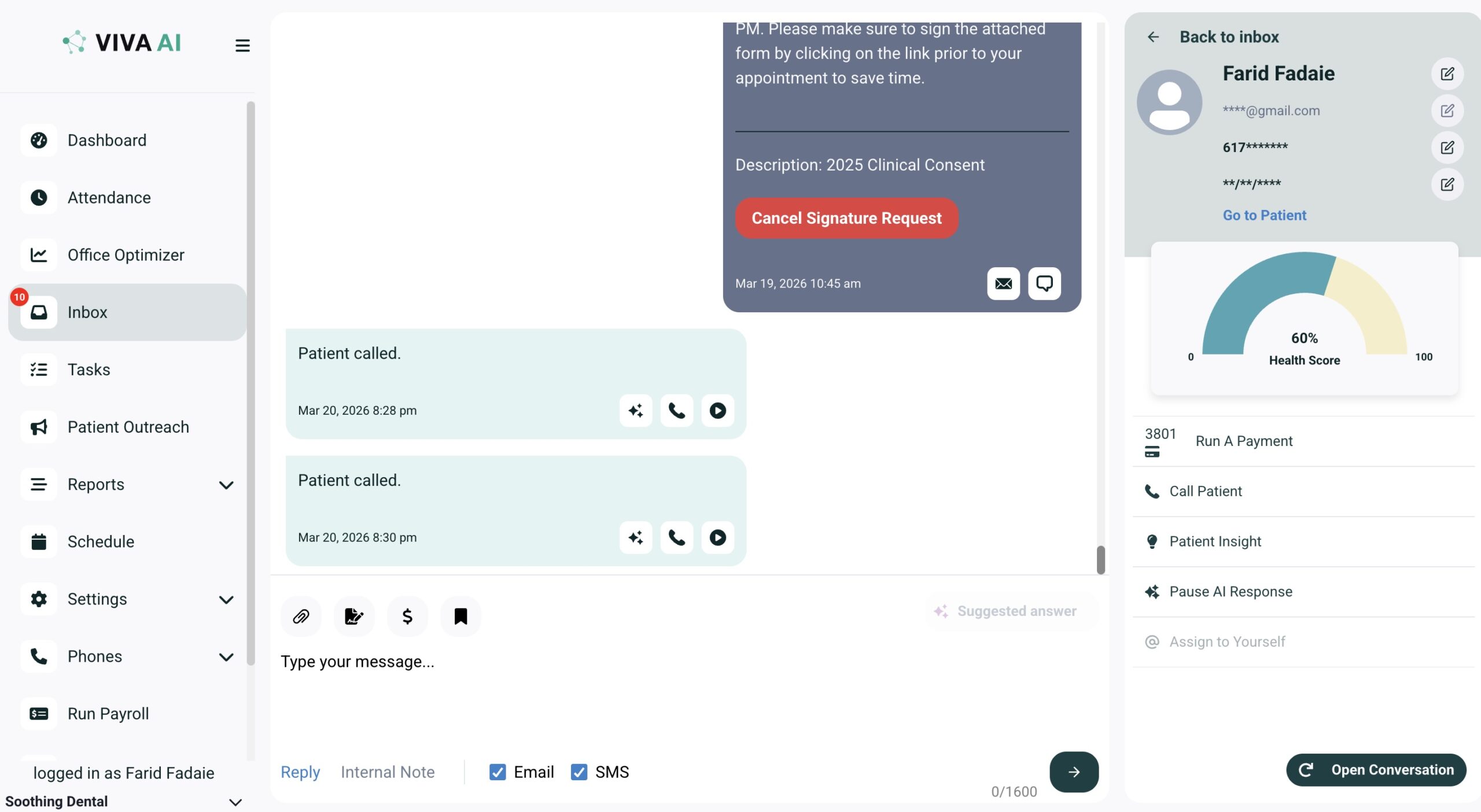
Viva answers its own demo line — call or text (866) 944-8482, or book a full platform tour.
Getting Started
If you’re running a DSO in California, you’re operating in the hardest market in America. You’re managing language diversity, regulatory complexity, high turnover, and intense competition. Your reception infrastructure needs to be as sophisticated as your clinical protocols.
We’ve put together a guide to evaluating AI receptionist systems for DSOs that asks the questions that matter in California: Can it actually handle multiple languages? Is it compliant with California privacy law? Can you manage it centrally? Does it integrate with your existing stack? Is it designed for healthcare or is it consumer tech adapted for dentistry?
If you’re ready to move from hiring-focused reception to platform-focused reception, start with Viva’s AI receptionist system and see how it transforms your patient capture and operational consistency across all your California locations.
California demands excellence. Your reception infrastructure should match.