

Florida is a unique dental market because it’s not really one market—it’s three overlapping markets competing for attention and revenue.
First, there’s the growth market: young families moving to Tampa, Orlando, Jacksonville, and the Treasure Coast, looking for affordable housing and good schools. These patients are employed, insured, and actively scheduling. Second, there’s the diversity market: Miami, Fort Lauderdale, and Tampa have substantial Spanish-speaking, Haitian Creole, Brazilian Portuguese, and Caribbean communities. These patients have high treatment needs and often face insurance barriers. Third, there’s the seasonal market: winter visitors who split time between Florida and the Northeast, or wealthy retirees who own multiple homes and move between states.
Each market has different operational requirements. Your AI receptionist infrastructure needs to handle all three simultaneously.
Florida’s DSO Market: Comprehensive Landscape
Florida’s dental market is dominated by national powerhouses and increasingly sophisticated regional operators. The market includes mega-chains and innovative regional DSOs competing across Miami, Fort Lauderdale, Tampa, Orlando, Jacksonville, and the Treasure Coast. Here’s the actual competitive landscape:
National DSOs with Major Florida Presence
- Heartland Dental (HQ: Effingham, IL) — Over 1,900 locations nationally; 300+ locations across Florida. Significant expansion through Smile Design Dentistry acquisition. Heavy presence in Miami, Fort Lauderdale, Tampa, and Orlando with dentist partnership model.
- Aspen Dental (HQ: Chicago, IL) — Over 1,100 locations nationally; 90+ in Florida. Rapid de novo expansion across major metro areas and growing secondary markets. General dentistry with high-volume accessibility focus.
- Smile Brands (HQ: Irvine, CA) — Approximately 700+ locations nationally; 75+ in Florida. Multi-brand portfolio focused on family dentistry across all major Florida metros.
- Affordable Care / DentalOne Partners (HQ: Morrisville, NC) — Approximately 450+ locations across 25 states; 40+ in Florida. Value-focused general dentistry particularly in Central and South Florida.
- Dental Care Alliance (HQ: Sarasota, FL) — Approximately 400+ locations across 25 states; 60+ in Florida (headquarters location). Growing presence throughout the state with emphasis on multi-location efficiency.
Florida-Based Regional Leaders and Emerging Players
- Sage Dental (HQ: Boca Raton, FL) — 150+ locations across multiple states; 50+ in Florida. Multi-specialty DSO including general dentistry, orthodontics, and oral surgery. Strong South Florida presence with expanding statewide operations.
- Parkview Dental Partners (HQ: Sarasota, FL) — One of Florida’s fastest-growing DSOs with 40+ locations across the state. Emphasis on clinician autonomy, work-life balance, and comprehensive care. Strong presence in West Coast and Central Florida markets.
- DECA Dental (Multi-state with Florida presence) — Growing DSO with 25+ Florida locations, particularly in Central and South Florida. Multi-specialty model including general dentistry and specialized services.
- Beacon Oral Specialists — Specialty-focused DSO expanding its partnership network across Florida. 15+ locations with emphasis on oral and maxillofacial surgery referral partnerships.
- Mortenson Dental Partners (HQ: Louisville, KY, with Southeast expansion) — Growing multi-state DSO with 20+ Florida locations. Emphasis on practice support and clinician partnership models.
Specialty-Focused and Multi-Specialty DSOs
- ClearChoice — Specialty DSO focused on implant dentistry and full-mouth restoration. 80+ centers nationally; 10+ in Florida including Miami, Tampa, and Orlando.
- Imagen Dental Partners (HQ: Scottsdale, AZ, with Florida expansion) — Growing multi-specialty DSO with 35+ locations including 12+ in Florida. Focus on comprehensive dental care and specialty services across major metros.
- Smile Doctors — Specialty DSO focused on orthodontics with 50+ locations including 8+ in Florida metro areas.
For all of these organizations—from massive Heartland to innovative regional players like Parkview—Florida presents a unique operational challenge: how do you manage seasonal patient populations, diverse immigration backgrounds, retiree segments, and rapidly growing young professional markets all simultaneously?
Florida’s Multilingual Reality: More Than Spanish
About 29% of Floridians speak a language other than English at home, but the distribution is geographically concentrated and linguistically diverse.
In Miami-Dade County, 68% speak a language other than English at home—primarily Spanish, but also Creole, Portuguese, and indigenous Caribbean languages. In Fort Lauderdale and the surrounding Broward County, it’s 47%. In Hillsborough County (Tampa), it’s 32%. In Orange County (Orlando), it’s 24%. And that’s before you factor in the growing Latin American immigrant communities in Jacksonville, Gainesville, and the Panhandle.
Here’s what makes Florida different: the Spanish-speaking community is not homogeneous. Cuban Spanish, Puerto Rican Spanish, Dominican Spanish, Mexican Spanish—they have different dialects, different colloquialisms, different cultural contexts. A receptionist who speaks Spanish might speak the variant her grandmother spoke in Havana, but your patient speaks Mexican Spanish because he’s recently arrived from Chiapas. The vocabulary is different. The accent is different. The patient feels either understood or patronized, and that feeling decides whether they return.
Then add Haitian Creole—spoken by a substantial population in Miami and surrounding areas, but not commonly available in healthcare. Patients who speak Creole often end up in situations where no one at the dental office understands them, which creates barriers to scheduling, insurance verification, and clinical communication.
A one-size-fits-all bilingual strategy doesn’t work in Florida. You need infrastructure that can handle multiple Spanish dialects, Creole, Portuguese (Brazilian Portuguese is different from European Portuguese), and English, all at the same location. That’s not a hiring problem—it’s a platform problem.
The Seasonal Population Swing and Reactivation Opportunity
Florida has unique seasonal dynamics. Winter visitors—often affluent retirees with excellent insurance—are in Florida December through April. Then they go back North. They need their teeth cleaned, their cavities filled, their root canals completed while they’re here. But they’re not here consistently. They miss appointments because they left early. They cancel because they’re leaving next week. They need appointment reminders in September because they’re back again.
This creates a specific operational challenge: you need to maintain contact with patients who aren’t consistently in your service area. Traditional in-office reception can’t do that—by the time the patient leaves Florida, the office has moved on to other patients. But AI-powered outbound communication can work with inactive patients continuously. It can identify seasonal visitors who haven’t been in for a cleaning in 8 months. It can call them in their language, in their time zone (because they might be back in New Jersey now). It can offer a specific time slot and ask them to confirm. When they come back to Florida next winter, you’re top-of-mind.
This is unique to Florida. Most states don’t have this dynamic. But in Florida, it’s a major operational feature—and it’s a major revenue opportunity. Seasonal patient management is the difference between losing $200K per year in revenue (patients who move around) and capturing it.
The Retiree Patient Profile and Communication Style
Florida has more residents over 65 than any other state except Maine. That’s not just demographic trivia—it changes your operational profile.
Retirees often have different communication preferences. They prefer phone calls to text messages. They want to talk to a human, not an automated system. They have time flexibility—they can come in at 10 AM on a Tuesday afternoon—and they value appointment reminders. They’re often on Medicare and Medicaid, which have different authorization requirements than commercial insurance. They might be taking 5+ medications, which affects their treatment plan. They might have multiple chronic conditions—diabetes, hypertension—that influence how quickly you can schedule them and what anesthetics you use.
This doesn’t mean your AI receptionist should be cold or robotic. It means it should sound respectful, speak clearly, and be patient with patients who are harder of hearing or who need information repeated. An AI with emotional intelligence can navigate these preferences—it can recognize when a patient is stressed or confused, slow down, acknowledge their concerns, and match their communication style.
You can’t train 40 receptionists to all do this, but you can build it into one system and have it consistent everywhere.
The Growth Market: Young Families and Insurance Verification
Meanwhile, in Tampa, Orlando, and Jacksonville, you’re seeing rapid population growth. Young families are moving in. They’re employed, insured, and actively seeking healthcare providers. They’re also savvy—they expect online scheduling, they want text reminders, they’re comparing you to other practices on Google and Yelp.
These patients are high-value, but they’re also impatient. If you don’t answer quickly, they call a competitor. If your insurance verification is slow, they get frustrated. If you don’t confirm their appointment via text or email immediately, they might forget or schedule elsewhere.
Your AI receptionist needs to serve this market at the speed they expect. Answer immediately. Check insurance instantly. Send confirmation immediately. Remind them the day before. These are the baseline expectations in a competitive growth market. Your reception infrastructure is either meeting them or losing patients.
Medicaid Complexity and Access Barriers
Florida Medicaid is generous relative to other states, but it’s also complex. Different managed care plans have different provider networks. Prior authorization is required for some procedures. Reimbursement rates are lower than commercial. Many dentists have opted out of Medicaid because the margins are tight and the administrative burden is heavy.
But Medicaid patients still need dental care. They still call practices. And if your office can’t quickly verify Medicaid coverage, can’t explain benefits, can’t navigate prior auth—those patients go somewhere else, or they don’t go at all.
An AI receptionist that understands your Medicaid acceptance policy, that can verify coverage in real-time, that can explain what’s covered and what’s not—that’s patient access infrastructure. It’s also referral protection. Medicaid patients often have high treatment needs (because they’ve delayed care due to cost). They’re loyal patients if you can make them feel welcome and if the financial piece is transparent. Your AI system does both.
Real Challenges Specific to the Florida Market
Seasonal staff turnover: Florida’s high cost of living, especially in coastal areas, drives reception staff turnover. People come to Florida for retirement or seasonal work, not for permanent reception jobs. Your team turns over 30-40% annually. Every new hire needs training. Every new hire brings different language capabilities, different service standards. An AI system that doesn’t depend on staff stability is your consistency lever.
Multiple insurance regimes: Florida attracts people from different states at different life stages. Young families have employer plans similar to the rest of America. Retirees have Medicare and potentially supplemental plans. Medicaid patients have variable coverage. Seasonal visitors might have out-of-state insurance. Your system needs to handle all of these simultaneously, verify coverage correctly for each, and know which reimbursement rate applies to each. That’s not something you can train 40 receptionists to do—you need a system.
After-hours and weekend call volume: Retirees are awake and making calls at 7 AM. Young professionals are making calls at 8 PM. Your office is closed at both times. Your voicemail fills up. Your staff comes in to 20 messages. An AI that takes after-hours calls, books appointments, and sends confirmations means you’re not starting the day behind.
Hurricane season and patient accessibility: June through November, Florida is vulnerable to hurricanes. Patients evacuate, cancel appointments, move temporarily. Your appointment schedule becomes fragmented. Outbound AI capability lets you reach patients proactively—check if they’re okay, confirm appointments, reschedule those who need flexibility. That’s operational continuity and patient care.
The Financial Model
A 35-location Florida DSO typically manages 1,400-1,750 inbound calls per day across all locations. Let’s say your current answer rate is 72% (typical for offices with one receptionist per location). That means you’re losing 390-490 calls per day to voicemail, busy signal, or transfer to another staff member who’s busy.
If 30% of those missed calls don’t follow up, you’re losing 117-147 potential appointments per day. Let’s conservatively say 50 of those actually would have converted to booked appointments. At $180 average treatment value, that’s $9,000 per day in lost revenue. Per month: $180K. Per year: $2.16M.
An AI receptionist that answers 97% of calls and books 40% of the previously-missed calls captures an additional $750K-1M+ per year in revenue. The cost is a fraction of that. The payback is measured in weeks.
Plus, you’re not hiring incremental staff to handle the growth from 30 to 35 to 40 locations. You’re adding locations without proportionally adding reception staff. That margin improvement is real.
The Seasonal Advantage
Florida’s seasonal dynamic is actually an advantage if you have the right infrastructure. While other DSOs are managing stable, predictable patient volumes, you’re managing peaks and valleys. That’s harder—but it’s also an opportunity.
Your winter visitors are high-value patients—affluent, well-insured, have treatment needs. If your system can identify them, reach them before they arrive, book them into available slots, remind them when they’re in-town, and reactivate them when they leave—you’re capturing revenue that competitors miss. Seasonal patient management isn’t a problem to solve; it’s a revenue stream to exploit.
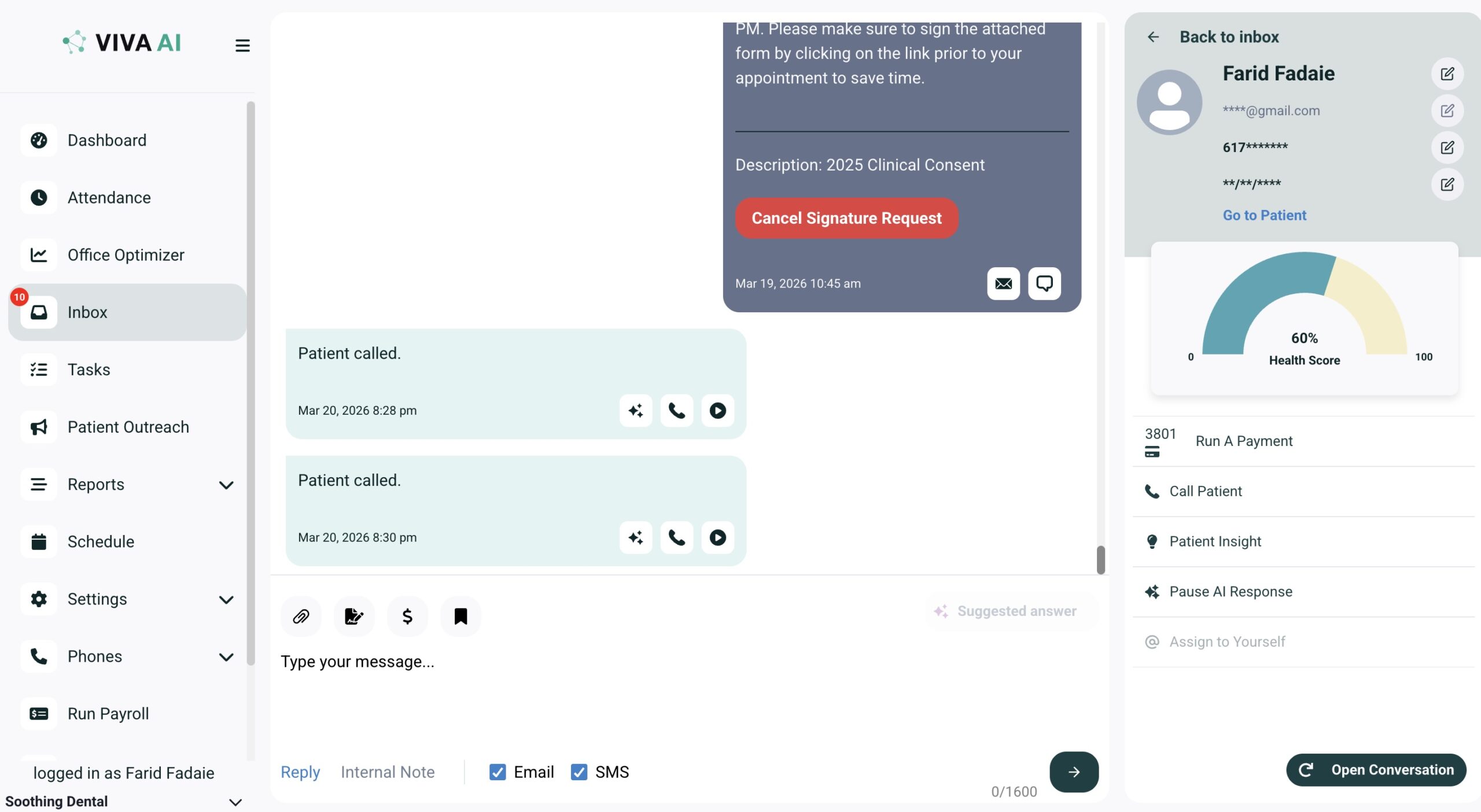
Viva answers its own demo line — call or text (866) 944-8482, or book a full platform tour.
Getting Started
If you’re running a DSO in Florida, you’re managing a unique market. You have seasonal dynamics that create operational complexity but revenue opportunity. You have multilingual, multi-generational patient populations. You have rapid growth in some regions and established practices in others. Your reception infrastructure needs to be sophisticated enough to handle all of it.
We’ve built a guide to evaluating AI receptionist systems for DSOs that covers the specific questions Florida DSOs should ask: Can it handle your multilingual requirements? Can it work with seasonal patient patterns? Can it integrate with your Medicaid and Medicare requirements? Can you manage all your locations from one dashboard?
If you’re ready to move from a staffing-dependent, location-fragmented reception model to a platform-based approach that handles seasonal dynamics, multilingual patients, and rapid growth, start with Viva’s AI receptionist system and see how it transforms your patient capture and operational efficiency.
Florida is growing. Your reception infrastructure should grow with it.