

Atlanta is becoming the next major DSO hub in America. The city has explosive growth, relatively low cost of living compared to coastal metros, a sophisticated business environment, and a dental market that’s still fragmented enough for DSOs to consolidate.
But consolidation at growth velocity creates a specific problem: you’re adding locations faster than you can build operational infrastructure. You hire great clinical staff. You set up the practice management system. And then you realize: you don’t have a cohesive reception infrastructure. Each location is doing its own thing. You’re hiring, training, and managing reception staff at 3-4 new locations per year. Your operational model doesn’t scale as fast as your growth rate.
That’s where platform thinking becomes essential.
Georgia’s Emerging DSO Hub: Comprehensive Market Landscape
Georgia is rapidly becoming the next major DSO hub in the Southeast. The market combines national powerhouses with innovative Georgia-founded regional leaders, all competing for market share across Atlanta, Augusta, Savannah, and emerging secondary markets. Here’s the competitive landscape:
National DSOs with Growing Georgia Presence
- Aspen Dental (HQ: Chicago, IL) — Over 1,100 locations nationally; 51+ locations across Georgia. Expanding de novo development across Atlanta metro and secondary markets with aggressive growth strategy.
- Heartland Dental (HQ: Effingham, IL) — Over 1,900 locations nationally; 45+ in Georgia with significant Atlanta metro coverage. Dentist partnership model with growing presence across urban and suburban markets.
- Smile Brands (HQ: Irvine, CA) — Approximately 700+ locations nationally; 40+ in Georgia. Multiple brand portfolio focused on family dentistry across major metros and suburbs.
- Affordable Care / DentalOne Partners (HQ: Morrisville, NC) — Approximately 450+ locations across 25 states; 25+ in Georgia. Value-focused general dentistry with growing Southeast presence.
- Dental Care Alliance (HQ: Sarasota, FL) — Approximately 400+ locations; 20+ in Georgia, particularly Atlanta and surrounding areas.
Georgia-Based Regional Leaders and Emerging DSOs
- Blueprint Smiles (HQ: Georgia) — Georgia-founded, doctor-led DSO recognized on Inc. 5000 list of America’s Fastest-Growing Companies (2023, 2024). 35+ locations across Georgia and Southeast. Emphasis on clinical leadership and practice autonomy.
- Mortenson Dental Partners (HQ: Louisville, KY, with Southeast expansion) — Growing multi-state DSO with 30+ Georgia locations, particularly in Atlanta metro and surrounding areas. Emphasis on clinician partnership and operational support.
- Sage Dental (HQ: Boca Raton, FL, with Southeast expansion) — 150+ locations across multiple states; 18+ in Georgia. Multi-specialty model including general dentistry, orthodontics, and oral surgery.
- Imagen Dental Partners (HQ: Scottsdale, AZ, with Southeast expansion) — Growing multi-specialty DSO with 35+ total locations including 12+ in Georgia. Focus on comprehensive dental care and specialty services.
Specialty-Focused DSOs
- Smile Doctors — Specialty DSO focused on orthodontics with 50+ locations including 8+ across Georgia’s major metros.
- ClearChoice — Specialty DSO focused on implant dentistry. 80+ centers nationally with 5+ in Georgia including Atlanta location.
- Beacon Oral Specialists — Specialty-focused DSO with growing presence in Georgia. Focus on oral and maxillofacial surgery referral partnerships with 6+ Georgia locations.
For all of these organizations—from Heartland’s massive network to Blueprint Smiles’ innovative regional model—Atlanta’s explosive growth creates both opportunity and operational complexity: how do you scale reception infrastructure as fast as you open new locations, maintaining consistency while serving increasingly diverse communities?
Atlanta Metro Growth and Expansion Patterns
Atlanta metro—Fulton, DeKalb, Cobb, Gwinnett, Clayton counties—is adding 100,000+ people per year. That’s sustained, structural growth. Young professionals moving in from other states. Families relocating for jobs. People drawn by lower housing costs and strong job market.
For DSOs, this means: new locations are possible everywhere. You can open in midtown Atlanta, but you can also open in Marietta, in Decatur, in Alpharetta. The metro is sprawling, which is good (more addressable market) and hard (less geographic clustering, more operational complexity).
Here’s what we see with fast-growing DSOs in Atlanta: they open 3-4 locations per year for 2-3 years. Then they hit an inflection point. They have 12-15 locations, they’re profitable, but they’re exhausted. The reception infrastructure didn’t scale with the growth. Each location is understaffed, overworked. Staff turnover is creeping up. Patient satisfaction is declining. Clinical team is spending time on administrative stuff instead of patient care. Growth slows because the operational foundation is cracking.
The DSOs that avoid this don’t hire their way out—they build platform infrastructure early. They implement a centralized AI reception system when they have 5-7 locations, not when they have 20. That infrastructure scales with them as they grow to 30, 40, 50 locations.
Demographic Shifts and Multilingual Opportunity
Georgia’s population is becoming more diverse, especially in Atlanta metro. About 21% of Georgia residents speak a language other than English at home. In Atlanta proper, it’s higher. In Gwinnett County, one of the fastest-growing counties in the state, it’s 28% and rising. In parts of DeKalb County, it’s 32%.
The languages are shifting, too. Yes, Spanish is primary, but you’re also seeing Korean communities (especially in Gwinnett), Chinese, Vietnamese, and African immigrant languages (Amharic, Yoruba, Somali). This is different from the historical Southeast—it’s cosmopolitan growth driven by young professionals and immigrant entrepreneurship.
For DSOs, this creates an opportunity and a challenge. The opportunity: these communities have high treatment needs and strong insurance. They’re seeking healthcare providers they can trust and communicate with. The challenge: your reception infrastructure needs to serve them without requiring location-by-location hiring for linguistic diversity.
A platform approach—AI receptionist system that handles 100+ languages with zero per-location configuration—is how you serve these communities without exploding your hiring requirements. Your Gwinnett location can serve Korean and Spanish speakers immediately. Your Decatur location can serve Spanish and Amharic. You don’t hire for it—the platform provides it.
The Scale-Up Path: From Single Location to 40+
Let’s talk about the operational math of fast scaling.
You start with 1 location. You’re the dentist, dentist/founder, you’re answering phones, managing everything. You add location 2. Now you hire your first full-time reception staff member at location 1, and one at location 2. They’re separate teams. Different workflows, different phone scripts, different insurance protocols. But it works.
You add location 3. Now you have three practices, three separate reception teams. You start noticing that patients get different answers about the same question at different locations. You’re losing efficiency. You hire an office manager to oversee all three. Her job is basically “make sure these three receptionists are doing the same thing.” That’s not a job that adds value—it’s a job that exists because your infrastructure doesn’t scale.
You add location 4, 5, 6. Now your office manager is managing 6 receptionists across 6 locations. She’s doing hiring, training, scheduling, resolving conflicts, ensuring consistency. She’s burning out. You hire a second office manager. Now you have two middle managers whose job is making sure 10-12 staff members are doing the same thing, consistently, across multiple locations.
You add location 15. You have 15 office/reception staff. You have 3 office managers. You’re not growing your patient capacity much anymore—you’re growing your administrative overhead. That’s the inflection point where fast-growing DSOs start to slow.
But here’s the alternative: implement an AI operating system, not just a receptionist tool when you have 5-7 locations. The AI handles 70% of the reception work automatically. It schedules 60% of appointments directly. It qualifies leads before they reach your staff. It integrates with your practice management system, so your staff sees pre-filled patient information. Your reception staff shrinks from 1.5-2 FTE per location to 0.75-1 FTE per location. Your office manager’s job shifts from “manage reception staff” to “optimize the AI system.” You don’t need office manager at location level anymore—you need one regional operations manager overseeing AI system performance across all locations.
Growth path with people-only model: 15 locations, 20+ reception staff, 3-4 office managers, $800K+ in annual reception/management overhead, burnout, slowdown.
Growth path with platform model: 40 locations, 30-35 reception staff, 1 regional operations manager, $500K in combined reception/management overhead, runway, acceleration.
This is the difference between scaling as a staffing problem and scaling as a systems problem.
Integrating with Your Existing Tech Stack
Atlanta-based DSOs tend to be sophisticated about technology. They’re using Dentrix or Softdent for practice management. They’re using Yext or similar for online reputation. They’re using Mailchimp or ActiveCampaign for patient communication. They’re trying to build an integrated ecosystem.
The last thing you want is another standalone tool. You need an AI reception system that plugs into your stack and makes every system smarter. Your practice management system should automatically see appointments the AI booked. Your insurance verification system should use the AI’s intake data. Your patient communication platform should know which patients the AI couldn’t reach.
This requires API-first architecture. It requires thinking of the AI not as a receptionist tool, but as a central nervous system for your practice operations. When you integrate properly, the AI doesn’t add work—it eliminates it. Your staff spends 50% less time on data entry because the AI filled it in. Your practice management system sees better data because the AI qualified it.
Rural Georgia and Access Challenges
Atlanta is the engine, but Georgia is a large state. You have rural areas—south Georgia, parts of northwest Georgia—where dental access is limited. Some areas have only 1-2 dentists for 50,000 people. Patients drive 45+ minutes for appointments.
For DSOs expanding into these markets, the calculation is different. You’re competing on access, not convenience. Your patient might drive an hour to get to you. Your call volume is lower (maybe 20-25 calls per day instead of 45). But your staff is stretched—you have fewer hands, more patients with access barriers, often more Medicaid/rural insurance complexity.
In these markets, AI becomes even more valuable. You have one receptionist managing lower but still steady call volume, plus you need to handle post-appointment tasks—appointment reminders, cancellation management, follow-up. An AI that handles the front desk work means your receptionist can focus on patient relationship building, insurance problem-solving, treatment acceptance conversations. That’s the real value-add in rural markets.
Scaling From 1 to 50 Locations
We’ve put together a detailed framework for scaling DSOs from 1 to 50 locations that covers staffing, technology, and operations. The core insight: your software architecture needs to scale faster than your hiring. AI reception is the leverage point.
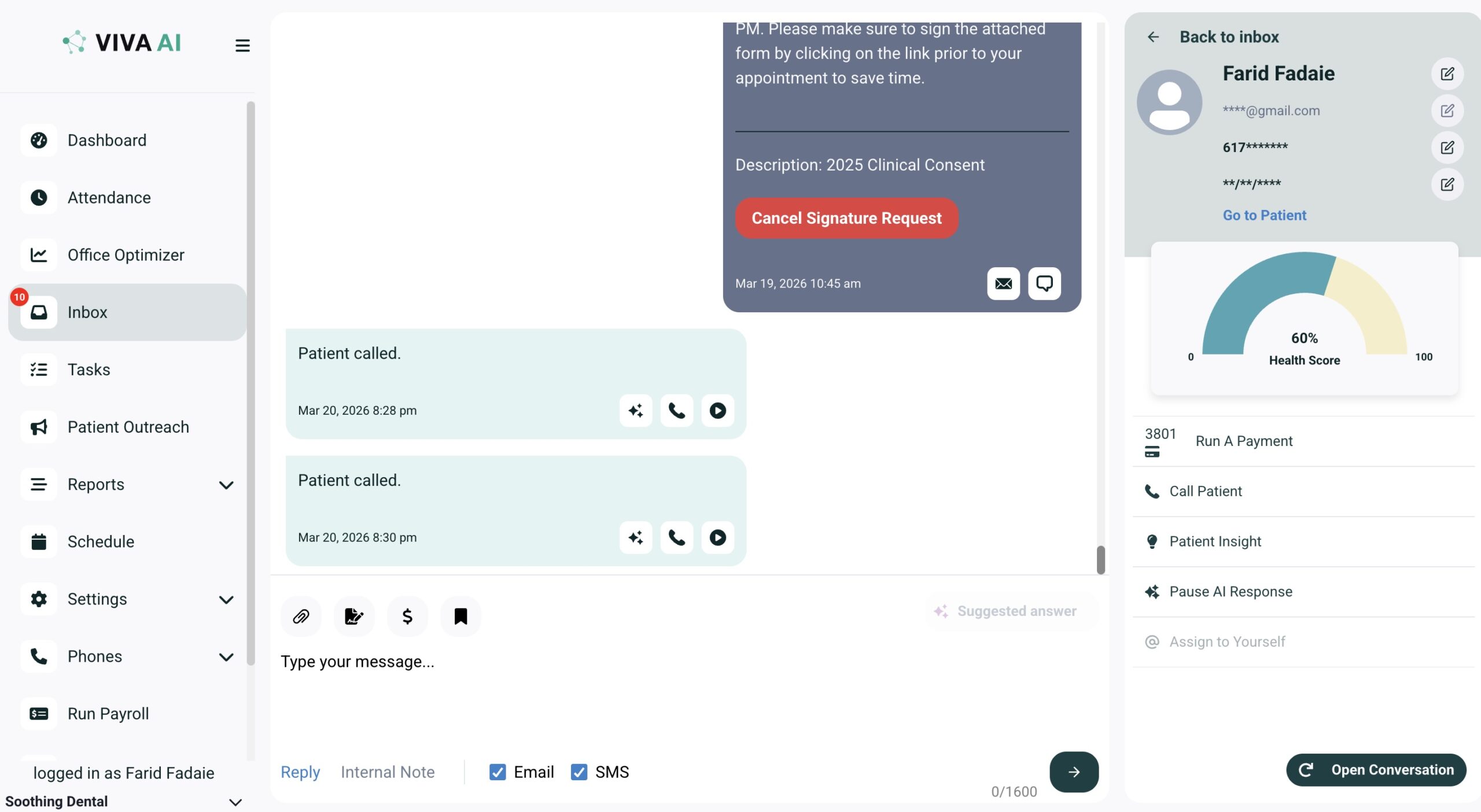
Viva answers its own demo line — call or text (866) 944-8482, or book a full platform tour.
Getting Started as You Scale
If you’re running a DSO in Georgia and you’re planning rapid growth, your inflection point is coming. The time to build platform infrastructure is now, not after you hit 20 locations and realize you’ve built a people-management company instead of a dental company.
We’ve built a guide to evaluating AI receptionist systems for DSOs that covers the questions that matter for fast-growing networks: Can you manage it centrally as you scale? Does it integrate with your existing tech stack? Can it handle your growth rate? Does it reduce staff dependency or increase it?
If you’re ready to move from a location-by-location staffing model to a platform-based scale infrastructure, start with Viva’s AI receptionist system and build the foundation for 40+ locations before you’re stressed and overwhelmed at 15.
Atlanta is a growth market. Your operations infrastructure should be a growth infrastructure.