
Michigan is a study in contrasts. You have Detroit metro—one of America’s most diverse urban areas, with dense population, sophisticated healthcare infrastructure, and intense competition. You have rural Michigan—vast areas with sparse population, limited healthcare access, and significant unmet treatment needs. And you have Midwest sensibilities that don’t fit either coastal model.
For DSO leaders in Michigan, this means managing two very different markets, two different patient demographics, and two different competitive landscapes from a unified operational platform.
Michigan’s Diverse DSO Landscape: Comprehensive Market Overview
Michigan’s dental market combines national powerhouses with Michigan-founded regional leaders, all competing across Detroit metro, Midwest markets, and underserved rural communities. Here’s the competitive landscape:
National DSOs with Strong Michigan Presence
- Heartland Dental (HQ: Effingham, IL) — Over 1,900 locations nationally; 90+ in Michigan. Extensive coverage across Detroit metro, Lansing, Grand Rapids, and secondary markets with dentist partnership model.
- Aspen Dental (HQ: Chicago, IL) — Over 1,100 locations nationally; 70+ in Michigan, heavily concentrated in Southeast Michigan and Detroit corridor with aggressive de novo expansion.
- Smile Brands (HQ: Irvine, CA) — Approximately 700+ locations nationally; 50+ in Michigan. Multi-brand portfolio with strong presence across major metros.
- Affordable Care / DentalOne Partners (HQ: Morrisville, NC) — Approximately 450+ locations; 25+ in Michigan, particularly in Southeast Michigan and Midwest markets.
- Mortenson Dental Partners (HQ: Louisville, KY, with Midwest expansion) — Growing multi-state DSO with 30+ Michigan locations across major metros and secondary markets.
Michigan-Based and Midwest-Focused Regional Leaders
- Great Expressions (HQ: Southfield, MI) — Michigan-founded DSO with approximately 300+ locations across Midwest. Strong concentration in Detroit corridor and Southeast Michigan. Emphasis on general dentistry and accessibility.
- Smile Partners (HQ: Troy, MI) — Michigan-based DSO supporting over 100+ practices across Midwest region. Focus on practice management and clinical support services.
- Midwest Dental (Midwest-based) — Regional DSO with 100+ locations including significant Michigan presence. Focus on clinician partnerships and practice support.
- Guardian Dentistry Partners — Multi-state DSO operating across 11 states including Michigan with 160+ affiliated practices. Focus on comprehensive practice support and clinical excellence.
- Sage Dental (HQ: Boca Raton, FL, with Midwest expansion) — 150+ locations; 15+ in Michigan. Multi-specialty model including general dentistry, orthodontics, and oral surgery.
Specialty-Focused DSOs
- Allied OMS — Specialty DSO serving approximately 60 doctors across 39 locations in multiple states including Michigan. Focus on oral and maxillofacial surgery with 8+ Michigan locations.
- Smile Doctors — Specialty DSO focused on orthodontics with 50+ locations including 6+ across Michigan metros.
- ClearChoice — Specialty DSO focused on implant dentistry with 80+ centers nationally; 4+ in Michigan including Detroit area.
- Imagen Dental Partners (HQ: Scottsdale, AZ, with Midwest expansion) — Growing multi-specialty DSO with 35+ total locations including 8+ in Michigan.
For all of these organizations—from Great Expressions’ Michigan roots to national leaders like Heartland—Michigan presents a distinctive operational challenge: how do you build reception infrastructure that excels in the diverse, competitive Detroit metro while simultaneously serving underserved rural communities across the state?
Detroit Metro Diversity and the Arab-American Community
Michigan, and Detroit metro specifically, has a remarkable demographic fact: it has the largest concentration of Arab-Americans outside the Middle East. About 350,000+ people of Arab descent live in Michigan, with heavy concentration in Dearborn, Hamtramck, and surrounding areas.
This creates both opportunity and operational complexity. Arab-American communities tend to have strong family structures, good insurance coverage (many work in automotive and manufacturing), and consistent engagement with healthcare. They’re not sporadic patients—when they find a dentist they trust, they commit. But they need communication that respects their language and cultural preferences.
Arabic isn’t commonly available in healthcare settings, and it’s not simple Arabic—you might have patients who speak Egyptian Arabic, Lebanese Arabic, Iraqi Arabic, and Palestinian Arabic, with different dialects and colloquialisms. A receptionist who speaks “Arabic” might not connect with a patient who speaks a specific dialect. Moreover, many patients—especially women—prefer to communicate with women when possible, and prefer cultural understanding about treatment timing (during Ramadan, for example, some patients prefer to schedule after iftar).
A hiring-based approach to serving this community means hiring Arabic-speaking receptionists for each location, training them on cultural protocols, and hoping turnover doesn’t destroy continuity. A platform approach means AI receptionist system that fluently handles Arabic (and its dialects) with cultural awareness, configured once, applied everywhere, improving with every interaction.
This is your competitive advantage in Michigan. Most dental practices don’t serve this community well. DSOs that do—through proper language infrastructure—will dominate it.
Detroit Metro Diversity Beyond Arabic
But Arab-Americans are just one part of Detroit’s demographic story. You also have significant Asian communities—Chinese, Vietnamese, Bangladesh—substantial Latin American populations, significant African immigrant communities, plus the historic white working-class and Black middle-class populations that built the region.
In Dearborn, about 29% speak a language other than English. In Detroit proper, about 26%. In Warren, about 20%. The linguistic diversity isn’t as extreme as New York or Los Angeles, but it’s real, and it’s concentrated in specific neighborhoods.
The operational implication: your different locations serve different populations. Your Dearborn location needs to be fluent in Arabic. Your Detroit location needs to be strong in English, Arabic, and Black vernacular. Your Warren location can be primarily English. But you can’t hire location-specifically for this—you need to hire generally and provide infrastructure that gives every location linguistic capability.
A centralized multilingual AI system is the only way to do this without creating hiring complexity at every location.
Rural Michigan and Healthcare Access
Outside metro Detroit, Michigan has vast rural areas. Upper Peninsula communities, rural west Michigan, rural mid-Michigan—many areas with 1-2 dentists for 30,000-50,000 people. Patients drive 30-45 minutes for appointments. Rural insurance is predominantly Medicaid and high-deductible plans.
For DSOs expanding into rural Michigan, the operational model is different. You’re not competing on convenience; you’re competing on access. Your challenge is: can you staff a location in a rural area where hiring is difficult? Can you attract and retain clinical staff when the local job market is thin? Can you build volume when population is sparse?
The reception infrastructure that works in rural areas is different. You need staff that can do more than just schedule appointments. You need staff that can explain insurance, work through access barriers, handle post-appointment follow-up, and manage patient relationships. You need AI that supports that staff, not replaces it.
AI with emotional intelligence—understanding patient anxiety, responding to frustration, building trust—is especially valuable in rural markets where patients might be skeptical of big dental organizations, where they want personal connection, where they need hand-holding through the care process.
Your rural receptionist shouldn’t be replaced by AI. Your rural receptionist should be made better by AI—handling the phone volume, the scheduling, the follow-up, so she can focus on the relationship building that actually matters in small communities.
Winter and Weather Volatility
Michigan winters are severe. Ice storms, snow, power outages—they’re real operational factors. Upper Peninsula and rural Michigan face significant winter access challenges. Patients cancel because driving is dangerous. Staff can’t get to work. Your appointment schedule becomes volatile.
Outbound AI capability becomes essential in Michigan. You need to reach patients proactively before storms hit—confirm appointments, reschedule those who will struggle with winter travel, manage the shifting calendar. You need to work with remote staff—if your receptionist can’t get to the office, the AI is still answering phones, still booking appointments. You need post-storm outreach—checking on patients who missed appointments, rescheduling quickly.
This isn’t theoretical. Winter cancellation and no-show rates are 15-20% higher in Michigan than in temperate states. Managing that volatility is a competitive advantage.
Manufacturing Communities and Insurance Complexity
Michigan’s economy has historically been built on manufacturing. Union jobs, pension plans, good benefits. But that’s changing. Manufacturing plants are closing or downsizing. Workers are transitioning to lower-benefit jobs or gig work. Insurance coverage is becoming more fragmented.
For patients, this means: insurance is unpredictable. Some have good coverage, some are underinsured. Some have transitioned from union plans to marketplace plans. Some are between jobs. Your AI receptionist needs to handle this complexity—verify coverage, explain deductibles, work through prior authorization, offer financial arrangements.
This is especially true in communities where Medicaid enrollment has increased. Michigan expanded Medicaid, so you have more Medicaid patients. They have different prior auth requirements, different benefit structures, different prior approval timelines. Your system needs to know this, handle it correctly, and explain it clearly to patients.
The Dual-Market Strategy
Here’s what works for Michigan DSO leaders:
Metro strategy: compete on specialization and convenience. In Detroit metro, you’re competing with other DSOs and independent practices. Your advantage is linguistic service, extended hours, appointment availability, and integrated marketing. You can’t compete on price—other DSOs are more aggressive. You compete on being easier to reach, easier to schedule, easier to understand.
Rural strategy: compete on access and continuity. In rural Michigan, you’re often the only dental provider for 30+ miles. You’re competing on being open, being reliable, being in the community. Your advantage is consistent staffing, personal relationships, and treating patients like people, not transactions.
A unified AI platform serves both strategies. In metro areas, it’s handling high volume, multiple languages, and competing for patients. In rural areas, it’s supporting staff, managing weather/access volatility, and enabling continuity.
Integration With Michigan Healthcare Ecosystem
Michigan has a sophisticated healthcare infrastructure—University of Michigan, Henry Ford Health System, Beaumont, Spectrum—major academic and hospital systems. If you’re affiliated with any of these as a DSO, you have integration opportunities and constraints. You need to understand their data requirements, their referral pathways, their patient communication preferences.
An AI receptionist system that integrates cleanly with electronic health records (EHR), shares data securely with hospital systems, and provides a unified patient experience across dental and medical care, is a strategic advantage.
The Financial Model for Dual-Market Operations
Let’s model a Michigan DSO with 20 locations: 12 in metro Detroit, 8 in rural areas.
Metro locations: 45 calls per day, 1.5 FTE reception staff per location = 18 FTE total. Rural locations: 25 calls per day, 1 FTE per location = 8 FTE total. Total reception headcount: 26 FTE. Annual cost: roughly $975K (salaries + benefits at Michigan wage rates).
Implementing an AI system: reduces reception FTE from 26 to 18 (metro drops from 18 to 12 FTE, rural drops from 8 to 6 FTE). Annual savings: $300K+. Cost of AI system: $60-80K per year. Net savings: $220-240K per year.
But there’s a second-order benefit: your retained reception staff are now doing higher-value work—patient relationship building, complex problem-solving, treatment acceptance conversations. Staff satisfaction improves. Turnover drops from 30% to 20%. Your onboarding cost (currently $8-10K per hire) is lower. You reduce turnover cost by $80-100K per year.
Total first-year value: $300-340K in direct costs + reduced turnover. That’s game-changing for a 20-location DSO.
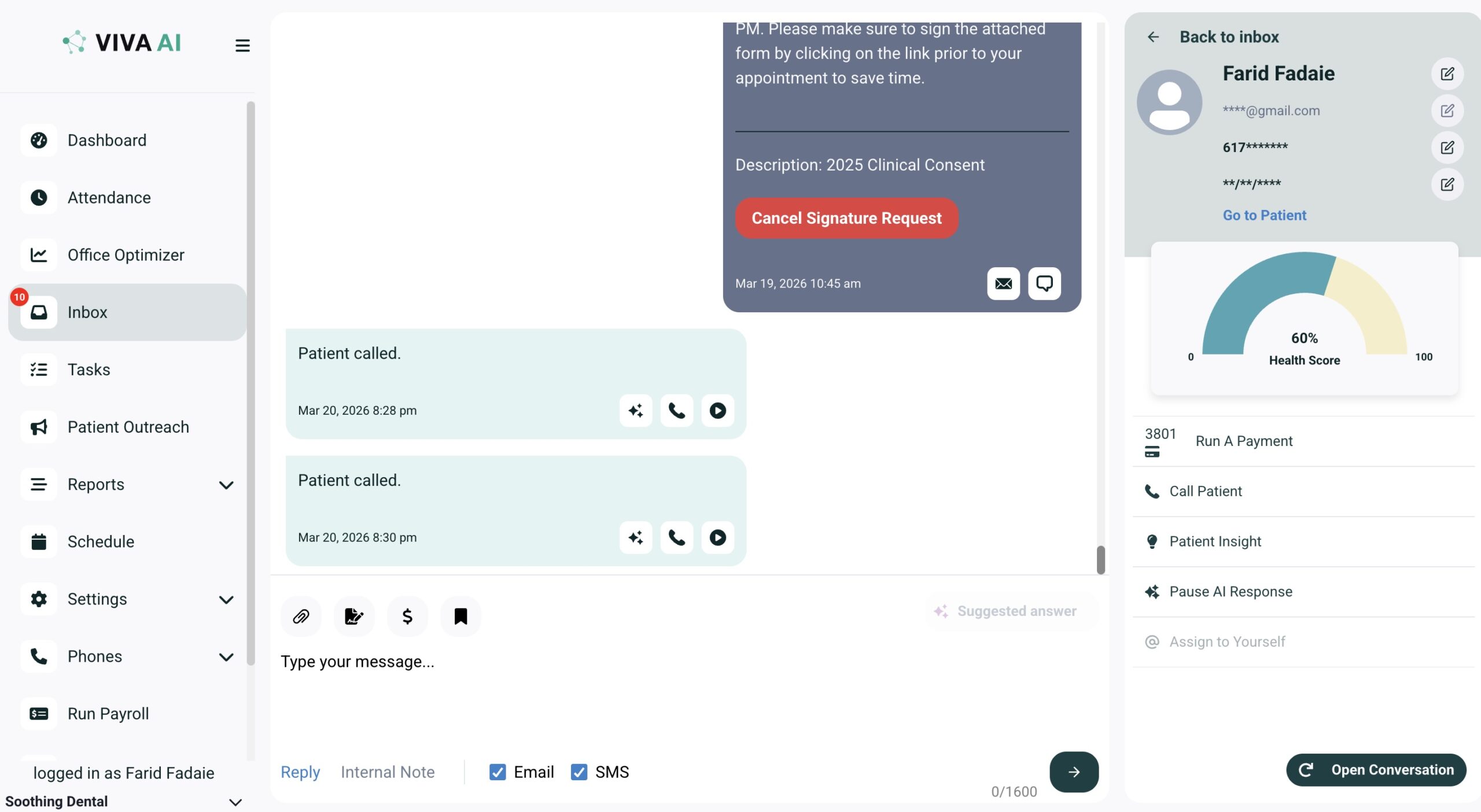
Viva answers its own demo line — call or text (866) 944-8482, or book a full platform tour.
Getting Started
If you’re running a DSO in Michigan, you’re managing a complex, dual-market situation. You need reception infrastructure that works in high-volume metro and sparse rural. You need to serve Arab-American communities, Asian communities, rural American communities. You need to handle winter volatility and insurance complexity.
We’ve built a guide to evaluating AI receptionist systems for DSOs that covers the specific questions Michigan DSOs should ask: Can it handle your language diversity? Can it work with rural and metro simultaneously? Can it integrate with hospital systems? Can you manage it across very different operational contexts?
If you’re ready to move from staffing-dependent operations to platform-based operations that scale across diverse markets, start with Viva’s AI receptionist system and see how it transforms your efficiency across urban and rural communities.
Michigan is complex. Your operations infrastructure should match that complexity.