

New York dentistry is a different category of business problem. You’re not just managing a dental network—you’re managing a geographically concentrated, linguistically fragmented, fast-paced, high-stakes market where every patient expectation is shaped by the most competitive service industries on Earth.
Your patients expect to reach you as easily as they reach Seamless or Uber. Your staff is managing 8-15 different languages in a single practice. Your locations are close enough to compete with each other, far enough apart that they can’t share reception coverage. And your operational rhythm is dictated by Manhattan business hours—which means your phone volume peaks at times that break traditional staffing models.
This isn’t a regional challenge. It’s a systemic architecture problem.
New York’s DSO Ecosystem: Comprehensive Market Overview
New York hosts one of the most sophisticated and densely concentrated DSO markets in America. The market includes heavyweight nationals and innovative regional players competing across Manhattan, Brooklyn, Queens, upstate, and Long Island. Here’s the actual DSO landscape:
National DSOs with Significant New York Presence
- Aspen Dental (HQ: Chicago, IL) — Over 1,100 locations nationally; 120+ across New York State including Manhattan, Brooklyn, Queens, and upstate. Aggressive de novo expansion in underserved boroughs and suburban markets.
- Heartland Dental (HQ: Effingham, IL) — Over 1,900 locations nationally; 100+ across New York including significant Manhattan and Long Island presence. Dentist partnership and supported practice model.
- Affordable Care / DentalOne Partners (HQ: Morrisville, NC) — Approximately 450+ locations across 25 states; 50+ in New York. Value-focused general dentistry particularly strong in Queens and Brooklyn.
- Pacific Dental Services (HQ: Irvine, CA) — Approximately 900+ locations; 35+ in New York. Multi-brand approach including specialty and general dentistry.
- Smile Brands (HQ: Irvine, CA) — Approximately 700+ locations; 40+ in New York under multiple brand portfolios.
Northeast-Based Regional Players
- 42 North Dental (HQ: Waltham, MA) — Growing Northeast DSO with 80+ locations across New England and expanding into New York metro area. Focus on general dentistry and modern care delivery models.
- Dental365 — New York-based DSO with significant presence in all five boroughs plus Long Island. 35+ locations with focus on comprehensive general dentistry and accessibility. Strong brand recognition in NYC market.
- Tend Dental — Emerging multi-state DSO with growing New York presence. Focus on patient-centric technology, transparent pricing, and modern care models.
- Premier Care Dental Management (New Hyde Park, NY) — Established New York-based DSO with 20+ locations across the metro area and upstate. Multi-specialty model including general dentistry and pediatrics.
- Sage Dental (HQ: Boca Raton, FL, with Northeast operations) — 150+ locations across multiple states; 12+ in New York. Multi-specialty model including general, orthodontics, and oral surgery.
Specialty-Focused DSOs
- ClearChoice — Specialty DSO focused on implant dentistry. 80+ centers nationally; multiple locations across New York metro area.
- MAX Surgical Specialty Management (Northeast-based) — Specialty DSO operating 26+ locations across the Northeast region including multiple New York locations. Focus on oral and maxillofacial surgery and specialty procedures.
- Salt Dental Partners — Emerging specialty-focused DSO adding pediatric and specialized practices to its network. Growing New York presence with focus on comprehensive specialty care.
- Smile Doctors — Specialty DSO focused on orthodontics with 50+ locations including New York metro market presence.
For all of these organizations—from mega-chains like Heartland and Aspen to innovative regional players—the operational complexity is identical: how do you manage consistent, high-speed patient communication across dozens of locations while serving 200+ languages in the market?
New York’s Language Complexity
When you look at census data for New York State, you see that 29% speak a language other than English at home. But New York City alone is 49% non-English speakers. And those aren’t just two languages—they’re 200+.
In Manhattan, you’re managing English, Spanish, Mandarin, Cantonese, Korean, Japanese, Russian, French, Arabic, Bengali, Urdu, and Polish in overlapping neighborhoods. In Flushing, Queens, you’re primarily Mandarin and Korean. In Jackson Heights, Queens, you’re primarily Spanish and South Asian languages. In Brooklyn, you’re managing the most diverse borough in America—Indian, Pakistani, Russian, Arabic, Bangladeshi, Chinese, Spanish, Korean communities all within a few miles of each other.
This isn’t about hiring “a bilingual receptionist” for each location. It’s about building infrastructure that can serve 8-12 languages at every location. And that’s impossible with traditional hiring.
Your options are: hire expensively for linguistic diversity at each location (high turnover, marginal benefit, enormous cost), or build a platform that handles the linguistic diversity centrally and applies it everywhere. One of those scales. The other breaks under growth.
The Operational Complexity Multiplier
New York DSOs typically manage 25-60 locations. Call volume is heavy—40-60 calls per location per day—because the population density is high and the competition is intense. Patients call because a competitor’s website says they can fit them in faster.
Now layer on the complexity:
Your Midtown location handles 50+ calls per day. Your staff is bilingual (English/Spanish, or English/Mandarin). The calls in the other 8-10 languages your patients speak either go unanswered or take three times longer to handle. Your scheduler who speaks Mandarin is booked solid answering Mandarin calls—she can’t help with the English queue. Your team is context-switching between languages all day, which destroys focus and increases errors. Insurance verification is slower because you’re waiting for the patient to explain their coverage in imperfect English, or you’re trying to parse their explanation in a language you barely understand.
The patient experience is: “I called my dentist, no one spoke my language clearly, I’m not sure my appointment is booked, I’m annoyed.” Then they call a competitor. That competitor has the same problem, but three calls later, they reach someone who speaks their language, and that’s who they schedule with.
The business result: high appointment cancellation rates, low show rates, and constant patient acquisition pressure instead of retention. You’re running a leaky bucket where your operational architecture is the leak.
Speed of Service: The New York Expectation
New York patients have a specific expectation: if I call a business at 9:15 AM, someone answers by 9:18 AM. That’s not because they’re demanding—it’s because in New York, that’s the baseline. Restaurants answer in 3-4 seconds. Banks answer in 10 seconds. Your dental practice should too.
But you have one receptionist taking calls. She’s on the phone with a patient who speaks Spanish and is asking about insurance. She’s not picking up the other six calls that are ringing. They go to voicemail. Some of those patients will call a competitor who answered. That’s lost revenue.
An AI receptionist answers every call, in the patient’s language, within 2 seconds. It qualifies the appointment, checks insurance, and either books it directly or transfers a qualified lead to your staff. Your receptionist now takes fewer calls—because 60% are handled by AI—and each call she takes is pre-qualified, so she’s making better use of her time. Your call answer rate goes from 70% to 99%. Your phone queue empties instead of growing.
That’s a fundamental shift in how you compete in New York.
The Centralized Management Imperative
You have 30 locations. Each has slightly different scheduling preferences. Some open at 8 AM, some at 7 AM. Some offer Saturday hours, some don’t. Some take Medicaid, some don’t. Some specialize in pediatrics, some in root canals. Some have a waiting list three weeks out, some have availability next Tuesday.
If you have 30 independent reception teams, they’re making 30 different decisions about how to schedule, who to refer, which insurance to accept. The result is chaos. Patients who call location A get a different answer than patients who call location B. Your leadership team can’t see patterns—you don’t know if your problem is one bad location or a system-wide issue.
A centralized management dashboard shows you what’s happening across all your locations in real-time. Which locations are seeing call volume spikes? Which ones are having trouble with a specific language? Which ones are scheduling patients into the wrong appointment type? You see patterns. You make one configuration change. It applies everywhere. Your operational efficiency stops being hostage to individual staff members’ capabilities.
This is especially critical in New York because your locations are close together and your patients are mobile. Someone in Upper Manhattan can reach you, find you have no availability, and call the Upper East Side location two miles away. If both locations are using the same AI system, both have the same information about appointment availability. They can coordinate. They can tell the patient “We don’t have availability at this location, but our Upper East Side practice has an opening Tuesday at 10 AM—we can book you there.” That’s coordination that’s impossible with independent reception teams but trivial with a centralized system.
Emotional Intelligence and Patient Communication
New York patients are sophisticated and impatient. They don’t want to be talked down to. They don’t want to repeat information. They don’t want to feel like they’re being routed to an AI. They want service, fast, in their language, with respect for their time.
What this means: your AI receptionist needs to be smart about how it communicates. It needs to sound natural, not robotic. It needs to understand context—if a patient is frustrated, it should acknowledge that, not double down on formality. It needs to use emotional intelligence to navigate difficult conversations—a patient who’s worried about cost, a patient who’s had a bad experience before, a patient who’s skeptical about a treatment recommendation.
You can’t teach 30 receptionists to all do this the same way, but you can build it into one system and apply it everywhere. That system learns from every call—what works, what doesn’t, where patients are most likely to be confused or frustrated. And it gets better with every deployment.
The Real Challenges Specific to New York
Population density and geographic fragmentation: Your locations are in different neighborhoods with different demographics, different affluence levels, different patient expectations. Manhattan patients have different needs than Brooklyn patients. But your staff is limited by geography—the receptionist at your Williamsburg location can’t help with the queue at your Park Slope location. A centralized AI that serves both equally is the only way to balance load across neighborhoods.
Insurance complexity and prior authorization: New York has hundreds of insurance plans. Empire Blue Cross, Oxford, United, Aetna, Medicaid—all with different prior authorization requirements, different coverage rules, different pre-approval timelines. Your AI needs to know which insurance plans your practice accepts. It needs to verify eligibility in real-time. It needs to know which procedures require pre-auth. When a patient says “I have Empire,” your system needs to immediately know whether Empire is in-network at that location, what the copay is, and whether their cleaning is covered. That’s not possible with human staff working location by location—it requires a centralized system with access to your insurance rules.
Medicaid complexity and reimbursement: Medicaid in New York is generous compared to other states, but it’s also complex. Coverage rules change. Patients eligibility fluctuates. Your reimbursement is tighter than commercial insurance. You need to be efficient at every step—patient acquisition, insurance verification, appointment show rate, treatment capture. An AI that improves every one of those metrics has real financial impact.
24/7 voicemail alternatives: New York moves at night. Lots of patients call after hours—not tomorrow morning, but literally 11 PM, checking hours or leaving a message. Your voicemail box fills up. Messages get lost. You’re checking voicemail at 7 AM and finding 15 new patients from the night before. An AI that takes calls 24/7, books appointments for the next available time, and sends a confirmation immediately, means you don’t miss patients because of after-hours volume.
The Financial Calculation
Let’s do the math for a 30-location New York DSO:
Each location gets 50 calls per day. Total system load: 1,500 calls per day. Not all are appointment-related—some are questions, some are cancellations—but let’s say 60% are potential patient bookings. That’s 900 appointment opportunities per day.
Your current answer rate is 70% (because sometimes no one picks up). That means you’re answering 630 calls, losing 270 to voicemail. Of the 270 lost calls, maybe 30% follow up—that’s 81 lost appointments. At $150-200 per filling, that’s $12K-16K per day in lost revenue, every single day, from missed calls. Per month: $250K-400K. Per year: $3M-4.8M.
That’s not theoretical. That’s real money leaving the organization because your infrastructure isn’t designed for your call volume.
An AI receptionist that answers 99% of calls improves your answer rate from 70% to 99%. That captures most of those 270 daily missed calls. Let’s say you capture 70% of the previously-missed calls—that’s 189 additional appointments per day. Even if just 20% of those convert to actual booked appointments, that’s 38 additional patients per day, 190 per week, 760 per month, 9,120 per year. At $150 average treatment value, that’s $1.4M+ in recovered revenue.
The cost of the platform? A fraction of that. The payback period? 2-3 months. The ongoing value? Permanent.
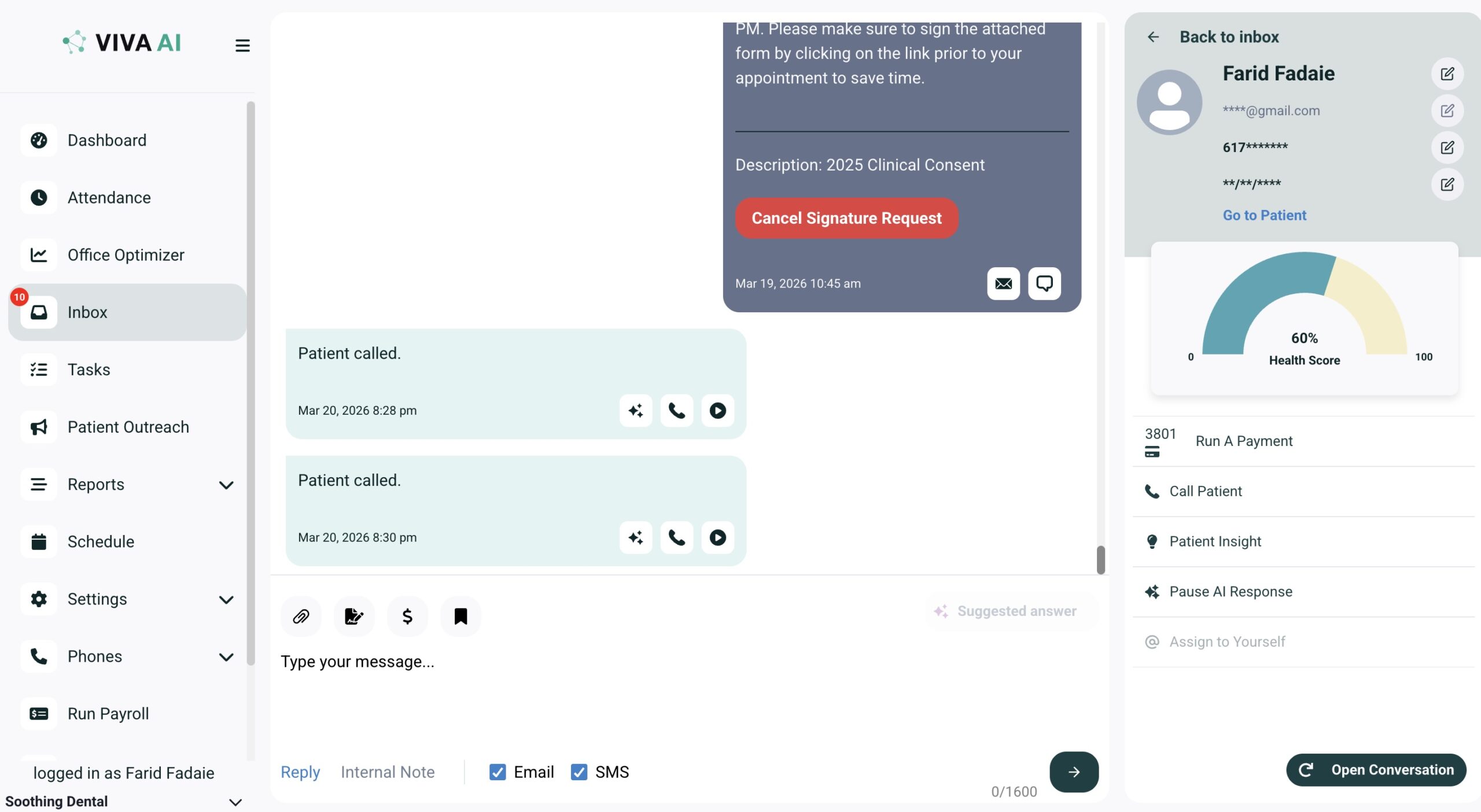
Viva answers its own demo line — call or text (866) 944-8482, or book a full platform tour.
Getting Started
If you’re managing a DSO in New York, you’re operating in one of the most complex dental markets in America. You’re managing multilingual patients, high call volume, intense competition, and sophisticated insurance logistics. Your reception infrastructure is directly tied to your profitability.
We’ve built a guide to evaluating AI receptionist systems for DSOs that covers the specific questions New York DSOs should ask: Can it actually handle your language volume? Can you manage it centrally? Can it integrate with your existing systems? Does it give you visibility into what’s happening across all locations?
If you’re ready to move from a fragmented, location-by-location reception model to a centralized, AI-powered platform, start with Viva’s AI receptionist system and see how it transforms your call capture, scheduling efficiency, and ultimately your bottom line.
New York is fast. Your reception infrastructure should be faster.