

Ohio is a bellwether state—demographically, economically, and operationally. You have three major metros: Columbus, Cleveland, Cincinnati. Each has different growth patterns, different competitive intensity, and different patient demographics. Then you have extensive rural areas with access challenges, aging population, and lower commercial insurance penetration.
For DSO leaders in Ohio, the challenge is managing this geographic and demographic complexity from a unified operational platform. One receptionist strategy doesn’t work everywhere. But you need enough consistency that your organization feels coherent.
Ohio’s DSO Competitive Landscape: Comprehensive Market Overview
Ohio’s dental market combines national powerhouses with innovative regional consolidators, all competing across Columbus (growth leader), Cleveland (legacy market), Cincinnati, and underserved rural areas. Here’s the competitive landscape:
National DSOs with Strong Ohio Presence
- Heartland Dental (HQ: Effingham, IL) — Over 1,900 locations nationally; 100+ in Ohio. Extensive coverage across Columbus, Cleveland, Cincinnati, and secondary markets with dentist partnership model.
- Aspen Dental (HQ: Chicago, IL) — Over 1,100 locations nationally; 80+ in Ohio, particularly in growth-driven Columbus and major metros with aggressive de novo expansion.
- Smile Brands (HQ: Irvine, CA) — Approximately 700+ locations nationally; 55+ in Ohio. Multi-brand portfolio with strong presence across all major Ohio metros.
- Mortenson Dental Partners (HQ: Louisville, KY) — Growing multi-state DSO with 40+ Ohio locations across Columbus, Cleveland, Cincinnati, and surrounding areas.
- Affordable Care / DentalOne Partners (HQ: Morrisville, NC) — Approximately 450+ locations; 30+ in Ohio, particularly in underserved communities and secondary markets.
Regional and Emerging DSOs
- Midwest Dental — Regional DSO with 100+ locations including significant Ohio presence. Focus on clinician partnerships and practice support.
- Smile Partners (HQ: Troy, MI) — Michigan-based DSO supporting 100+ practices across Midwest with growing Ohio presence. 15+ locations across the state.
- Benevis (formerly Kool Smiles) — Approximately 100+ locations nationally with specialty focus on Medicaid and underserved communities. 12+ locations in Ohio, particularly in access-barrier rural areas.
- Sage Dental (HQ: Boca Raton, FL, with Midwest expansion) — 150+ locations; 12+ in Ohio. Multi-specialty model including general dentistry, orthodontics, and oral surgery.
- Premier Care Dental Management (Multi-state, Ohio expansion 2026) — Growing regional DSO actively acquiring Ohio practices. 20+ locations and expanding across major metros.
- Phase 1 Equity — Emerging Ohio-focused DSO specializing in multi-site orthodontic practice acquisitions and consolidation. 18+ locations across state.
Specialty-Focused DSOs
- Smile Doctors — Specialty DSO focused on orthodontics with 50+ locations including 8+ across Ohio metros.
- ClearChoice — Specialty DSO focused on implant dentistry with 80+ centers nationally; 5+ in Ohio including Columbus and Cleveland.
- Imagen Dental Partners (HQ: Scottsdale, AZ, with Midwest expansion) — Growing multi-specialty DSO with 35+ total locations including 10+ in Ohio.
For all of these organizations—from Heartland’s massive network to innovative regional players—Ohio presents an operational puzzle: how do you build unified reception infrastructure that competes effectively in growth-driven Columbus, serves traditional expectations in legacy Cleveland, and maintains efficiency in rural access-barrier communities?
The Three Metros and Their Distinct Characteristics
Columbus is the growth leader. It’s adding population faster than Cleveland or Cincinnati. Tech jobs are moving in (JobsOhio has been aggressive with incentives). Young professionals. Good insurance penetration. Patient expectations are shaped by national chains—they want online scheduling, text reminders, digital experience. Competition among DSOs is intense because Columbus is growing and profitable.
Cleveland is the legacy metro. Manufacturing decline, population drift, but stable middle-class and working-class patient base. Strong institutional healthcare (Cleveland Clinic). Lots of union workers with pension-based insurance (still good, but aging population). Patient expectations are more traditional—they value personal relationships, phone accessibility, local ownership feeling.
Cincinnati sits in between. Moderate growth. Diverse patient mix. Proximity to Kentucky and Indiana means some patients cross state lines for care. Healthcare market is competitive but not as aggressively so as Columbus.
A one-size-fits-all reception strategy fails here. Columbus expects omnichannel, digital-first. Cleveland expects personal, phone-accessible. Cincinnati expects moderate sophistication. But you need your brand and operational standards to feel consistent across all three.
The Growing Somali Community in Columbus
Columbus has an unusual demographic factor: one of the fastest-growing Somali communities in America. An estimated 40,000+ Somali refugees and immigrants live in Columbus, primarily in the south side. This is a distinct market opportunity and operational challenge.
Somali communities tend to be younger (median age in the 20s), have family-oriented values, and have strong community networks. They have relatively good insurance (many are employed in manufacturing, healthcare, and service sectors). They face linguistic and cultural barriers in healthcare access. They have high unmet dental treatment needs (because access is difficult in Somalia, many arrived with advanced dental disease).
For DSOs, this is an addressable market with willing patients and good economics. But you need infrastructure that serves them. Somali is not commonly available in dental offices. Cultural understanding matters—many Somali patients prefer gender concordance (women patients prefer women providers), face time as preferred communication, and community-based word-of-mouth marketing.
An AI receptionist that fluently handles Somali, with cultural awareness, is immediately valuable in Columbus. It lets you serve this community at a service level competitors can’t match. It’s differentiation that money can’t buy—unless you have the right platform.
Rural Ohio and Access Barriers
Outside the three metros, Ohio has significant rural areas. Eastern Ohio (coal country), western Ohio (agricultural), northwestern Ohio (agricultural) all have sparse population, limited healthcare access, and aging demographics.
Many rural Ohio patients are on Medicare, Medicaid, or self-pay plans. Insurance verification is critical and often complex. Treatment plans need to account for access—if the patient lives 45 minutes away, they’re unlikely to come back for follow-up unless it’s critical. Your operational model needs to reflect that reality.
Outbound AI capability is especially valuable in rural Ohio. You can reach patients proactively—appointment reminders, follow-up calls, reactivation campaigns for inactive patients. You can handle no-shows and cancellations quickly. You can manage the patient who lives far away more carefully (confirm appointments more aggressively, reschedule missed appointments immediately, avoid long gaps between visits).
Rural Ohio isn’t a growth market, but it’s a stable market with opportunity for DSOs that manage access well.
Medicaid Complexity and Prior Authorization
Ohio Medicaid is complex. Different managed care plans have different provider networks, different prior auth requirements, different benefit structures. Some Medicaid patients age out of pediatric coverage and lose dental entirely. Some transitions between plans cause coverage gaps. Your system needs to navigate this.
Moreover, the fragmented nature of dental insurance—different carriers, different benefit designs, different prior auth rules—means your reception team is constantly verifying coverage, explaining benefits, and working through authorization issues. An AI that understands your insurance acceptance policies, that can verify coverage in real-time, and that can explain benefits clearly, is the difference between patient frustration and patient acceptance.
The Urban-Rural Integration Challenge
Here’s the specific problem Ohio DSOs face: your Columbus locations are competing with well-resourced, sophisticated DSOs. Your rural locations are serving patients who don’t have many other options. You need a reception infrastructure that excels at both.
In Columbus, excellence means: answer fast, book immediately, communicate via text and email, integrate with your website and online scheduling, manage high volume efficiently. In rural Ohio, excellence means: know the patient by name, understand their insurance complexity, schedule them carefully for access, follow up to ensure they actually come.
These aren’t contradictory. They’re different expressions of the same principle: meet patients where they are. But you can’t achieve both with a one-size-fits-all reception team. You need infrastructure that’s flexible enough to serve both strategies well.
A centralized platform with location-level customization is how you do it. The AI operates with the same protocols everywhere—answer quickly, qualify accurately, integrate with systems. But you configure different appointment types, different messaging tones, different follow-up patterns by location based on patient demographics.
Manufacturing, Insurance, and Economic Transition
Ohio manufacturing is in transition. Plants are closing or downsizing. Workers are moving into service sector jobs (lower pay, worse benefits) or gig work (no benefits). Insurance is becoming less stable.
This affects your patient mix. You have fewer patients with excellent union insurance. You have more patients with high-deductible plans or marketplace plans. You have more self-pay patients or patients on state insurance. Your financial conversations are more complex. Your collection rate is lower. Your staff is spending more time on patient financial arrangements and less time on clinical care.
An AI system that handles the financial conversation—explaining deductibles, discussing payment plans, verifying what’s covered—reduces staff time on collections and administrative work. It also improves patient experience. Patients want to understand cost upfront, not be surprised after care. An AI that clarifies this before treatment actually improves adherence and reduces financial conflict.
Tech Stack Integration in Ohio Markets
Ohio DSOs tend to be pragmatic about technology. They’re using practice management systems like Dentrix or Softdent. They’re not as digitally native as California or New York, but they’re catching up. Many are using patient communication platforms, insurance verification tools, and basic CRM.
What matters for Ohio DSOs: AI receptionist should integrate cleanly with existing systems. It should handle the heavy lifting (calls, qualification, appointment booking) and pass clean data to practice management. It should reduce the number of manual data entry steps. For offices that are already stretched on administrative work, this is essential.
Real Financial Impact
A 25-location Ohio DSO typically manages 900-1,100 inbound calls per day. Current answer rate: about 70% (typical). That means 270-330 calls per day going to voicemail or busy signal. Of those, maybe 50% follow up. That’s 135-165 lost calls per day. If 30% would have booked appointments, that’s 40-50 lost appointments per day. At $160 average treatment value, that’s $6,400-8,000 per day in lost revenue. Per month: $130-160K. Per year: $1.5-2M.
An AI that answers 98% of calls and books 50% of the previously-missed calls captures $750K-1.2M per year in recovered revenue. The cost is a fraction of that. The payback is 4-6 months.
Plus, you’re reducing staff overtime and burnout. Reception team satisfaction improves when they’re not drowning in call volume. Turnover drops. Onboarding cost drops. That’s a second-order benefit.
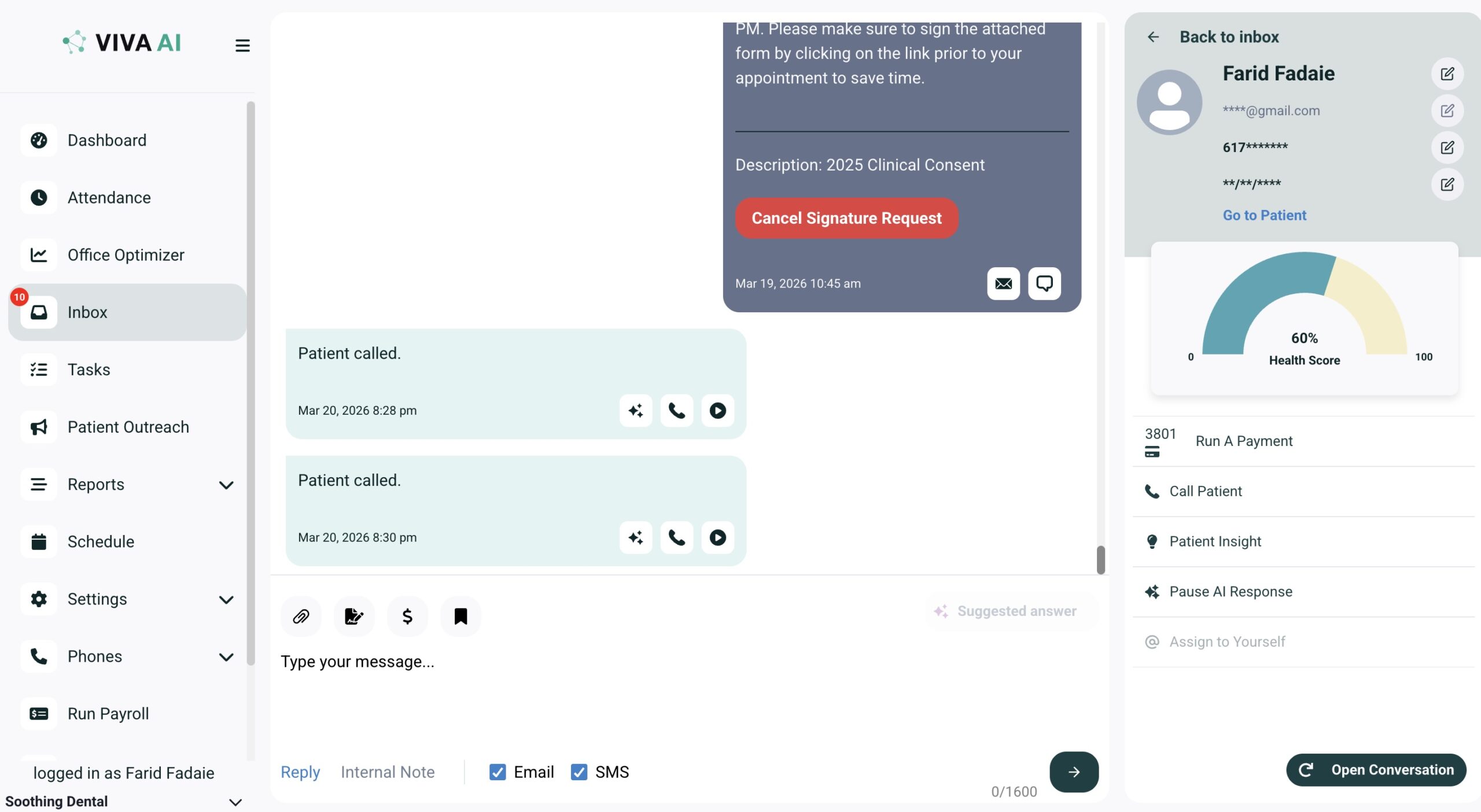
Viva answers its own demo line — call or text (866) 944-8482, or book a full platform tour.
Getting Started
If you’re running a DSO in Ohio, you’re managing a complex, multi-market situation. You’re competing in Columbus against sophisticated national players. You’re serving rural communities with access challenges. You’re navigating insurance complexity. You’re managing economic transition.
We’ve built a guide to evaluating AI receptionist systems for DSOs that covers the specific questions Ohio DSOs should ask: Can it handle your geographic diversity? Can it serve specific communities (like Somali in Columbus)? Can you manage all locations from one dashboard? Does it reduce staff burden or increase it?
If you’re ready to move from a staffing-heavy, location-fragmented model to a platform-based approach that bridges urban and rural, that serves your specific communities, and that recovers lost revenue from missed calls, start with Viva’s AI receptionist system and see how it transforms your operational efficiency.
Ohio is about balance. Your operations infrastructure should be too.