
Pennsylvania is a state of two major metros that barely know each other. Philadelphia is an East Coast city—dense, sophisticated, expensive, intensely competitive. Pittsburgh is a Rust Belt city recovering from industrial decline—smaller, pragmatic, still rebuilding. Between them is a vast expanse of rural Pennsylvania with sparse population, aging demographics, and limited healthcare access.
For DSO leaders in Pennsylvania, this geographic and cultural divide requires a fundamentally different operational approach than managing a single cohesive market. Your Philly locations compete with some of the best dental practices in the country. Your Pittsburgh locations compete in a recovering market with growth opportunity. Your rural Pennsylvania locations serve communities with serious access barriers. One reception model doesn’t work everywhere.
Pennsylvania’s Evolving DSO Landscape: Comprehensive Market Overview
Pennsylvania’s dental market combines major national DSOs with emerging regional leaders and specialty-focused operators, all competing across Philadelphia (dense, competitive East Coast market), Pittsburgh (recovering Rust Belt market), and rural Pennsylvania (access-barrier communities). Here’s the competitive landscape:
National DSOs with Strong Pennsylvania Presence
- Heartland Dental (HQ: Effingham, IL) — Over 1,900 locations nationally; 80+ in Pennsylvania including significant Philadelphia metro concentration. Recent partnerships including Artistic Smiles with continued expansion.
- Affordable Care / DentalOne Partners (HQ: Morrisville, NC, headquartered in Pennsylvania!) — Approximately 450+ locations across 43 states; 45+ in Pennsylvania including multiple Affordable Dentures & Implants locations across the state.
- Aspen Dental (HQ: Chicago, IL) — Over 1,100 locations nationally; 40+ in Pennsylvania, particularly Philadelphia area with expanding secondary market presence.
- Smile Brands (HQ: Irvine, CA) — Approximately 700+ locations nationally; 30+ in Pennsylvania with focus on major metro areas.
- Mortenson Dental Partners (HQ: Louisville, KY, with Northeast expansion) — Growing multi-state DSO with 20+ Pennsylvania locations across Philadelphia and surrounding areas.
Northeast-Based and Emerging Regional Players
- Dental365 (New York-based, with Pennsylvania expansion) — Growing Northeast DSO with significant Pennsylvania presence including acquisitions in Center Valley, Camp Hill, and multiple practice group partnerships. 25+ Pennsylvania locations.
- Guardian Dentistry Partners (HQ: Miami, with Northeast expansion) — Multi-state DSO operating across 11 states with 160+ affiliated practices including 20+ in Pennsylvania. Focus on comprehensive practice support.
- Sage Dental (HQ: Boca Raton, FL, with Northeast expansion) — 150+ locations; 12+ in Pennsylvania. Multi-specialty model including general dentistry, orthodontics, and oral surgery.
- 42 North Dental (HQ: Waltham, MA, with Northeast expansion) — Growing Northeast DSO with 80+ locations including Pennsylvania presence. 10+ Pennsylvania locations.
- Smile Doctors — Specialty DSO focused on orthodontics with 50+ locations including 8+ across Pennsylvania.
Specialty-Focused DSOs
- ClearChoice — Specialty DSO focused on implant dentistry with 80+ centers nationally; 5+ in Pennsylvania including Philadelphia area.
- Leading Edge Oral Surgery — Specialty DSO focused on oral and maxillofacial surgery with strong Pennsylvania network. 12+ locations across state.
- Max Surgical Specialty Management (Northeast-based) — Specialty DSO operating across Northeast region including 8+ Pennsylvania locations focused on oral surgery and specialty services.
- Imagen Dental Partners (HQ: Scottsdale, AZ, with Northeast expansion) — Growing multi-specialty DSO with 35+ total locations including 8+ in Pennsylvania.
- Omega Dental — Regional DSO with growing Pennsylvania presence focused on general dentistry and practice support. 6+ locations across state.
For all these organizations—from Heartland’s extensive Pennsylvania network to specialty-focused leaders—Pennsylvania presents a multi-market challenge: how do you build unified reception infrastructure that competes at the highest level in sophisticated Philadelphia, builds relationships in relationship-oriented Pittsburgh, and serves access-barrier communities in rural Pennsylvania?
Philadelphia Metro: Northeast Density and Competition
Philadelphia metro (Philadelphia, Chester, Bucks, Montgomery, Delaware counties) has 6+ million people. It’s dense, established, competitive. The dental market is mature. Practices are sophisticated. Patients have high expectations and lots of alternatives.
Call volume is high—50-65 calls per location per day. Your staff is busy. Patients can’t reach you? They call a competitor. You’re too slow to book? They book elsewhere. Competition is fought on service level and speed.
Philly is also linguistically diverse. About 32% of Philadelphia County residents speak a language other than English at home. Spanish, Vietnamese, Chinese, Portuguese (from both Brazilian and Portuguese communities), Russian, and Arabic communities are all substantial. Your Philly locations need to serve these populations fluently or lose them to competitors who do.
The operational implication: your Philly reception team needs to be highly responsive, multilingual, and integrated with your practice management system. Patients expect to schedule online, by phone, by text. They expect confirmation immediately. They expect appointment reminders. Your reception infrastructure needs to deliver all of this.
Pittsburgh Metro: Growth Opportunity and Market Positioning
Pittsburgh (Allegheny County and surrounding areas) is 2.3 million people. It’s smaller than Philly. The economy is transitioning from steel manufacturing to healthcare, technology, education. It’s growing, but more slowly and more steadily than high-growth metros like Austin or Atlanta.
The dental market is less saturated than Philly. Patient expectations are more traditional. They value personal relationships, reliability, local ownership feeling. They’re less price-sensitive than Philly patients, but more value-conscious. They want to feel taken care of, not processed.
Linguistically, Pittsburgh is less diverse than Philly. About 16% speak a language other than English at home. Spanish is primary, but the volume of multiple languages isn’t as high.
For DSOs, Pittsburgh is an easier market to serve but a smaller market. You need to excel at local service, community relationship, and patient care—not just speed and efficiency. Your reception infrastructure should reflect that.
Rural Pennsylvania and Access Barriers
Outside these metros, Pennsylvania is rural. Appalachian areas, agricultural areas, declining industrial areas—many communities with 1-2 dentists per 50,000 people. Patient dental health is worse (high disease burden due to access barriers). Healthcare competition is minimal. DSO consolidation is an opportunity.
But rural operations are different. Patients are on Medicare, Medicaid, or limited insurance. Your margins are thinner. Your staff turnover is high (it’s hard to attract educated workers to rural areas). Your patient base is aging and shrinking. You need to be efficient and effective simultaneously.
For rural Pennsylvania, the reception infrastructure needs to support access and continuity. You need AI that handles the call volume when you’re short-staffed. You need outbound capability to manage no-shows (patients who live 30+ minutes away and miss appointments impact your schedule significantly). You need insurance expertise because Medicaid is complex and your margins are tight.
Medicaid Complexity and Reimbursement
Pennsylvania Medicaid varies significantly by location. You have both fee-for-service and managed care options. Different managed care plans have different provider networks, different prior auth requirements, different benefit structures. This is especially complex in rural areas where Medicaid penetration is higher and your margins are lower.
Moreover, Pennsylvania has been expanding Medicaid, so you have more Medicaid patients. They’re often high-need (delayed care, advanced disease). Your team needs to understand Medicaid benefits, navigate prior auth, and manage expectations.
An AI receptionist that understands your Medicaid acceptance, that verifies coverage in real-time, that knows which procedures require prior auth, and that can explain benefits to patients, is your operational efficiency lever. It also improves patient experience—patients understand coverage upfront, not after receiving a bill.
The Dual-Market Strategy for Philly and Pittsburgh
Here’s what effective Pennsylvania DSO strategies look like:
Philly: compete on service sophistication. You’re competing with practices that have unlimited resources. You compete by being better organized, faster, more responsive, more multilingual. Your Philly locations need to be the easiest practices to reach and schedule with. You do this through reception infrastructure excellence.
Pittsburgh: compete on relationship and value. You’re competing on being trustworthy and community-oriented. Your Pittsburgh locations need to feel like they care about patient outcomes, not just patient throughput. Your receptionists are part of that—they know patients by name, they remember family situations, they follow up on treatment outcomes.
Rural: compete on being present and reliable. You’re often the only option or one of two. Your competitive advantage is consistent availability, honest dealings, and being part of the community. Your receptionists are critical to this—they’re the face of the practice, the first human contact.
A unified AI platform serves all three strategies. In Philly, it’s handling high volume and complexity. In Pittsburgh, it’s supporting relationship-focused staff. In rural areas, it’s providing coverage when staff is limited.
Tech Stack and Integration Complexity
Pennsylvania DSOs range from Philly-based sophisticated networks to smaller regional consolidators. Philly practices tend to have modern tech stacks. Pittsburgh practices might be in transition. Rural practices might have legacy systems.
Your AI receptionist needs to integrate cleanly with this diversity. It needs to work with modern practice management systems in Philly, transitioning systems in Pittsburgh, and older systems in rural Pennsylvania. That requires flexible architecture.
Pharmaceutical Complexity and Specialty Care
Pennsylvania has a significant pharmaceutical and healthcare research presence (especially in Philly and Pittsburgh metros). Patients might be on specialized medications that affect dental treatment. Your team needs to understand drug interactions, medication timing, and how dental treatment intersects with pharmaceutical regimens.
This is especially true for older patients (Pennsylvania has an aging population) and Medicaid patients (who often have multiple chronic conditions). Your reception team’s ability to gather accurate medication information is critical. An AI that asks the right questions, captures the information accurately, and flags potential conflicts is patient safety infrastructure.
Geographic Challenges and Winter Disruption
Pennsylvania winters are harsh. Ice storms, snow, power outages disrupt operations, especially in rural areas. Your appointment schedule becomes volatile. Staff can’t get to work. Patients cancel.
An AI that works 24/7, that doesn’t depend on staff being present, that can handle after-hours calls and rescheduling—is operational continuity. You don’t lose patients because your office was closed due to weather. You proactively reach out to confirm appointments before storms. You reschedule quickly after weather events.
The Financial Model
A 30-location Pennsylvania DSO with 12 in Philly metro, 8 in Pittsburgh, 10 rural manages 1,100-1,400 inbound calls per day. Philly locations: 55+ calls each. Pittsburgh: 40 calls each. Rural: 20-25 calls each. Current answer rate: 70% average.
Lost calls: roughly 330-420 per day. Of those, 50% follow up—165-210 missed calls where patients actually try to reach you. If 25% would have booked appointments, that’s 41-52 lost appointments per day. At $180 average treatment value, that’s $7,380-9,360 per day in lost revenue. Per month: $150-190K. Per year: $1.8-2.3M.
An AI that answers 98% of calls recovers most of that. Plus, you’re not adding reception staff proportionally as you expand to new locations.
First-year value: $900K-1.4M in recovered revenue. Cost: $90-120K per year. Net: $780K-1.3M in value, with compounding benefit thereafter.
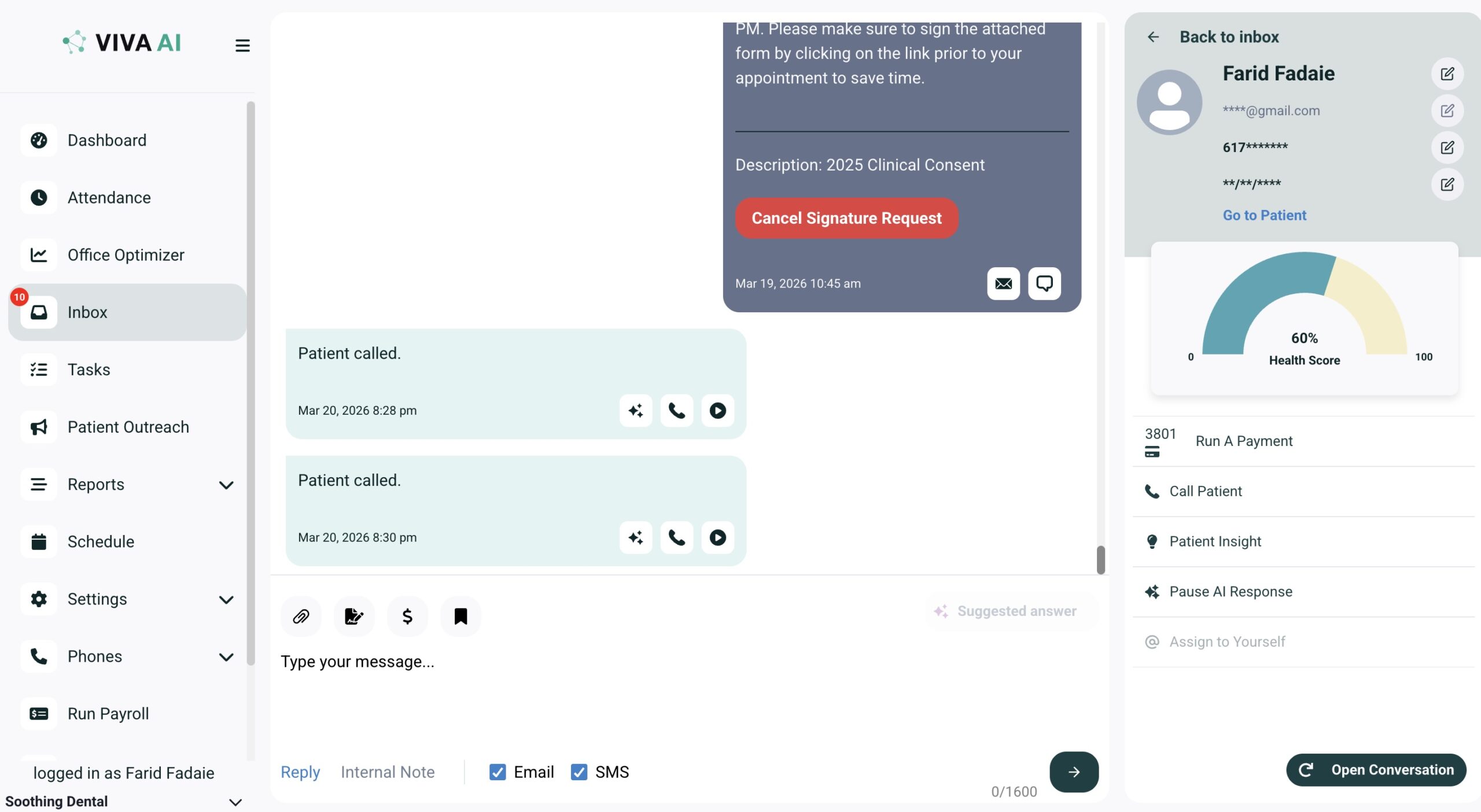
Viva answers its own demo line — call or text (866) 944-8482, or book a full platform tour.
Getting Started
If you’re running a DSO in Pennsylvania, you’re managing a complex, multi-market situation. You’re competing at the highest level in Philly. You’re building relationships in Pittsburgh. You’re serving access-barrier communities in rural areas. Your reception infrastructure needs to be sophisticated, flexible, and culturally aware.
We’ve built a guide to evaluating AI receptionist systems for DSOs that covers the specific questions Pennsylvania DSOs should ask: Can it work across Philly sophistication and rural simplicity? Can it integrate with diverse tech stacks? Can you manage all three market types from one platform? Does it improve patient experience in all three contexts?
If you’re ready to move from a fragmented, market-by-market approach to a unified platform that excels in sophistication, relationships, and service, start with Viva’s AI receptionist system and see how it transforms your operations from Philly to Pittsburgh to rural Pennsylvania.
Pennsylvania is diverse. Your operations infrastructure should celebrate that diversity and excel in all of it.