

Texas is running at a different speed than the rest of America. The state added 2.3 million people in the last decade—more than any other state—and that growth isn’t slowing down. For dental DSO leaders in Texas, that means opportunity and operational complexity arriving together.
We’ve been working with DSO leadership teams across Houston, Dallas, Austin, and San Antonio, and we keep hearing the same challenge: the people they’re trying to reach don’t all speak English at their kitchen table. And if you’re not reaching them smoothly on the phone, you’re already losing them to a practice down the street that is.
The Texas DSO Landscape: Comprehensive Overview
Texas hosts the densest DSO market in America, with national giants and rapidly growing regional players competing for market share across Dallas, Houston, Austin, San Antonio, and emerging markets. Here’s the current landscape:
National DSOs with Major Texas Presence
- Heartland Dental (HQ: Effingham, IL) — Over 1,900 affiliated locations nationwide; approximately 120+ locations across Texas with strong presence in Dallas, Houston, and Austin. General practice focus with supported dentist ownership model.
- Pacific Dental Services (HQ: Irvine, CA) — Approximately 900+ locations nationally; 80+ locations in Texas. Multi-brand portfolio including Bright Now! and Monarch Dental. General dentistry with high-volume appointment model.
- Aspen Dental (HQ: Chicago, IL) — Over 1,100 locations nationwide; 60+ locations in Texas. Rapid expansion through de novo development in underserved markets. General dentistry and cosmetic focus.
- Affordable Care / DentalOne Partners (HQ: Morrisville, NC) — Approximately 450+ locations across 25 states; 35+ locations in Texas. Value-focused general dentistry with emphasis on accessibility.
- Smile Brands (HQ: Irvine, CA) — Approximately 700+ locations nationwide; 55+ Texas locations under multiple brands including Bright Now!, Monarch, and CareCredit partnerships.
Texas-Based Regional Leaders
- MB2 Dental (HQ: Carrollton, TX) — 600+ locations across the nation with 180+ in Texas. Texas’s largest homegrown DSO. Multi-brand model including Dental Care Plus. Strong presence in Dallas-Fort Worth, Houston, and Austin. Recognized for 86% revenue growth on Inc. Regionals: Southwest list.
- Dental Care Alliance (HQ: Sarasota, FL) — Approximately 400+ locations in 25 states; 25+ locations in Texas. General dentistry with growing Texas footprint, particularly in Houston and Dallas markets.
- Sage Dental (HQ: Boca Raton, FL) — 150+ locations across multiple states; 20+ Texas locations. Multi-specialty model including general dentistry, orthodontics, and oral surgery.
- Brident Dental Partners — Growing Texas-based DSO with 15+ locations across major metros. Focus on general dentistry and community-centered care.
- D4C Dental Brands — Regional Texas-based DSO operating 20+ locations, primarily in Dallas-Fort Worth and Houston. General dentistry with emphasis on digital integration.
- Tend Dental (Multi-state) — Growing presence in Texas markets with emerging care model emphasizing patient-centric technology and transparent pricing.
Specialty-Focused DSOs
- U.S. Oral Surgery Management (Irving, TX) — Operates 122 dental practices across Texas with specialty focus on oral and maxillofacial surgery. One of America’s largest specialty-focused DSOs.
- Allied OMS (Southlake, TX) — Specialty DSO focused on oral surgery and implantology. Multiple Texas locations with emphasis on surgical excellence and referral management.
For all of these organizations—from $1.9B Heartland to emerging regional players—the operational challenge remains identical: how do you maintain consistent patient communication across dozens or hundreds of locations in a state where 35% of the population speaks a language other than English at home?
The Texas Multilingual Reality: Not Just Spanish
Yes, Spanish matters in Texas—about 35% of Texans speak a language other than English at home. But here’s what makes Texas different from other high-growth states: the distribution is uneven, and it’s shifting fast.
In Houston, 43% of residents speak a language other than English at home. Spanish dominates, but Vietnamese, Mandarin, and Korean communities are substantial. In Dallas, the figure is 38%. San Antonio sits at 54% non-English speakers, with Spanish as the overwhelming primary language. Even Austin, the tech hub, is at 28%—and growing toward those other numbers as the city urbanizes.
What this means operationally: your call center strategy can’t be monolithic. You can’t hire bilingual receptionists at scale and call it solved. Your infrastructure needs to be multilingual by default, not as an afterthought. And it needs to adapt as neighborhoods and zip codes shift.
The Multiplier Math: Growth Compounds Your Staffing Problem
Let’s do some math that Texas DSO leaders are living with right now.
Say you’re managing 40 locations across the state. Average location gets 35-45 inbound calls per day during business hours. That’s roughly 1,400-1,800 calls per day across your network. With Texas’s growth, you’re opening 2-3 new locations per year—that’s an additional 70-90 calls per day in year one alone, compounding from there.
Now layer on the multilingual reality: if 35-45% of your patient base requires non-English communication, traditional staffing means hiring proportionally more bilingual receptionists. Not everyone wants to come into an office. Turnover in reception is brutal—25-30% annually in some markets, higher in high-cost metros like Austin and Dallas. Each location needs at least one backup bilingual staff member (because your backup can’t be unavailable when your primary is out). That’s expensive, and it compounds with every new location you open.
An AI system that handles inbound calls in real-time, across 15+ languages, zero configuration, doesn’t replace your receptionists. It eliminates the staffing multiplier problem. It captures calls that hit voicemail or went unanswered because your team was busy. It qualifies leads before they reach your desk. It schedules the appointment in the patient’s language. And it learns your protocols—your insurance preferences, your hygiene availability, your treatment philosophy—without needing retraining every time you open a new location.
What Actually Works in Texas
We’ve learned what works and what doesn’t in Texas DSOs through real deployments:
Integration over isolation: Texas practices use 5-7 software platforms on average—practice management system, insurance verification, patient communication, marketing automation, accounting. A receptionist AI that lives in its own silo creates more work, not less. It needs to pass what it learns directly into your practice management system, your outbound communication platform, your analytics dashboard. Otherwise your staff is re-entering data, and you’ve gained nothing.
Outbound capability matters more here than in slower-growth markets: Texas has seasonal populations (winter visitors, remote workers who split time), people who miss appointments, and fast-moving neighborhoods where patient contact information goes stale. AI-powered outbound calling for appointment reminders, cancellation capture, and reactivation isn’t a nice-to-have in Texas—it’s survival. When you’re growing 5% per year, you’re also chasing patients who fell out of the schedule. An AI that can work both directions, handling the patient that calls you and the patient you need to reach, is the difference between profitable growth and burnout.
Consistency across locations is everything: Texas DSO leaders tell us their biggest operational headache isn’t any single location—it’s drift. Ten locations, ten slightly different workflows. Twenty locations, twenty interpretations of “how we answer the phone.” By the time you’re at 40, you’re managing dozens of microcultures. A single AI system answering for all locations, learning your protocols once and applying them everywhere, is the consistency lever that actually works.
The Compliance Layer You’re Already Worrying About
Texas doesn’t have California’s privacy laws, but you’re operating nationally if you’re a real DSO, and you’re handling patient health information. If your AI system needs manual configuration for different languages, different protocols for different states, different security approvals for different jurisdictions—you’ve scaled your compliance headache to match your growth.
What you actually want: an SOC2 Type II system that handles multilingual communication by default, not by special request. One set of security controls, one audit story, zero configuration. That’s the architecture that scales to Texas size without creating a compliance department.
Real Challenges Specific to the Texas Market
Power grid volatility and telecom infrastructure: Texas’s power infrastructure is strained during growth periods. You need an AI receptionist system that doesn’t depend on local resources being perfect. Cloud-native is non-negotiable. Redundancy is mandatory.
Extreme weather and population displacement: When hurricanes, ice storms, or floods hit, your patients vanish from their normal patterns. Appointment no-shows spike. Your team is either out of the office or understaffed. An outbound-capable AI that can reach patients, check status, reschedule preemptively—that’s operational continuity, not a feature.
Market-by-market hiring fragmentation: Hiring for Houston is different from hiring for El Paso. Labor markets are local. You can’t hire one cohesive reception team. You need infrastructure that doesn’t depend on local hiring talent. That’s what a platform does.
The Real ROI Calculation
Here’s what we see actually move the needle for Texas DSO leadership teams:
You open 3 new locations per year. Each location needs $90K-120K in annual reception staffing (salary + benefits + turnover replacement cost). That’s $270K-360K per year in incremental cost. But the cost isn’t just dollars—it’s the operational complexity, the training, the protocol drift, the language gaps.
An AI receptionist operating system that handles both inbound and outbound, multilingual by default, with zero per-location configuration, costs a fraction of that. It also captures the patient that calls at 6 PM when your office is closed. It schedules the appointment in the right patient language. It reaches the patient the day before with a reminder in their language. It tells your team which patients are ready to schedule and which need a different approach.
For a 40-location Texas DSO, we typically see:
- 25-30% reduction in missed calls (calls that hit voicemail or busy signal)
- 15-20% increase in appointment show rates (through better reminders and outreach)
- 40-50% reduction in receptionist time spent on scheduling and qualifying
- 3-4 weeks faster speed-to-hire for new locations (because reception staffing can be lighter)
That compounds. Year two, year three, year four. The gap between a platform approach and a people-only approach widens.
What Makes This Different from Hiring Smart
This isn’t about replacing receptionists. It’s about making receptionists possible at scale. The best receptionist in Dallas can’t be the best receptionist in San Antonio at the same time. The best bilingual team member in Houston needs to sleep. The best new hire at your Austin location needs training—and your existing team is too busy to give it.
An AI system that speaks 100+ languages with zero configuration, that learns your practice culture once and applies it everywhere, that works 24/7, that gets better with every call—that’s the infrastructure that makes human excellence possible at DSO scale.
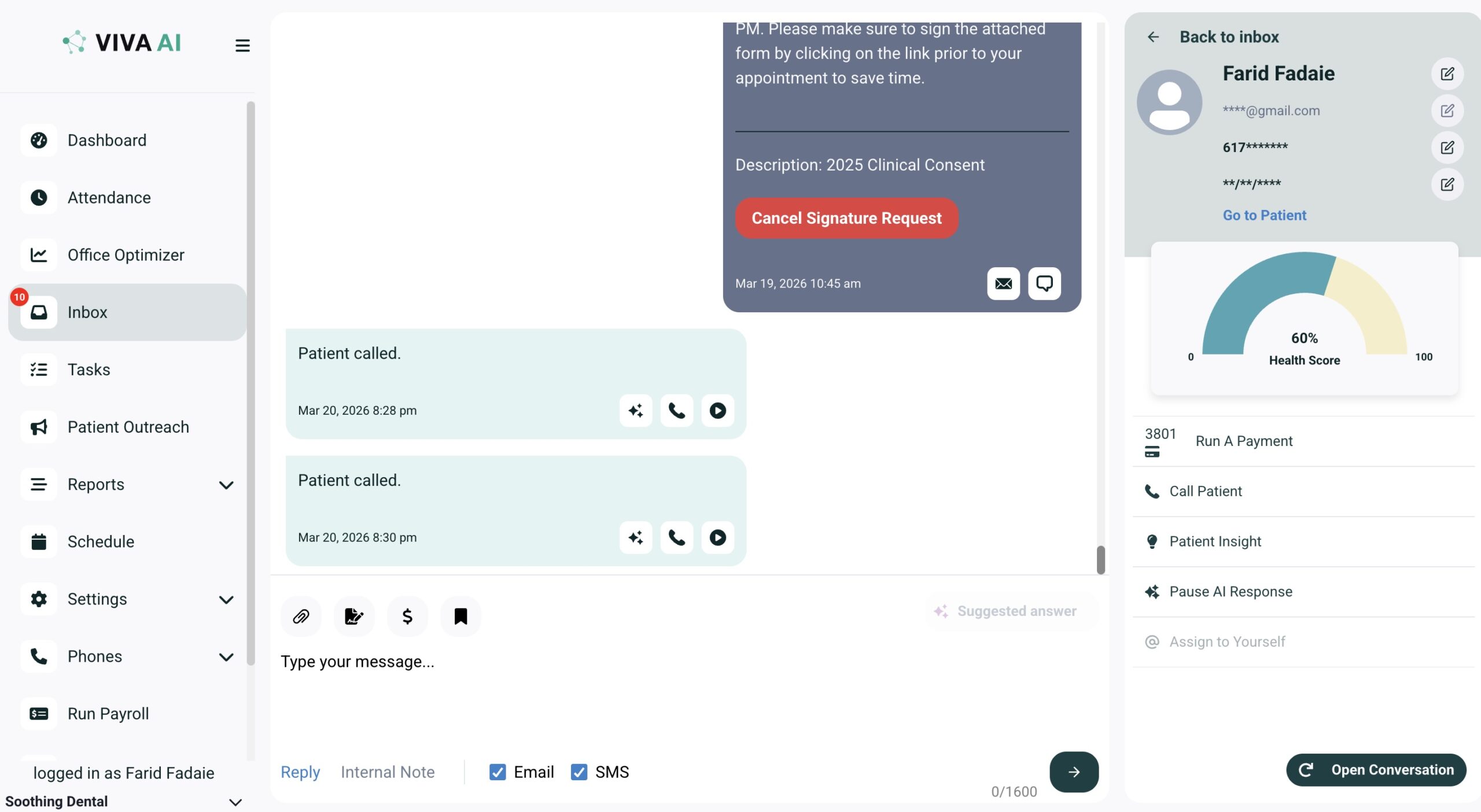
Viva answers its own demo line — call or text (866) 944-8482, or book a full platform tour.
Getting Started
If you’re running a DSO in Texas and you’re looking at your growth targets for 2026-2027, your bottleneck isn’t money or locations—it’s operational consistency and language reach. Those are both solvable with the right platform.
We’ve built a guide to evaluating AI for DSOs that asks the right questions: Does it integrate with your tech stack? Can it actually handle your languages, not just English and Spanish? Does it work both inbound and outbound? Can you manage it centrally as you grow? Is it designed for healthcare compliance or are you bolting it onto a consumer system?
If you’re ready to move from hiring mode to platform mode, we’re here to show you what that actually looks like. Start with Viva’s AI receptionist system and see how it shifts the math on growth, language, and consistency.
Texas is moving fast. Your reception infrastructure should move with it.