
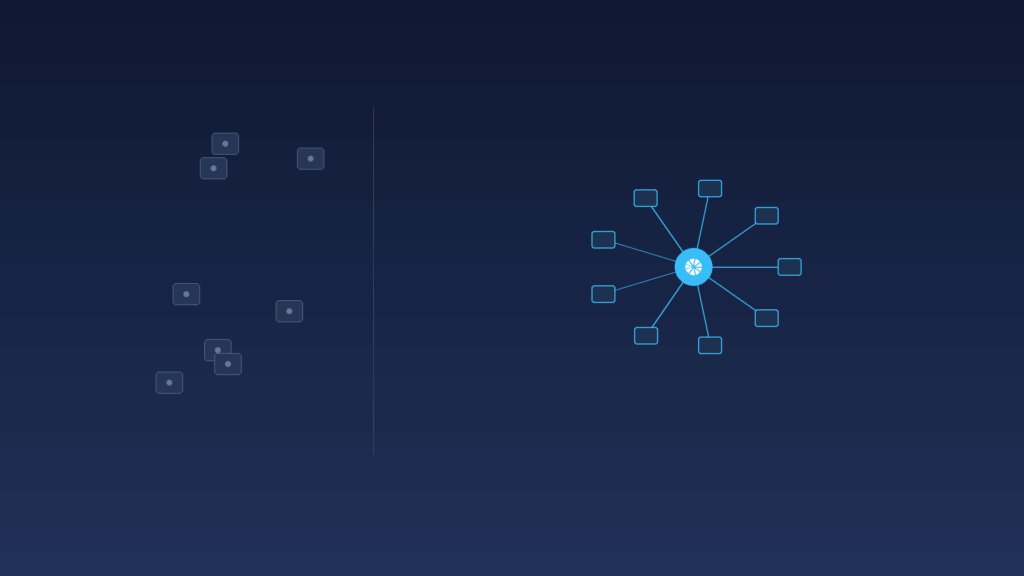
The DSO Scheduling Dilemma
How patient calls are routed and appointments are booked is one of the most consequential operational decisions a DSO makes. Get it right, and your chairs stay full with optimized provider utilization. Get it wrong, and you bleed revenue through missed calls, scheduling errors, and frustrated patients who give up and go elsewhere.
DSOs broadly choose between three models: centralized, decentralized, or hybrid. Each has trade-offs that depend on your size, growth stage, and technology infrastructure.
Model 1: Decentralized (Each Location Handles Its Own Calls)
How it works: Each office has its own front desk team that answers its own phone, manages its own schedule, and handles its own patients.
Pros:
- Local knowledge (staff knows the providers, the patients, the community)
- Personal relationships (patients talk to “their” receptionist)
- Simple to manage for small groups (under 10 locations)
Cons:
- Missed calls during peak hours, lunch, and after hours (no overflow coverage)
- Inconsistent patient experience across locations
- No centralized visibility into call handling quality
- Staffing gaps directly impact revenue (sick day = missed calls)
- Doesn’t scale — each new location needs 1-2 more front desk FTEs
Model 2: Centralized (All Calls Route to a Central Team)
How it works: Patient calls from all locations route to a centralized call center or scheduling hub, typically staffed by 10-30+ agents.
Pros:
- Consistent call handling across locations
- Centralized training and quality control
- Coverage during all hours (with shift scheduling)
- Easier to scale (add agents, not locations)
Cons:
- Expensive to build ($500K-$1M setup, $30-50K/month ongoing)
- Agents lack local knowledge (don’t know the providers or office layout)
- Multi-PMS challenge (agents need training on every PMS across your portfolio)
- High agent turnover (call center roles have 60-80% annual turnover)
- Patients notice they’re not talking to “the office”
Model 3: AI Hybrid (The Best of Both)
How it works: AI handles the volume (inbound calls, after-hours, overflow, scheduling, basic questions) while local staff handles in-office patient interactions and complex situations that need a human touch.
Why DSOs are moving here:
- Centralized quality, local flexibility: The AI delivers consistent call handling everywhere, but each location keeps its own identity, providers, and scheduling rules
- No infrastructure investment: No call center to build, no agents to hire — the AI platform deploys to all locations simultaneously
- Multi-PMS native: AI platforms like Viva AI integrate with Dentrix, Open Dental, Eaglesoft, CareStack — across your entire mixed-PMS portfolio
- Cross-location routing: When one office is fully booked, the AI can offer the patient an appointment at the nearest available location
- Scales instantly: Adding a new acquisition? The AI is live at that location within days, with the same quality as your flagship office
For more on how AI scheduling works at DSO scale, see our scheduling software and DSO platform pages.