

Why do patients say no to treatment? Every dentist has a guess: the price, the insurance, the economy. We wanted to know what really improves case acceptance in a dental practice.
So we looked at the records of 41 practices in 15 states. Together, they had 168,382 treatments that patients hadn’t had done yet, on 61,697 treatment plans. We waited six months and checked which ones got done.
Here is what we learned, as nine simple steps. You probably do the first five already. The last four may surprise you.
The nine steps
- Book the next visit before the patient leaves.
- Keep patients coming back for recare.
- Bring up unfinished treatment at every visit.
- Offer payment plans.
- Call insured patients in October and in January.
- Find everything, but talk about one or two things.
- Don’t lower your fees.
- Compare your dentists on the same procedures.
- Call the right patients, not everyone.
How to read the numbers
A few things to know first:
- “Got done” means finished. We only counted a treatment if the patient actually had it done at the practice within six months. Saying yes, or booking it, wasn’t enough.
- We counted treatments that were still waiting. Each time we looked, we listed every treatment that had been presented but not done yet. Some were a week old. Some were up to two years old.
- That’s why the numbers look low. On average, 10 out of 100 of these waiting treatments got done. Treatment done the same day it was presented isn’t in this count. And we counted each treatment, not each patient.
Is your practice different? Maybe. So we checked:
- The practices are in 15 states and use nine different software systems.
- Some are small offices. Some have several dentists.
- We took each practice’s normal results into account, and each dentist’s. The main patterns still showed up.
- We built a prediction tool from the early months and tested it on later months. Given two patients from the same practice, it picked the one who went ahead 80 times out of 100.
One more thing. These numbers show what tends to happen together. They don’t prove what causes what. When we guess at a reason, we say so.
Keep doing these
Most practices already do these five things. Here’s the proof that they work.
1. Book the next visit before the patient leaves
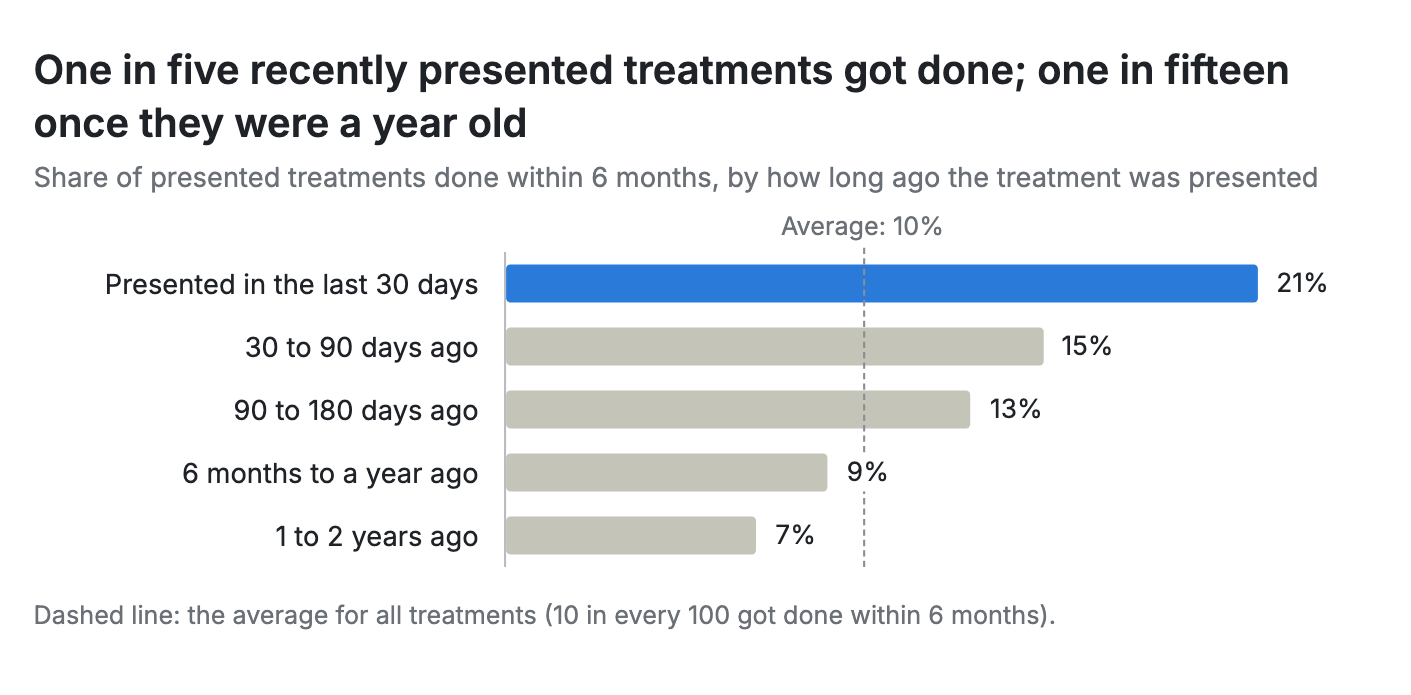
The longer a treatment waits, the less likely it is to get done:
- Presented in the last month: about 21 out of 100 got done.
- Presented a year or more ago: about 7 out of 100 got done.
But waiting isn’t the real problem. The real problem is the patient not coming back. Look at treatments more than a month old:
- No visit booked: 7 out of 100 got done.
- One visit booked (any kind of visit): 15 out of 100.
- Two or more visits booked: 28 out of 100.
Why we think this happens: In the chair, saying yes is easy. At home, the patient gets busy and forgets. A booked visit brings them back.
What to do. Book the next visit before the patient leaves. If they leave without one, call them within 30 days. At 90 days, present it again or check if it’s still needed. Don’t give up: about 13 out of 100 treatments that were three to six months old still got done.
2. Keep patients coming back for recare
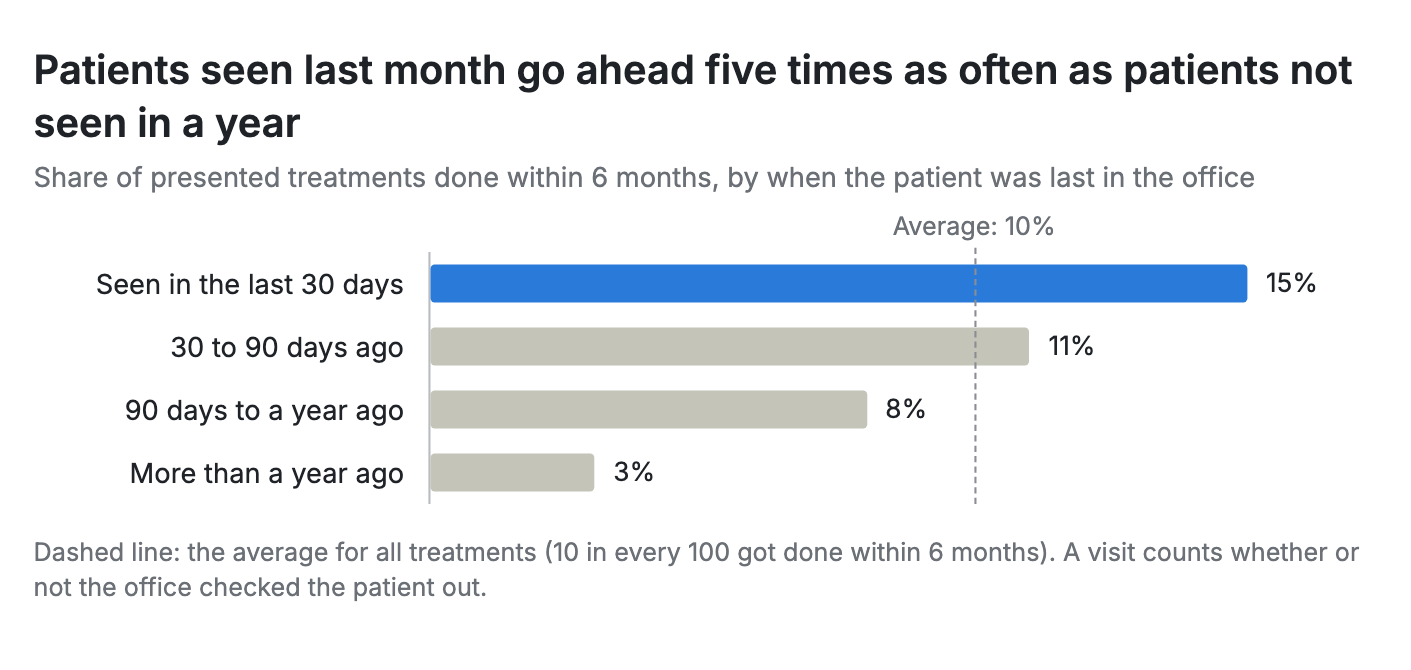
Patients who come in often are more likely to say yes:
- Seen in the last month: 15 out of 100 treatments got done.
- Not seen in over a year: 3 out of 100.
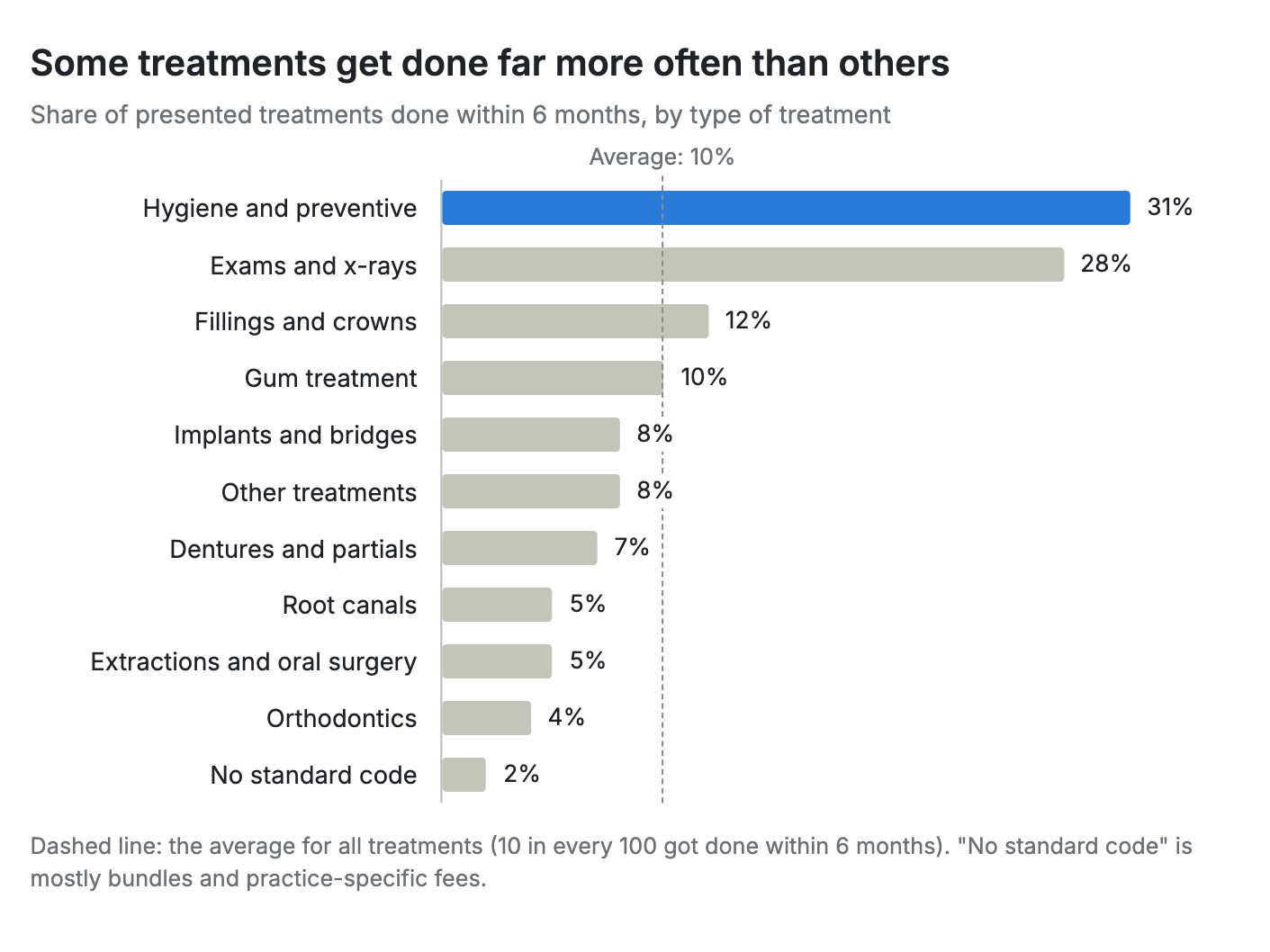
The recare visit itself (the cleaning and exam) gets done a lot: about 1 time in 3. Fillings get done about 1 time in 9. Crowns, about 1 in 7. Root canals and extractions, about 1 in 20.
Note: work you send to a specialist counts as “not done” here. We can only see what the practice did.
Why we think this happens: Every recare visit does two jobs. It builds trust. And it gives the dentist a chance to bring up the next treatment.
What to do. Keep patients on their recare schedule. At each visit, bring up the next one or two treatments. If a patient hasn’t been in for a year, get them back for a cleaning first. Then talk about treatment.
3. Bring up unfinished treatment at every visit
Some dentists mention the unfinished crown at every cleaning. Some people call that pushy. The data says it works.
Look at treatments more than a month old. The first number is for patients who didn’t come back. The second is for patients who came back three or more times:
- Fillings and crowns: 8 out of 100, compared with 13.
- Implants: 2 out of 100, compared with 11.
- Dentures: 2 out of 100, compared with 8.
Root canals and extractions are different. Coming back doesn’t help them much. Patients decide on those early, or not at all.
Why we think this happens: Big work like implants takes time to decide. Patients need to hear about it more than once.
What to do. Mention open treatment at every visit, in a sentence or two. You don’t need to present the whole plan again. Act fast on root canals and extractions.
4. Offer payment plans
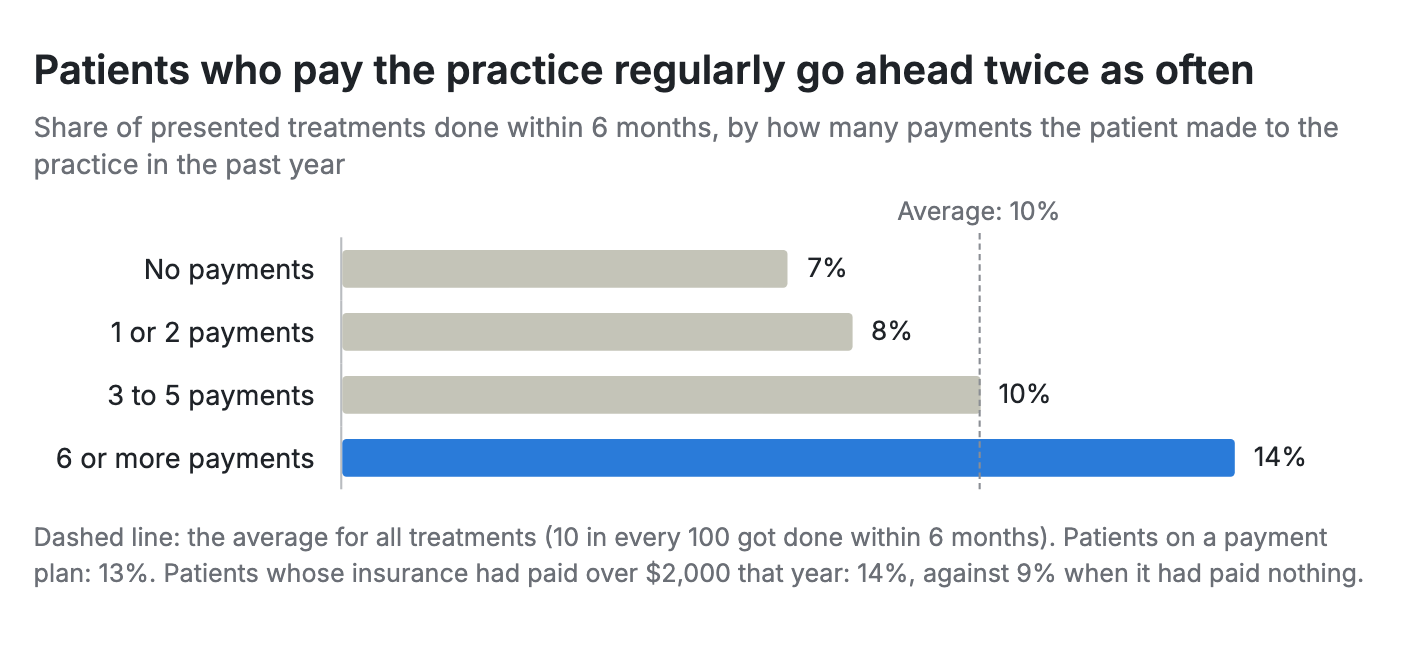
- Patients on a payment plan: 13 out of 100 treatments got done. The average was 10.
- Patients who paid the practice six or more times last year: 14 out of 100.
- Patients who paid nothing last year: 7 out of 100.
Why we think this happens: Patients who pay often are mostly patients who come in often. That’s steps 1 and 2 again. The part you control is how easy it is to pay.
What to do. Offer a payment plan as the normal way to pay, not as a last resort. Help patients use their insurance before it runs out.
5. Call insured patients in October and in January
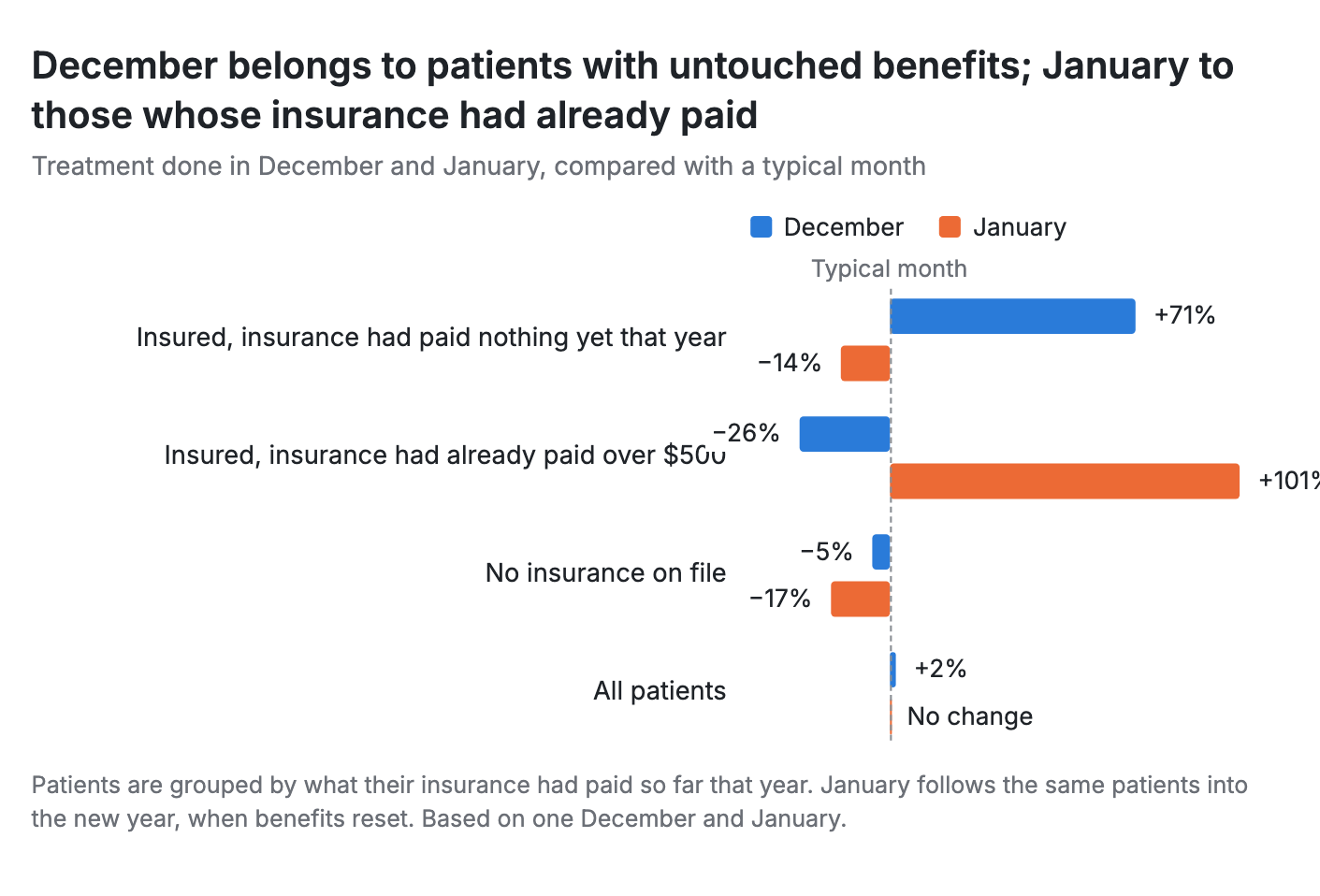
Overall, December isn’t much busier than other months. But two groups act very differently:
- Insured patients whose insurance hadn’t paid anything yet that year got 71% more treatment done in December than usual.
- Insured patients whose insurance had already paid over $500 got less done in December. Then in January, when their benefits started over, they got twice as much done as usual.
Why we think this happens: “Use it or lose it.” A deadline makes people decide.
What to do. In October, call insured patients with open treatment whose insurance hasn’t paid anything this year. In January, call patients whose insurance paid more than $500 last year. This is based on one year of data, so watch your own results.
Change these
These four may go against what you’ve been taught. Here is the evidence for each one.
6. Find everything, but talk about one or two things
This doesn’t mean a shorter exam. Find everything, and write it all down. Just don’t ask the patient to decide on everything at once.
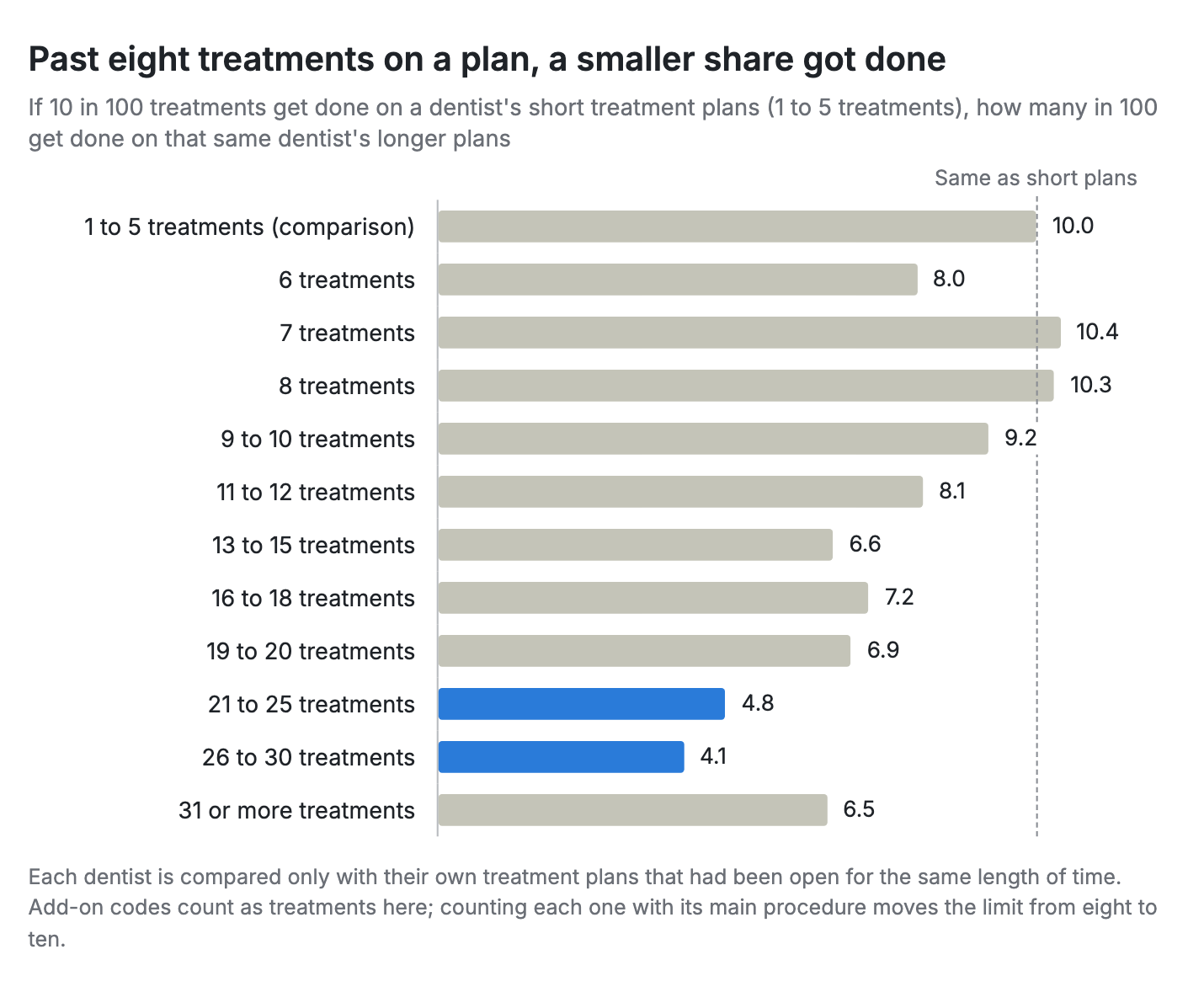
Some dentists write long treatment plans. Those same dentists also get less done in general. So, to be fair, we compared each dentist only with their own plans.
Say 10 out of 100 treatments got done on a dentist’s short plans (1 to 5 treatments). Then on that same dentist’s longer plans:
- Up to 8 treatments: about the same.
- 9 to 20 treatments: a bit lower (about 7 to 9).
- More than 20 treatments: much lower (about 4 to 7).
Some long plans did much worse than others:
- Long plans full of small, cheap items rarely got anything done.
- Long plans built around a crown or an implant got at least one treatment done about 1 time in 3.
- Gum treatment got done only a quarter as often on a long plan as on a short one.
- Fillings got done less often when an extraction or a root canal was on the same plan.
Why we think this happens: Twenty treatments at once sounds scary. The patient thinks, “My mouth is a disaster. This will cost a fortune.” So they decide nothing. One clear priority is easier to say yes to. And one yes leads to more. Patients who had said yes to an earlier treatment plan went ahead 13 out of 100 times. Patients who hadn’t went ahead 9 out of 100 times.
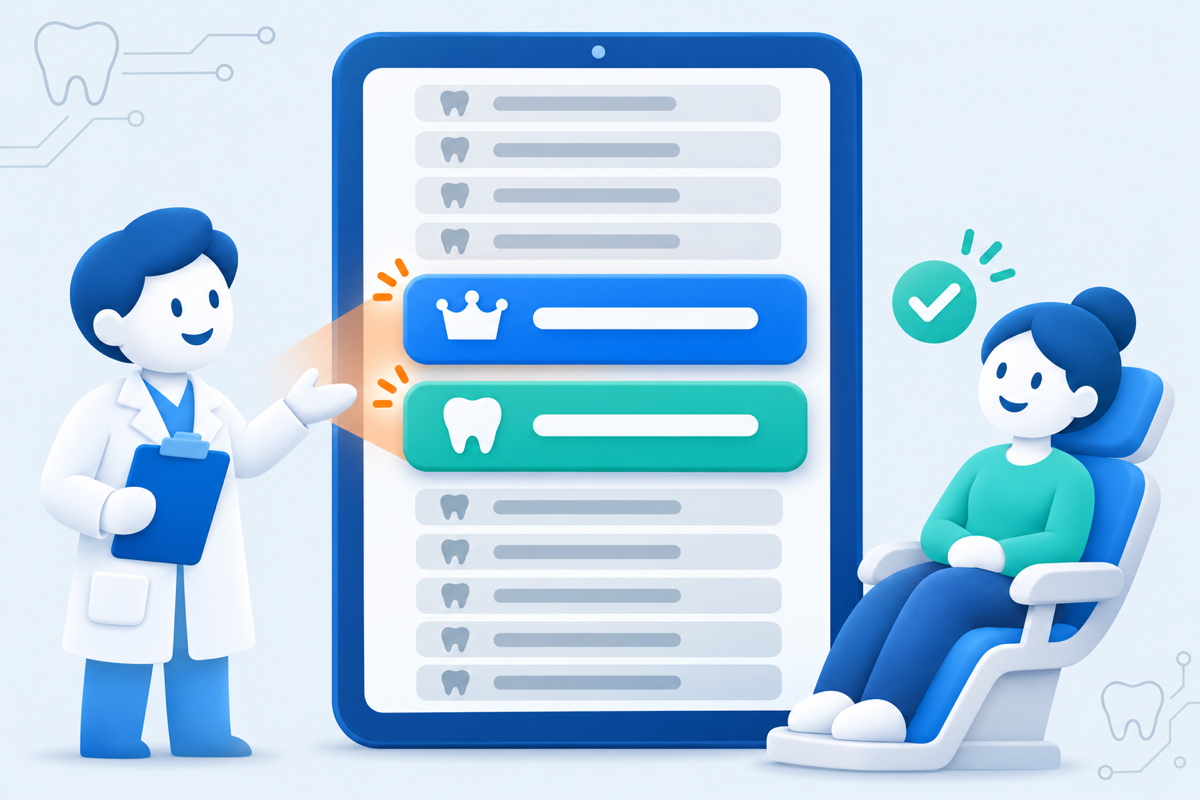
What to do. Do the full exam. Tell the patient everything you found, briefly. Then spend most of your time on the one or two most important treatments. Book the first one before they leave. Bring up the next ones at the next recare visit. If the patient wants to decide on more today, stop at about eight. Give gum treatment its own visit. Present an extraction or root canal before the fillings, not with them. And list add-ons, like a buildup, under the main procedure, so the plan doesn’t look longer than it is.
7. Don’t lower your fees
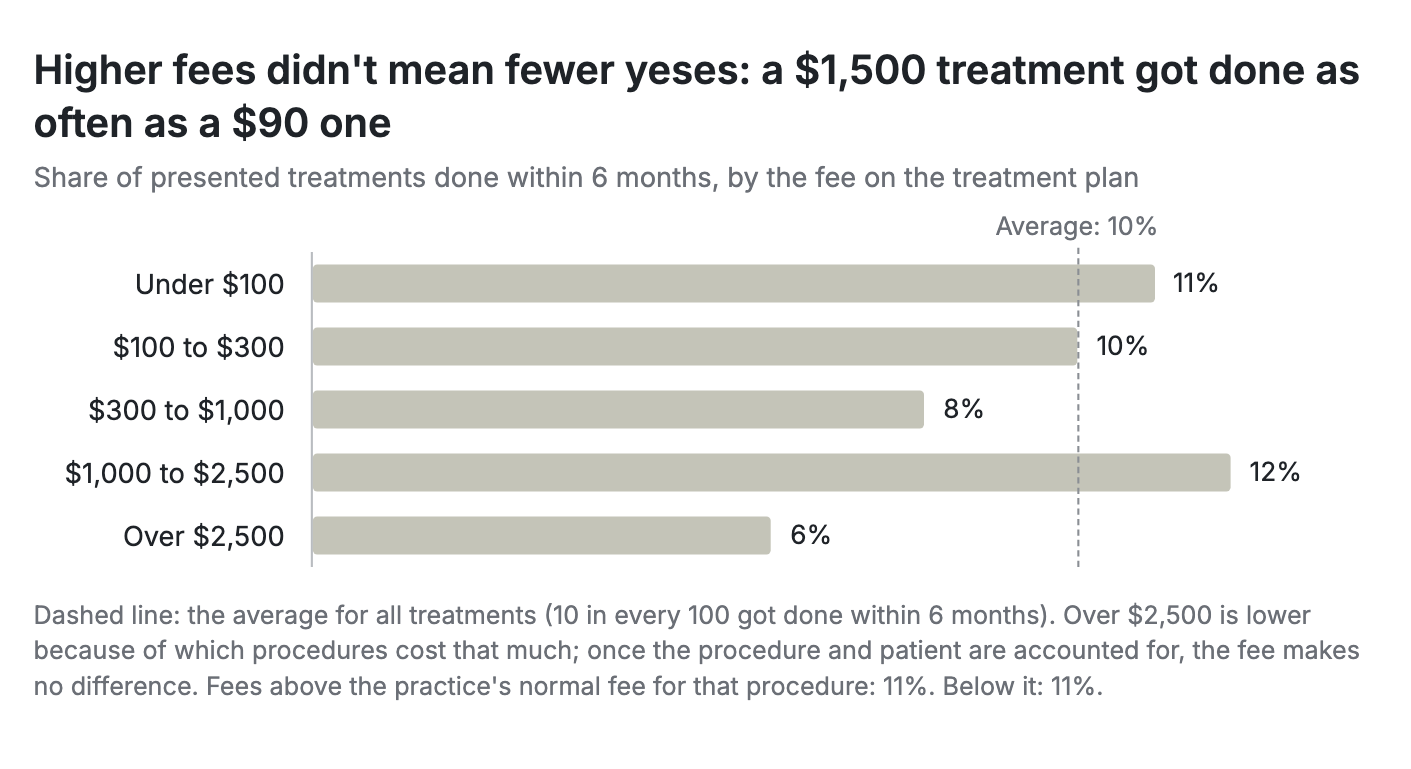
We compared the same procedure at different prices. The price made no difference:
- Priced above the practice’s normal fee: 11 out of 100 got done.
- Priced below the normal fee, from a discount or an insurance fee schedule: also 11 out of 100.
Patients turned down cheap crowns as often as expensive ones. Work over $2,500 did get done less often. But that’s because of what kind of work it is, not the price.
The type of insurance mattered a little. Medicaid patients went ahead with fillings and crowns about half as often as patients with commercial insurance. That’s mostly about what Medicaid covers.
Why we think this happens: “It’s too expensive” often means “I’m not sure I need this.”
What to do. Don’t discount to get a yes. Explain why this tooth needs work, and why now. Then offer a payment plan.
8. Compare your dentists on the same procedures
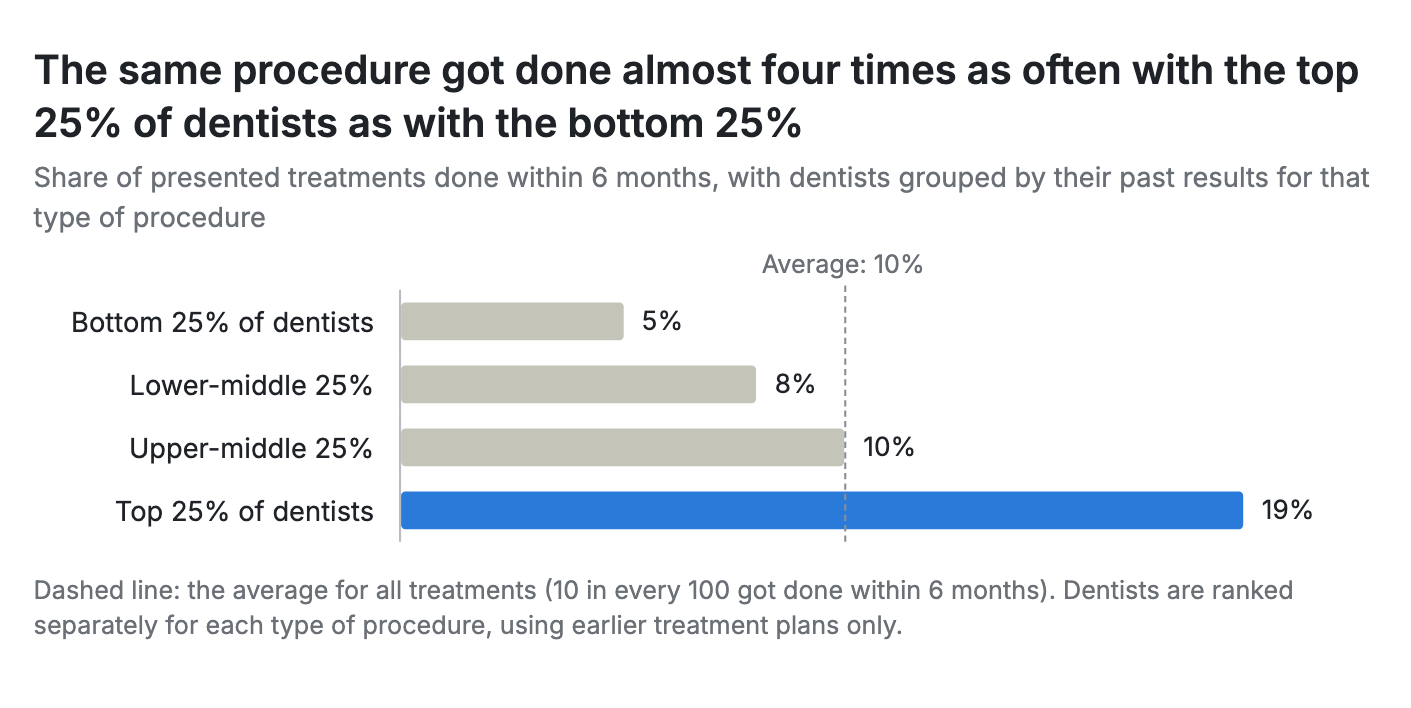
We ranked dentists by how often their patients went ahead in the past, one procedure at a time. Then we looked at what happened next:
- Top 25% of dentists: 19 out of 100 treatments got done.
- Bottom 25% of dentists: 5 out of 100.
That’s almost four times as many, for the same procedure.
Why we think this happens: Some of it may be the mix of patients each dentist sees. But we think a big part is skill: explaining the case clearly, booking the next visit, and following up. Those are skills. Skills can be taught.
What to do. Compare your dentists on the same procedures, in the same office. Talk about how they present, not how much they produce. Ask your best presenter to show the others how they do it.
9. Call the right patients, not everyone
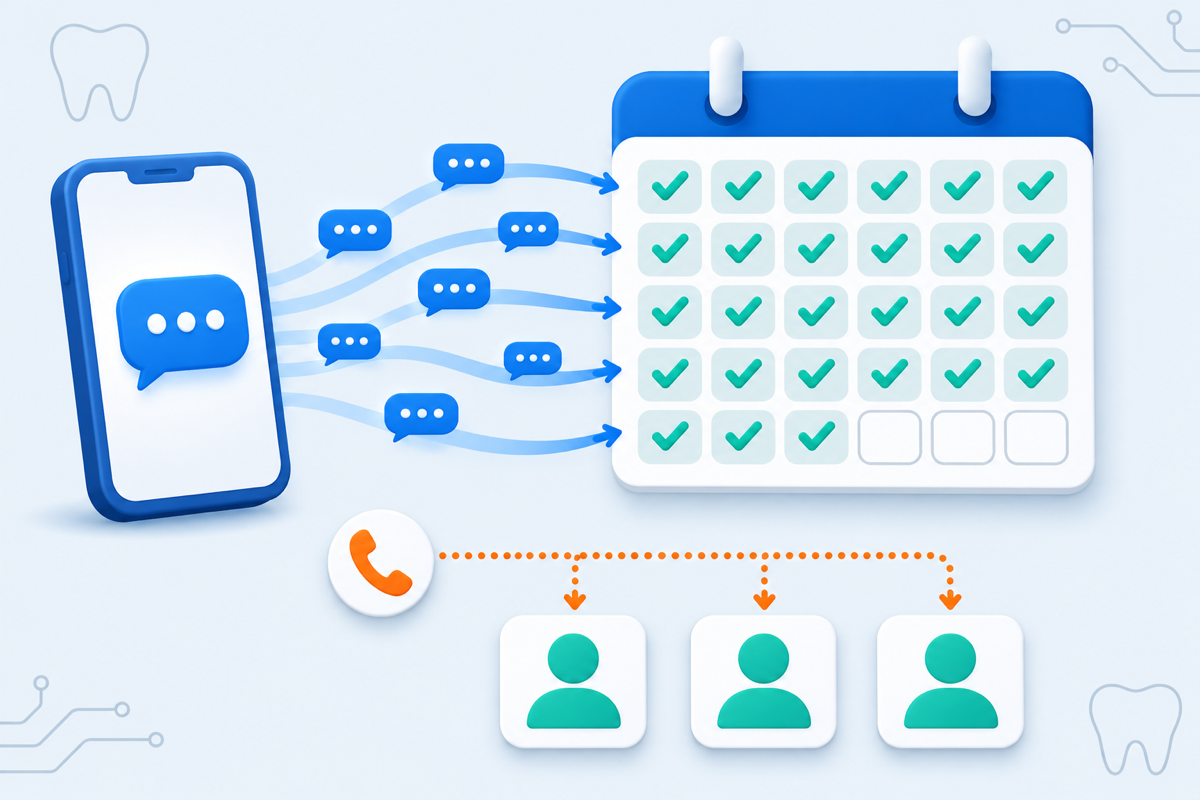
Keep your appointment reminders. They help booked patients show up. This step is about automatic reminders for treatment that isn’t booked yet.
Patients who got more of these reminders did go ahead more often. But most of them already had a visit booked. Once we took visits into account, the reminders made almost no difference.
So who should you call? Patients who:
- have no visit booked,
- were in recently,
- have a short treatment plan, and
- had the treatment presented in the last 90 days.
Our prediction tool picked out the top 10% of unbooked patients. With no special calls, 33 out of 100 of them went ahead anyway. For all unbooked patients, it was 9 out of 100.
We can’t prove that a call makes them more likely to go ahead. But these are the patients worth your time first.
What to do. Stop adding more automatic treatment reminders. Call the patients above instead. The goal of each call is a booked visit. Leave a few similar patients uncalled, so you can see whether the calls help.
Check it in your own practice
Your own records can tell you if these patterns fit your practice. Try these three simple reports:
- Booked or not. Take treatments presented three to four months ago. Split them into two groups: patients who left with a visit booked, and patients who didn’t. Count how many in each group got done.
- Long plans or short. Group last year’s treatment plans by size: up to 8 treatments, 9 to 15, and 16 or more. See how much of each group got done.
- Dentist by dentist. For crowns, fillings, and scaling and root planing, compare how often each dentist’s patients went ahead.
Your Monday-morning checklist
- Call every patient whose treatment was presented in the last 30 days and isn’t booked.
- End every treatment talk by booking the next visit.
- Keep patients on their recare schedule.
- Mention open treatment at every visit, briefly.
- Talk about one or two treatments, not twenty.
- Offer payment plans as the normal way to pay.
- Put October and January insurance calls on the calendar.
- Compare your dentists on the same procedures.
- Swap extra reminder texts for personal calls to the right patients.
Frequently asked questions
What is a good dental case acceptance rate?
It depends how you count. Most numbers you hear count treatment the patient agreed to. We counted something harder: treatment that was still waiting and then actually got done within six months. By that count, about 10 out of 100 got done. For treatment presented in the last month, it was about 21 out of 100. Compare your own rate one procedure at a time.
Why do patients decline dental treatment?
In our data, price wasn’t the reason. Treatment went undone most often when the patient left without a visit booked, stopped coming in, or got a long list of small treatments. Root canals and extractions also went undone more often. And the same procedure got done far more often with some dentists than with others.
How many treatments should a dentist present at one visit?
Find and write down everything, and tell the patient about all of it. But spend most of the talk on the one or two most important treatments. If the patient wants to decide on more, stop at about eight. On plans with more than 20 treatments, each treatment was about half as likely to get done.
Does the fee affect case acceptance?
Not on its own. For the same procedure, treatment priced above the practice’s normal fee got done 11 out of 100 times. Treatment priced below it also got done 11 out of 100 times. Patients turned down cheap crowns as often as expensive ones.
Does this data apply to my practice?
The data covers 41 practices in 15 states, on nine software systems, with all kinds of insurance. It takes each practice’s and each dentist’s normal results into account. The best check is to run three simple reports on your own data: booked versus not booked, long plans versus short, and dentist by dentist.
How should we follow up on unscheduled treatment?
Book before the patient leaves. If they don’t book, call within 30 days. At 90 days, present it again or check if it’s still needed. Call first the patients who were in recently, have a short plan and have no visit booked.
Do appointment reminders increase treatment acceptance?
Appointment reminders help booked patients show up, so keep them. Automatic reminders about unbooked treatment made almost no difference once we took visits into account. What counts is getting the patient back in the chair.
Can AI help reactivate lapsed treatment plans?
It can tell you who to call first. Our prediction tool’s top 10% of unbooked patients went ahead 33 out of 100 times, compared with 9 for all unbooked patients. It can’t tell you whether a call changes that, so leave a few patients uncalled and compare.
How we did it
Viva connects to the practice software that dental offices already use. We used the records of 44 practices on nine software systems, without changing anything.
Every three months, from May 2025 to May 2026, we copied each practice’s records. Each time, we listed the treatments that were presented but not done yet. Then we checked which ones got done in the next six months. We left out times when a practice’s records had gaps. That left 168,382 treatments, on 61,697 treatment plans, at 41 practices in 15 states.
For each treatment, we noted 110 facts. These included the procedure, the fee, the patient’s visits, payments and insurance, the dentist’s track record, and reminders.
The percentages in this article describe all 168,382 treatments. Two numbers come from a stricter test: the 80 out of 100, and the 33 out of 100 for the call list. For those, we tested the prediction tool on later months it had never seen. The tool is a type called gradient-boosted trees.
There are three limits. Some software overwrites a treatment plan once it’s done. So a few finished treatments may be missed. Where we could check, the numbers were close. Work sent to a specialist looks like “not done.” And the December and January pattern comes from one year only.
Patients were known only by a number. No names, contact details or clinical notes were used. No practice is named. The full white paper is available on request.
Viva scores every open treatment plan each night and makes a call list of the patients most likely to go ahead. It leaves out patients who are already booked. To see your own treatment plans scored this way, book a demo, or call or text our AI at (866) 944-8482.