
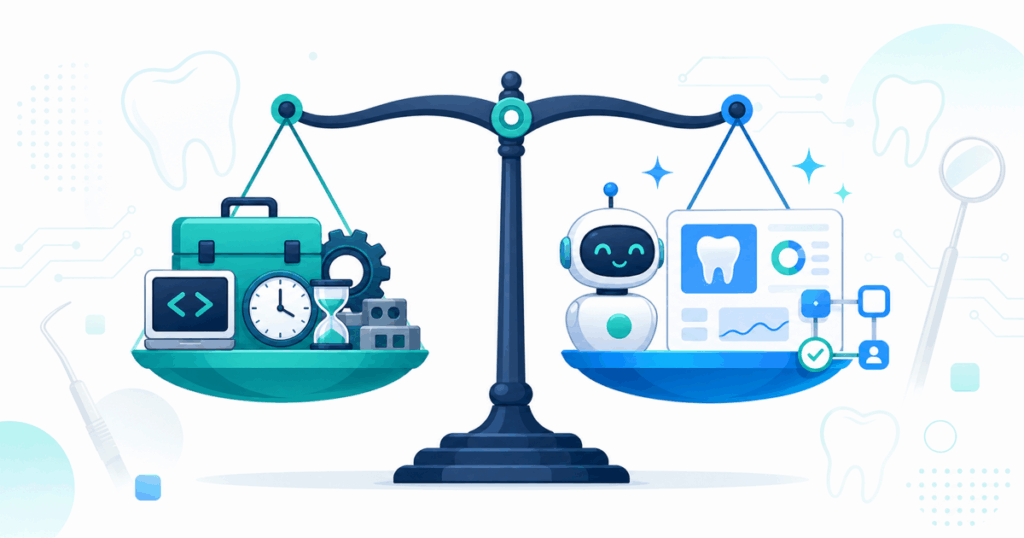
Every dental marketing agency above a certain size eventually asks the question: should we build our own AI lead-response system, or buy a platform? The pitch for building is obvious — keep the margin, own the IP, customize for your specific clients. The pitch for buying is the standard “focus on what you’re good at” argument. The right answer depends on agency size, technical capacity, and how much you actually want to be in the AI software business.
Here’s an honest 2026 analysis of what each path costs and what it actually delivers.
What you’re really building
If you go in-house, you’re not building one thing. You’re building a stack of seven:
- Voice AI infrastructure. Real-time speech recognition, response generation, text-to-speech, sub-second latency. Built on OpenAI Realtime, Anthropic, Vapi, or a stack of pieces.
- Telephony integration. Twilio (or competitor) for outbound calls and SMS, A2P 10DLC registration, carrier compliance, voicemail detection.
- Conversation orchestration. Multi-turn dialogue state, tool calling, error recovery, fallback to human.
- PMS integration per dental software. Dentrix, Eaglesoft, Open Dental, Dentrix Ascend, CareStack — each with its own API or scraping pattern.
- Lead source integrations. Meta lead-gen webhook, Google Lead Forms, Instagram, web form connectors, plus normalization across them.
- CRM webhook delivery. JSON event firing on every stage change, with retries, signing, and per-client config.
- Compliance. HIPAA, SOC 2, BAAs with every dental client, audit logs, encryption at rest and in transit.
You’re building all seven. Skipping any one of them makes the system either non-viable or non-sellable.
What it actually costs to build
A realistic minimum for a working v1 that handles inbound calls + outbound Facebook lead follow-up + one PMS integration:
- 2-3 senior engineers, 6-9 months ($300k-$500k in fully-loaded comp).
- Infrastructure costs during development — Anthropic/OpenAI tokens, Twilio testing, AWS — easily $5k-$10k/month.
- Compliance work — SOC 2 Type II audit alone runs $30k-$80k plus 6-9 months of remediation work. HIPAA training, BAA infrastructure, ongoing audit costs.
- Ongoing maintenance — 1-2 engineers continuously, plus on-call rotation, plus the speech-AI tooling evolves quarterly.
Total year-one cost: $500k-$900k for a one-PMS, single-language v1 that’s almost-as-good as the platforms that already exist.
Year-two cost: $300k-$500k just to keep up with the foundational model providers’ weekly changes, plus the additional PMS integrations your clients will demand.
What it costs to buy
Dental-specific AI receptionist platforms are priced considerably below traditional human dental call centers for the same hours of coverage — and dramatically below the loaded cost of an in-house front-office hire. Most agencies bundle the platform into their monthly retainer with markup, so the net cost to the agency is closer to zero, often profitable.
The platform handles the hard parts: real-time PMS integration with Dentrix, Open Dental, Eaglesoft, Dentrix Ascend, and CareStack; dental-specific conversation training; multilingual support (100+ languages with auto-detection); HIPAA + SOC 2 compliance; native Meta/Google/Instagram lead-source integration. None of these are commodity capabilities — they take years to build and certify.
Honest tradeoffs
Where build wins
- You’re a 50+ client agency with a true software engineering team.
- Your client portfolio is concentrated on one PMS (typically Dentrix Ascend or CareStack) so you don’t have N integrations to maintain.
- You have a strong product vision the platforms aren’t building toward (e.g., orthodontic-only specialty, or pediatric-only).
- You want to eventually become a software company that competes with the platforms — the dental AI agent IS your product, not a feature of your service.
Where buy wins
- You’re an agency below 30-40 clients. Building doesn’t pencil out.
- You manage clients on 3+ different PMSs. Each integration is months of work.
- Your differentiation is creative and media buying, not software. Doubling down on software dilutes what you’re actually good at.
- You want to ship a working speed-to-lead solution to clients in weeks, not 9 months.
The middle path: platform + light customization
Many agencies who want some of the upside of building without the full cost go a middle route: license a dental-specific AI platform (Viva, etc.) and build a thin layer on top — agency-branded reporting, custom client onboarding flows, integrations with the specific CRM stack the agency uses, custom retention/churn dashboards.
This is usually the right answer for agencies in the 20-100 client range. The platform handles the hard parts (voice AI, PMS integration, compliance, lead-source webhooks). The agency builds the parts that are actually its differentiator — its workflow, its reporting, its client experience.
What we typically see
Among agencies we’ve worked with at Viva:
- Single-founder agencies (under 10 clients): buy a platform, don’t even think about building.
- Small agencies (10-30 clients): buy a platform, possibly white-label.
- Mid-size agencies (30-100 clients): buy a platform, build a custom layer for reporting and onboarding.
- Large agencies (100+ clients) with engineering teams: typically still buy, with deeper customization. A few have built their own; most of those eventually migrated back to a platform after burning out the engineering team.
- DSO-tier agencies (managing campaigns for 200+ dental practices in a DSO portfolio): always buy. The compliance + scale risk of in-house is too high.
The bottom line
Building your own AI lead-response system in 2026 is technically possible. It’s almost never economically sensible for a dental marketing agency under 50 clients, and even at larger sizes the math is dominated by the compliance and PMS-integration costs that nobody factors in at the start of the project.
The agencies that win in 2026 aren’t the ones with the best in-house AI. They’re the ones who deploy the best AI quickly, layer their own brand and workflow on top, and stay focused on the creative + media buying work that actually differentiates them. The AI is infrastructure. Buy infrastructure, build differentiation.
For agencies evaluating Viva as the platform layer, see our agency landing page or the integrations list.