
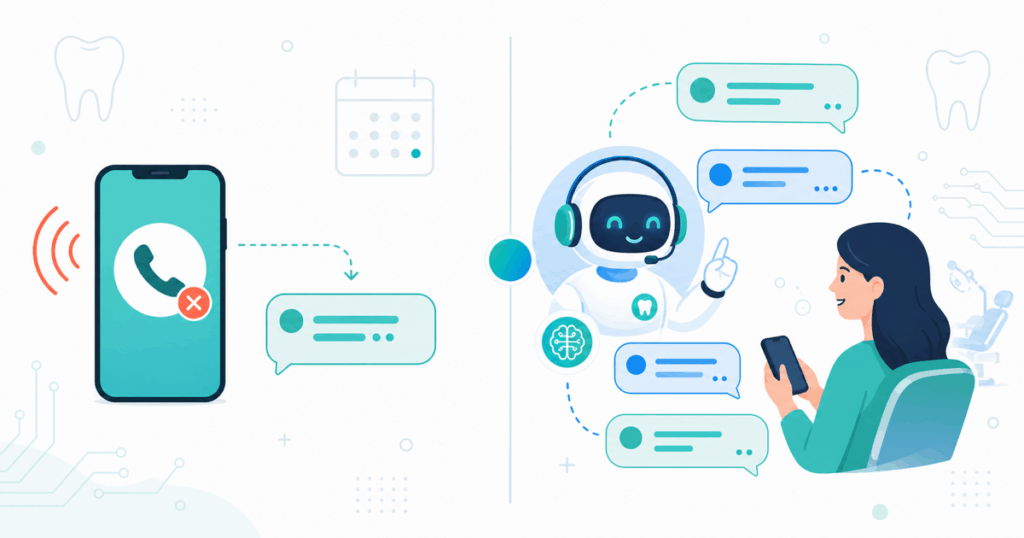
If you’ve shopped for dental marketing tools recently, you’ve seen Missed Call Text Back (sometimes “MCTB” or “call-back text”) pitched as a must-have feature. GoHighLevel, Podium, Birdeye, NexHealth, and a dozen other SMB platforms all advertise it. The idea is simple: when someone calls your practice and you don’t pick up, the system fires off an automated SMS that says “Sorry we missed you — can we help?”
It’s a useful feature. It is also, for most dental practices, a fraction of what you actually need. Here’s the honest comparison.
What missed call text back actually does
Missed call text back is a single automation: when an inbound call goes unanswered (busy, no answer, after hours), the platform sends an SMS to the caller’s number. The SMS template is fixed — usually some variant of “Hi, this is [Practice]. Sorry we missed your call. How can we help?”
Patients reply by text. A staff member at the practice picks up the reply in a unified inbox (or the platform’s mobile app) and continues the conversation manually. If the patient is ready to book, the staff member books them. If they’re not, the conversation peters out.
What it solves
- Captures inbound calls that would otherwise be 100 percent lost.
- Provides a low-friction return-to-conversation channel for patients who don’t want to call back.
- Cheap and easy to set up.
What it doesn’t solve
- The patient still has to wait for a human to reply to their text. The wait is often longer than just calling the office back.
- The system has no idea what the caller wanted. The SMS is generic.
- It only handles inbound phone calls — not Facebook leads, Google Lead Forms, web form submissions, or Instagram lead ads.
- It does not place outbound calls. If the lead came in through Facebook, missed call text back never fires.
- The text conversation goes to a staff inbox. Same staff who couldn’t pick up the phone are now also expected to respond to SMS. Bottleneck moved, not removed.
What an AI agent does
An AI agent — like Viva — picks up the inbound call in the first place. It greets the caller, asks what they’re calling about, looks up their record in the PMS if they’re an existing patient, and books the appointment in real time. The patient never hits voicemail. There is no missed call to text back.
On the outbound side, an AI agent connected to your lead sources places the first call within minutes of a Facebook or Google lead submission, follows up with SMS if needed, runs the conversation to book, and only escalates to a human staff member when the lead asks for one or the situation is unusual.
Head-to-head, for dental specifically
| Capability | Missed Call Text Back | AI Agent (Viva) |
|---|---|---|
| Inbound call answered live | No — only triggers after missed | Yes — answered on first ring |
| SMS follow-up after missed call | Yes — generic template | Yes — personalized to caller intent |
| Outbound first contact to Facebook leads | No | Yes — within 5 minutes |
| Real conversation in the SMS thread | No — handed to human staff | Yes — AI continues the conversation |
| Books appointment directly into PMS | No — human required | Yes — full PMS integration |
| Handles voicemail leads | No | Yes — AI leaves a personalized voicemail |
| 24/7 coverage | SMS yes, conversation no | Full coverage including weekends |
| Multi-language | No | 100+ languages auto-detected |
| HIPAA compliance | Varies by vendor | SOC 2 Type II + HIPAA |
When missed call text back is enough
If you run a single-location practice, you have no paid lead spend, your staff almost always picks up the phone within three rings, and the only gap you’re trying to close is the occasional missed call after hours — missed call text back is fine. It’s cheap, it’s easy, and it’ll catch some patients you would otherwise lose.
When you need an AI agent instead
If any of the following apply, missed call text back is leaving most of your opportunity on the table:
- You spend more than $1,000/month on Facebook or Google lead ads.
- Your front desk is regularly buried during business hours.
- You miss more than 15 percent of inbound calls.
- You’re a DSO or multi-location practice and want consistent lead response across all locations.
- You serve a multilingual community.
- You’re an agency selling lead-gen services and your clients keep churning when leads don’t convert.
For these situations, the AI agent is doing four jobs missed call text back doesn’t even attempt: answering inbound live, calling Facebook leads outbound, running the entire booking conversation without human handoff, and feeding booking events back into Meta’s ad algorithm to make your ad spend more efficient over time.
The honest cost comparison
Missed call text back is a small add-on inside a broader SMB marketing platform. It’s cheap because it’s narrow — one templated SMS, sent after a missed call, handed to your staff.
A dental-specific AI agent like Viva is doing materially more work — handling the inbound call live, calling Facebook leads outbound, qualifying in 100+ languages, and writing the booking into your PMS. The cost is considerably lower than a traditional human call center for the same hours of coverage, and unlike a call center the AI is trained on dental terminology, knows your services, and books directly into Dentrix, Open Dental, Eaglesoft, Dentrix Ascend, CareStack, and the other major dental PMSs in real time.
The bottom line
Missed call text back is a Band-Aid. It catches a small slice of the patients you would otherwise lose to phone tag. An AI agent is the actual front office — answering calls live, calling Facebook leads back, holding real conversations, booking appointments. If your goal is the broader “convert more leads into patients,” the AI agent is the right tool. If you just want to add a safety net for missed after-hours calls and you’re not running paid ads, missed call text back will do the job for less.
See Viva’s full AI lead response capability or the inbound-call side of the product.