
If you run a dental practice and you’ve ever wondered why your Facebook ads or Google Lead Forms aren’t producing the bookings the agency promised, the answer is almost never the creative. It’s almost always speed to lead — the elapsed time between a prospective patient submitting their info and someone (or something) on your end reaching out.
This article walks through what speed to lead actually means, why it matters more in dentistry than in most industries, what the data says about the financial cost of slow follow-up, and how AI tools have moved the realistic target from “call back the same business day” to “contact the lead in under five minutes, every time.”
What is speed to lead?
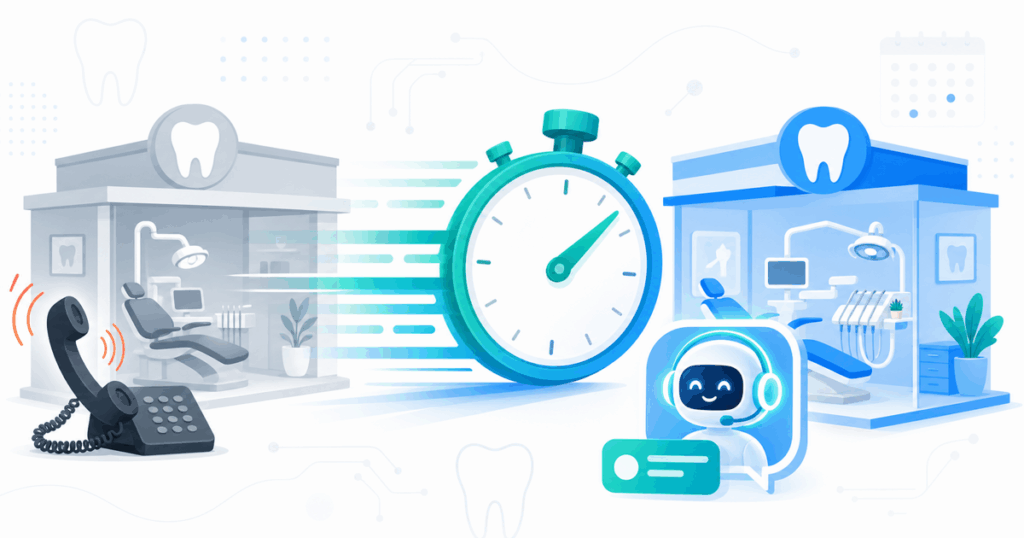
Speed to lead is the time it takes for a business to make first contact with a new inquiry after the inquiry is created. The clock starts the moment a prospective patient hits Submit on a Facebook lead ad form, fills out a request on your website, or hangs up after leaving a voicemail. The clock stops when someone — a front desk staffer, a call center agent, or an AI receptionist — actually reaches them.
Two things matter here: the median response time across all leads, and the percentage of leads that are never contacted at all. Most dental practices score poorly on both.
The data on lead response time
The most-cited research on speed to lead — Harvard Business Review’s audit of 2,241 US companies — found that the average first response time was 42 hours, and only 37 percent of leads received a response within an hour. A separate MIT InsideSales study established the well-known multiplier: leads contacted within five minutes were nine times more likely to convert than leads contacted within an hour, and the odds of qualifying a lead drop by 80 percent if the first contact happens more than 30 minutes after submission.
For dental specifically, the numbers are worse for two reasons. First, dental front desks are typically a single staffer juggling check-in, check-out, insurance verification, recall calls, and inbound questions — none of which yield to a Facebook lead notification. Second, a large share of dental ad clicks happen evenings and weekends, when the office is closed and there is nobody to call back the lead at all.
Why slow response is so expensive in dentistry
Compare a dental practice to a SaaS company. The SaaS lead probably evaluated three or four vendors, read reviews, and signed up for trials at several. They expect a sales follow-up. A few hours of delay is mildly annoying but not fatal.
A dental lead is different. They saw a Facebook ad for teeth whitening or dental implants, tapped the form because it auto-filled from their profile, and within two minutes were back to scrolling Instagram. They were not researching. They were curious for ninety seconds. If you call them ninety minutes later they don’t remember filling out the form. If you call the next day they’ve already booked with the next office that called them. If you don’t call at all, you paid Meta for nothing.
Most dental marketing agencies privately estimate that 50 to 70 percent of paid lead spend is wasted on leads that are never converted because the practice did not respond fast enough. That number is lower for practices with dedicated front-office staff and dramatically lower for practices that have automated follow-up.
What an under-5-minute response actually requires
Hitting the 5-minute window every time, 24/7, is harder than it sounds. The breakdown:
- The lead has to be ingested in real time. CSV exports and Zapier hops add minutes or hours.
- Someone or something has to be available to call. Front desk staff cannot drop a check-in to dial a Facebook lead, and they don’t work evenings or weekends.
- The first attempt has to be substantive — a real conversation, not a voicemail. Voicemails kill conversion almost as effectively as not calling at all.
- If the lead doesn’t pick up, the second attempt has to follow within the same window. A single missed call is rarely returned.
For most independent practices, hitting this consistently with human staff alone is not financially realistic. You would need to staff a dedicated lead-response role across all hours your ads are running.
How AI changes the math
AI receptionists were the missing piece. An AI agent that is connected directly to your lead sources, available 24/7, and capable of holding a real conversation can answer the inbound call AND make the outbound first-attempt within minutes — every time, without exception.
The mechanics, when done right:
- Native integration with the lead source. A direct connection to Meta’s leadgen webhook, Google Lead Forms, or your landing page’s POST endpoint means the AI has the lead in its queue within seconds of the form submission.
- Outbound call within minutes. The AI dials the lead’s phone within a configurable delay (we recommend two to five minutes to feel responsive without feeling creepy).
- A real conversation, not a recording. If the lead picks up, the AI greets them by name, references the campaign they responded to, answers questions, and offers to book the appointment.
- SMS backup. If the call doesn’t connect, a personalized SMS goes out within minutes — referencing the practice and the specific service the lead asked about.
- Multi-attempt drip. Five total contact attempts, spaced intelligently over the next 24 to 72 hours, until the lead either books, replies, or explicitly opts out.
The effect on conversion
Dental practices that switch from manual front-desk follow-up to AI lead response see their booked-appointment rate from paid leads roughly double — sometimes more. A practice converting 8 percent of Facebook leads to appointments often moves to 16 to 22 percent in the first month. That’s the same ad spend producing twice the patients.
The bottom line
Speed to lead is no longer a soft KPI for dental practices spending real money on Meta or Google ads. It is the single biggest determinant of whether the ad spend is profitable. Hitting under-five-minute response without an AI agent is operationally impossible for most independent practices and most DSOs. Hitting it with the right AI tools is now table stakes.
If you’re running paid lead campaigns and you’re not measuring your average response time, that’s the first metric to instrument. Pull last month’s leads, look at the timestamps, and check how many got contacted within five minutes. The number will be lower than you expect. Fixing it is the highest-ROI improvement most dental practices can make this year.
For a deeper look at how Viva’s AI lead response works under the hood, see the product page. If you’re a marketing agency running ads for dental clients, our agency landing page explains the partner-wide setup.