
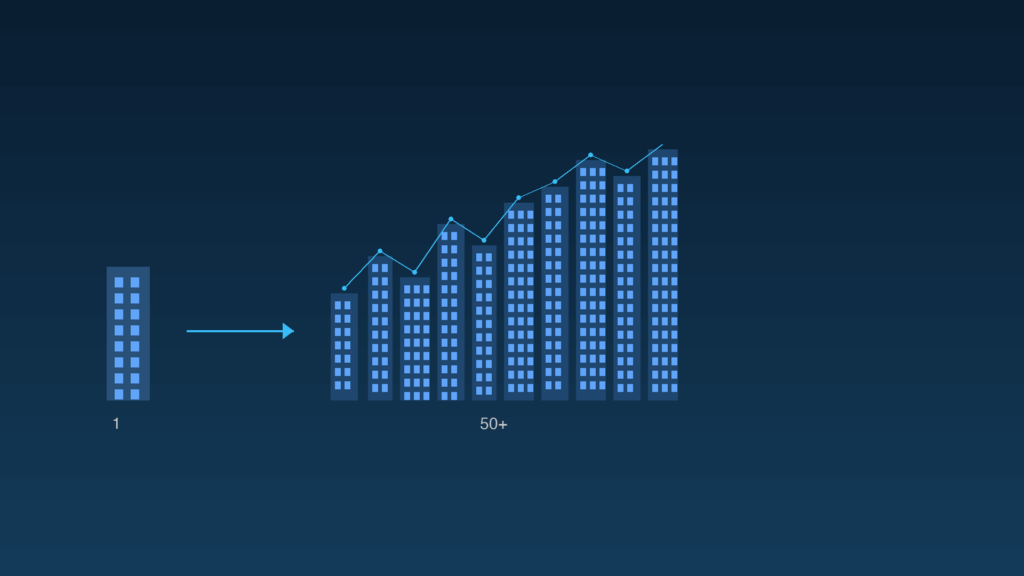
It’s the right question. We’ve seen DSO operators get burned by solutions that worked beautifully at 2 locations and fell apart at 8. Suddenly your vendor can’t handle the complexity. Support becomes unresponsive. Your onboarding timeline stretches from weeks to months. Integration breaks. And you’re stuck managing more configuration than you started with.
We designed Viva specifically to answer that question: yes, it works at 50 locations. Better than at 1. Here’s how.
The DSO Scaling Problem Nobody Talks About
Most DSO executives understand the financial math of acquisition. You buy a practice at X multiple, improve operations, reduce overhead, increase revenue, and sell the whole network at a higher multiple. That’s the strategy.
What often trips up executives is the operational layer. Each practice you acquire has its own:
— Practice management system configuration (sometimes different PMS providers entirely)
— Front desk workflow and staff skill levels
— Scheduling philosophy (some practices do first-available, others block by provider)
— Patient communication preferences
— Hours and coverage (some open weekends, some don’t)
— Insurance verification processes
— New patient intake procedures
Most “one-size-fits-all” vendors force you to override those local differences. Implement a centralized system. Strip away what makes each practice unique. Then wonder why booking conversion dropped 8% after you deployed across the network.
Viva takes a different approach: inherit-with-flexibility. When you add a new location, the AI inherits configuration from your existing locations. But each location can customize locally. Same underlying AI. Different expressions.
How New Location Onboarding Actually Works
Let’s walk through a realistic timeline. You’ve acquired a new practice. Here’s how fast Viva gets you live:
Day 1: Intake Meeting (1 hour)
We connect with the new practice manager and office manager. We understand their current workflow, PMS setup, hours, insurance requirements, and scheduling philosophy. We pull their phone system configuration. We take notes on anything unique about their patient base.
Days 2-3: Configuration (6-8 hours)
Our team sets up the new location in Viva using your existing locations as a template. We inherit your greeting style, your call routing, your scheduling logic. Then we make local adjustments: different hours, different insurance rules, specific provider instructions. We test integration with their PMS. We create user accounts for their staff. We make sure their phone system integrates cleanly.
Days 4-5: Training & Dry Run (4-6 hours)
The practice team learns the system. We simulate calls. We show the manager exactly what patients will experience. We catch edge cases: “What if someone calls about a crown and we don’t have the patient in the system?” We document the answers in their playbook. We run real test calls to make sure everything flows.
Day 6-7: Go-Live (1 hour)
We activate the AI during their regular business hours. We monitor the first 50 calls. We’re on standby if anything breaks. By day 7, they’re handling live patient calls through Viva.
That’s roughly 15-20 hours of implementation per location. For a growing DSO adding 2 locations per month, that’s sustainable. You’re not hiring new implementation staff. The AI itself does the heavy lifting—it doesn’t need training on scheduling logic the way a human receptionist does.
How the AI Learns Your Scheduling Logic (Without Chaos)
Here’s where most DSOs get nervous. “If I configure the AI differently at each location, won’t it get confused?”
The answer is no—because Viva’s AI is fundamentally location-aware. It’s not a single AI making all decisions. It’s a platform where each location has its own AI instance, but all instances share the same underlying training.
Think of it like franchising. A Starbucks in New York and a Starbucks in Austin operate under the same brand, same core standards, same quality bar. But the New York store might have different pastries. The Austin store might have different seasonal drinks. Both work. Both are Starbucks.
When you set up Location 2, Viva learns:
— Location 1 does first-available scheduling. Location 2 does Dr. Smith → 8am-12pm, Dr. Johnson → 1pm-5pm. The AI at Location 2 respects that instantly.
— Location 1 books cleanings 6 months out. Location 2 books cleanings 3 months out. Different availability windows, different booking logic. The AI knows the difference per location.
— Location 1 requires insurance verification for cosmetic cases. Location 2 doesn’t. The AI asks different questions based on location.
— Location 1 opens at 7am. Location 2 opens at 8am. Location 1’s AI answers calls at 6:58am with “good morning.” Location 2’s AI will start taking calls at 7:58am and says “good morning” appropriately. And if Location 2 serves a different language demographic, the AI automatically detects and responds in that language.
The AI doesn’t get confused because the configuration is location-specific, not global. Each location’s AI knows its own rules, its own hours, its own provider preferences.
The Multiplier Effect of Configuration Inheritance
Here’s the real operational win: you’re not starting from zero at each location.
Let’s say you’re at 15 locations and you want to implement a new standard: all locations should now ask about crown sensitivity during crown booking calls. Instead of manually reconfiguring 15 different systems, you update the template. All 15 locations inherit the change within 24 hours. Local overrides are preserved (Location 3 still doesn’t ask about sensitivity for single crowns, because they have a specific clinical reason). You’ve made a network-wide change that took 30 minutes instead of 15 hours.
That’s not just efficiency. That’s what makes 50-location DSOs actually manageable.
What Breaks Down at Scale (And How Viva Avoids It)
We’ve studied how other AI vendors fail at DSO scale. The pattern is consistent:
Problem #1: Support Becomes Unresponsive
A vendor supports 20 DSOs. Each DSO has an average of 3 locations. 60 locations, manageable. Then they sign a 30-location DSO. Suddenly they’re supporting 90 locations but their support team hasn’t grown. Response times go from 4 hours to 48 hours. Onboarding stretches. Bugs don’t get fixed. The DSO is stuck.
Viva’s model: we’ve built our support infrastructure to scale horizontally. We use tiered support (Tier 1 handles standard troubleshooting; Tier 2 handles integration issues; Tier 3 handles AI customization). We’ve also built extensive self-service documentation and training. Your team doesn’t need to call us every time a new location goes live—they should be able to handle 80% of onboarding themselves using our playbooks.
Problem #2: Integration Complexity Explodes
You’ve got 10 Dentrix locations, 3 Eaglesoft locations, 2 Dolphin locations. Each PMS needs a different integration approach. One vendor supports Dentrix tightly but Eaglesoft loosely. Suddenly the three Eaglesoft practices have all the problems, and the vendor says “we don’t fully support that system.”
Viva integrates with every major PMS equally well. We maintain integrations with Dentrix, Eaglesoft, Dolphin, Carestream Dental, Open Dental, and others. We test across all of them continuously. Your 50-location network might use 5 different PMSs, but we handle them all without degradation.
Problem #3: Configuration Drift
You configure Location 1 perfectly. Location 2 launches and goes well. Location 3 launches and someone changes a setting they shouldn’t have. Location 4 was configured 6 months ago and you’ve made improvements since then—they’re still running old config. By Location 15, you’ve got 15 different versions of your AI running, none of them optimal, all of them slightly different in ways nobody can remember.
Viva solves this with version control and templates. Your current best configuration is your template. New locations inherit from it. If you make updates to the template, you can push them to all locations at once or selectively. You always know what version each location is running. You can roll back a bad change network-wide in minutes.
The Growth Math That Matters
Let’s talk about what this means for your DSO economics. And remember, an AI operating system approach scales these economics non-linearly.
Assume you’re a 15-location DSO. Each location averages 350 inbound calls per month. That’s 5,250 calls across your network. Your human receptionists are converting 58% to booked appointments. That’s 3,045 booked appointments per month.
You deploy Viva AI at all 15 locations. The AI converts 76% to booked appointments (an 18-point improvement we commonly see). Now you’re at 3,990 booked appointments. That’s 945 additional bookings per month. At $425 average case value, that’s $401,625 in incremental monthly revenue. Annualized: $4.8M.
But here’s what scales even better: efficiency. Your 15 locations previously needed 22 full-time receptionists (at ~1.5 receptionists per location, split across shifts). With Viva handling inbound calls, you need 8 receptionists doing higher-value work (verifications, follow-ups, patient relationship building). That’s 14 FTE salaries you freed up. At $38,000 per FTE + benefits, that’s another $700,000 in annual savings.
Revenue and costs improve together. That’s what makes Viva scale with you.
What About 50 Locations?
We’ve designed Viva to handle networks of 50+ locations with the same operational simplicity as 5 locations. The onboarding process doesn’t get harder. The support model doesn’t degrade. The configuration complexity doesn’t explode.
What does improve: your network’s ability to compete. A 50-location DSO with Viva AI has unified patient experience, centralized AI performance monitoring, shared knowledge about what works, and the ability to implement changes at scale in hours instead of months.
A 50-location DSO without it is managing 50 independent technology stacks, 50 vendor relationships, 50 configuration nightmares, and 50 times the support burden.
One Last Thing We’ll Be Honest About
Scaling is never perfectly smooth. You will have locations with weird PMS customizations. You will have one location’s phone system that doesn’t integrate cleanly. You will discover edge cases—a practice that specializes in pediatric dentistry and has call patterns unlike any other location.
Here’s what we promise: we’ll solve those with you. We don’t say “that’s not in scope” or “we only support standard configurations.” We solve them because your success at scale is our success at scale.
Ready to Build for Growth?
If you’re thinking about acquiring your next practice, or scaling from 3 locations to 10, Viva scales with you. We’ve built the infrastructure to handle growth with zero operational friction. Add a location in a week. Integrate a new PMS without complexity. Make network-wide improvements in hours through centralized management. That’s how you win at scale. For a comprehensive framework on evaluating scalable systems, see our buyer’s guide.
Start with 1 location. Scale to 50 without the headache.