

Best AI Dental Receptionist 2026: Viva AI vs Arini vs Dentina vs TrueLark vs Peerlogic
If you’re a dental office owner or DSO operator evaluating AI receptionist software, the shortlist almost always lands on the same names: Viva AI, Arini, Dentina, TrueLark, and Peerlogic. They all promise to automate front-desk work — but they’re at very different points on the build curve, target different practice sizes, and ship different feature sets in production today (vs. “coming soon”). This guide compares the five on what’s actually shipped as of 2026.
One up-front note that changes the landscape: TrueLark was acquired by Weave in May 2025 and the product is now sold as the Weave AI Receptionist. Buyers evaluating TrueLark in 2026 are buying into Weave’s roadmap, not the standalone TrueLark of 2024.
Quick Answer: Which AI Dental Receptionist Should You Pick?
- You’re a single-location practice that mostly wants to stop missing voice calls: Arini or Dentina are simpler, voice-first options.
- You already use Weave for phones/texts and want one vendor: Weave AI Receptionist (TrueLark) is the natural fit, with the caveat that multilingual support, payments, and outbound recall are still “coming soon.”
- You already have receptionists and want analytics + coaching on top of the calls they handle: Peerlogic’s call-analytics product is the most mature in that niche, and their Aimee AI receptionist is an option if you want both in one platform.
- You want to replace the full front-office stack — voice, text, email, web chat, payments, forms, recall, multilingual — and run it consistently across 1 or 50 locations: Viva AI is the platform built for that scope.
What Viva AI Does
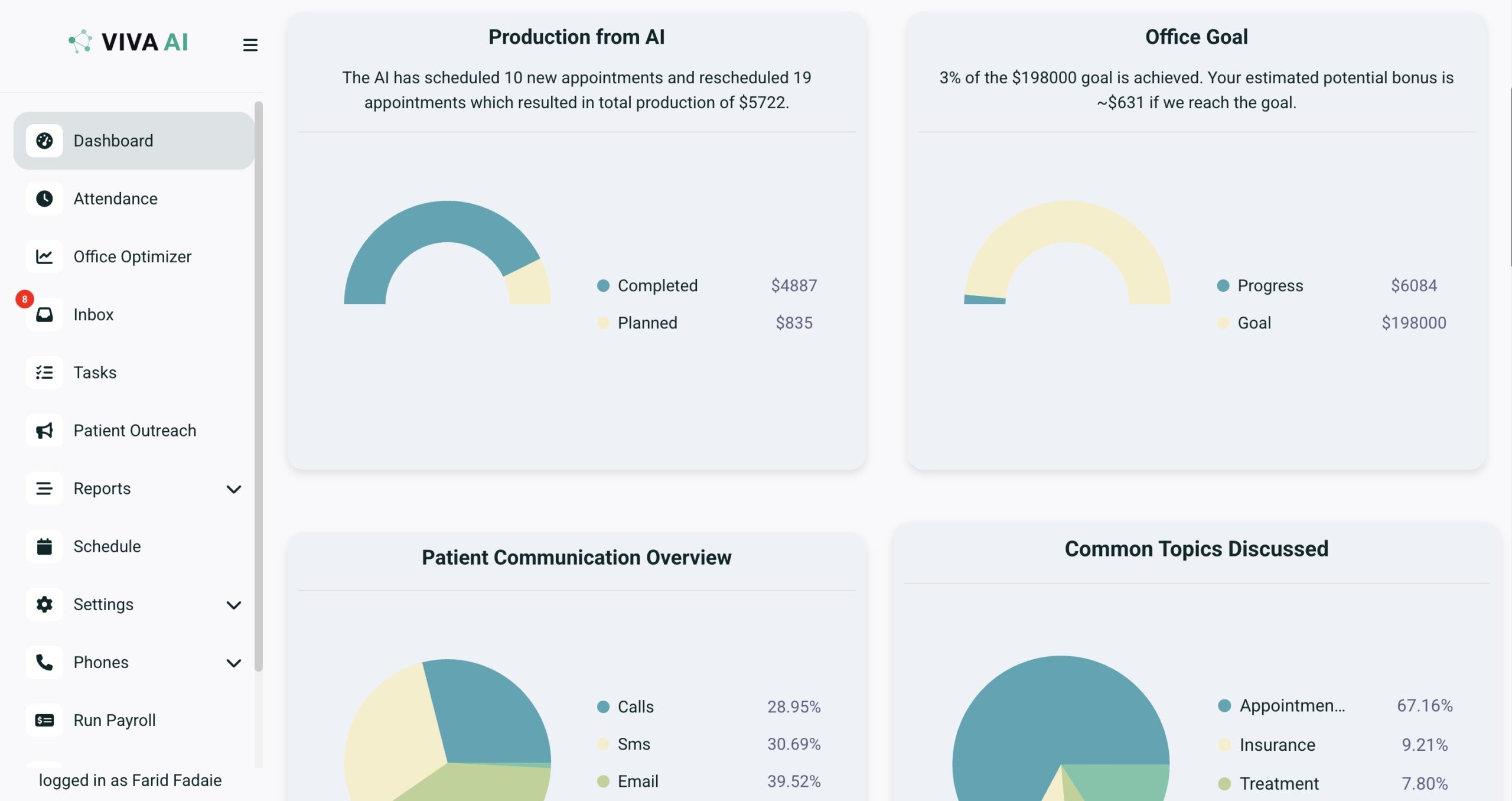
Viva AI is an end-to-end front-office platform for dental practices and DSOs. It handles inbound and outbound communication across voice, text, email, and web chat from a single conversational model, writes back into the PMS in real time, and ships with the office layer (payments, forms, recall, analytics) included rather than sold as separate modules.
- Channels: voice, SMS, email, web chat — all 24/7
- Languages: 100+ with automatic language detection, no per-language configuration
- PMS write-back: Dentrix Ascend, CareStack, Cloud9, and others — appointments and notes write directly back, not via scraping
- Outbound: recall campaigns, reactivation, confirmations, broadcast — shipped, not “coming soon”
- Office stack included: payment collection, digital forms, patient portal, optimization analytics
- Compliance: SOC 2 Type II certified + HIPAA compliant
- DSO architecture: single platform, multi-location dashboard, per-location and rolled-up analytics
Viva AI vs Arini
Arini is a voice-and-SMS AI receptionist focused on appointment booking. It supports 24/7 call handling, scheduling, and basic SMS, and integrates with Open Dental, EagleSoft, Denticon, and a number of phone systems (Weave, Mango, GoTo, Jive, others). Arini publicly claims HIPAA compliance; it doesn’t publicly list SOC 2 Type II. Multilingual coverage is referenced in third-party reviews (English, Spanish, sometimes Portuguese) but isn’t a headline feature on their site as of writing.
Where Viva pulls ahead: native multi-channel beyond voice + SMS (email, web chat included), 100+ languages auto-detected on a single number, outbound recall campaigns as a core feature, payments and digital forms built in, and SOC 2 Type II compliance on top of HIPAA. For a single-location office that just wants the phone covered, Arini is a clean fit. For a practice that wants the whole front desk replaced, Arini’s scope stops short.
Viva AI vs Dentina
Dentina.AI is positioned as an AI dental receptionist with PMS integration, voice + text handling, unlimited concurrent calls, and dental-specific clinical awareness (so it can triage based on dental concern). HIPAA-compliant per their materials. Public-facing product detail beyond that is sparse, and channel coverage outside voice/text is not advertised as shipped.
Where Viva pulls ahead: email + web chat as native channels, broader PMS write-back (Dentrix Ascend, CareStack, Cloud9 in addition to common practice systems), 100+ languages out of the box, an explicit DSO multi-location dashboard, payments and forms inside the same platform, and SOC 2 Type II compliance. Practices choosing between the two should ask: do you need just call answering with dental triage, or the whole front-office stack?
Viva AI vs TrueLark (Weave AI Receptionist)
TrueLark was acquired by Weave in May 2025 and is now positioned as the Weave AI Receptionist. The current product handles voice, text, and web chat, with PMS integrations to Dentrix, Eaglesoft, and Open Dental (plus a generic Weave calendar integration for other systems). Weave describes itself as “designed to meet” HIPAA standards; SOC 2 isn’t called out on the receptionist page as of writing.
Important roadmap caveat: as of 2026, Weave’s published page marks multilingual support, outbound treatment follow-up, and payment collection as “coming soon.” Practices buying in today get the inbound voice/text/web flow but not the outbound recall, multilingual, or payment layers that Viva ships in production today.
If you’re already a Weave customer for phones, the in-house AI receptionist is a low-friction add-on. If you’re buying based on what’s available in 2026 rather than what’s promised in the roadmap, the gap with Viva is wider than the marketing suggests. Deeper architectural and DSO-cost comparison: Viva AI vs TrueLark for DSOs.
Viva AI vs Peerlogic
Peerlogic is a different shape of company. Their original product is voice-based conversational analytics for dental practices — scoring calls, surfacing missed opportunities, and reporting on team performance. In 2026, they also offer Aimee, an AI receptionist that answers calls, texts back missed calls, and schedules. So Peerlogic now occupies both lanes: AI receptionist + call analytics, sold as one platform.
Where Viva differs: Viva’s analytics layer is built on top of an AI that’s actually answering the calls, with full multi-channel (email, web chat, plus voice and text), explicit 100+ language coverage, native outbound recall campaigns, in-platform payments and forms, and SOC 2 Type II compliance called out on the product. Peerlogic is the stronger pick if your front-desk team is staying in place and you primarily want post-call analytics; Viva is the stronger pick if you want the AI to be the front desk. Full breakdown: Viva AI vs Peerlogic for DSOs.
Feature Comparison: Viva AI vs Arini vs Dentina vs TrueLark vs Peerlogic
| Feature | Viva AI | Arini | Dentina | TrueLark / Weave | Peerlogic |
|---|---|---|---|---|---|
| Inbound voice (24/7) | ✅ | ✅ | ✅ | ✅ | ✅ (Aimee) |
| SMS / text | ✅ | ✅ | ✅ | ✅ | ✅ |
| Email channel | ✅ | — | — | — | — |
| Web chat | ✅ | — | — | ✅ | Partial |
| Multilingual (auto-detect) | ✅ 100+ | Limited | — | Coming soon | — |
| Outbound recall / reactivation | ✅ | — | — | Coming soon | — |
| In-platform payments | ✅ | — | — | Coming soon | — |
| Digital forms | ✅ | — | — | — | — |
| Call analytics / scoring | ✅ | Basic | Basic | Partial | ✅ specialized |
| PMS write-back (named) | Dentrix Ascend, CareStack, Cloud9, others | Open Dental, EagleSoft, Denticon | Listed integrations | Dentrix, Eaglesoft, Open Dental | Listed integrations |
| HIPAA | ✅ | ✅ | ✅ | “Designed to meet” | Not detailed |
| SOC 2 Type II | ✅ | Not advertised | Not advertised | Not advertised | Not advertised |
| Best fit | Practices & DSOs wanting one platform | Single-location, voice-first | Single-location, dental-aware voice | Existing Weave customers | Practices keeping human reception + adding analytics |
Sources: vendor product pages, public roadmap statements, and third-party reviews as of May 2026. Feature coverage on competitor products evolves quickly — verify the latest “coming soon” items directly with each vendor before signing.
The Real Decision Framework
The marketing pages collapse the choice to “which AI is best?” — but the practical question is closer to “which scope do you actually need filled?” Four honest scenarios:
- Stop missing inbound calls at one location. Any of the five will do this. Pick the cheapest one with your PMS integration. Don’t overbuy.
- Add scheduling + missed-call text-back, on top of your existing phone system. TrueLark/Weave or Peerlogic Aimee, if you’re already in those ecosystems. Otherwise Arini or Dentina.
- Coach a human front desk with call analytics. Peerlogic’s analytics product is the most specialized for this niche. AI receptionist not strictly required.
- Replace the full front-office stack across one or many locations — including outbound recall, multilingual, payments, forms, and PMS write-back, today, not “coming soon.” Viva AI is the only option in this list with that scope shipped end-to-end.
Pricing Context
Across the category, standalone AI receptionist platforms run roughly $200–$800/month for single-location practices, with custom quotes at DSO scale based on call volume and PMS integration complexity. The hidden cost is the “and also” stack — when an AI receptionist doesn’t include outbound recall, payments, forms, or multilingual, those become separate vendors with separate contracts. The platform-vs-point-solution math is covered in our true cost of AI fragmentation piece.
Final Takeaway
The five tools sit on a spectrum from “answer the phone” to “run the office.” Arini and Dentina answer the phone. TrueLark (now Weave AI Receptionist) is a strong omnichannel call-and-text agent with a roadmap that’s catching up. Peerlogic occupies the analytics-plus-receptionist hybrid. Viva AI is built for replacing the front office end-to-end, with multilingual, outbound, payments, forms, and DSO multi-location architecture shipped today.
If you’re trying to stop missed calls at one location, any of these will help. If you’re trying to compound front-office economics across 5 or 50 locations, only one of them is architected for that scope today.
Ready to See Viva AI in Action?
Visit getviva.ai to schedule a live demo and see how Viva AI replaces the front-office stack at one location or fifty.
Editor’s Note: This article reflects product information publicly available on each vendor’s website and in third-party reviews as of May 2026. Competitor features (especially items labeled “coming soon”) evolve quickly. Verify current capabilities directly with each vendor before signing a contract.
Viva answers its own demo line — call or text (866) 944-8482, or book a full platform tour.