
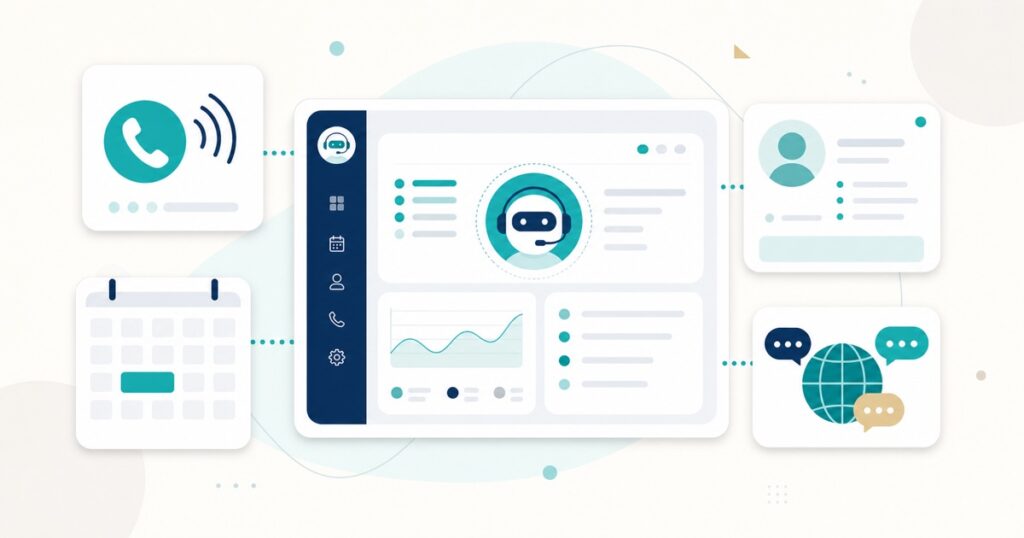
AI receptionist software is a category of business application that uses real-time conversational AI to answer inbound phone calls and messages, hold a back-and-forth dialogue with the caller, take actions on behalf of the business (book an appointment, collect a payment, route a question), and write the outcome back into the company’s system of record. For dental practices in particular, AI receptionist software replaces — or augments — the human front desk with software that handles voice, text, web chat, and outbound campaigns at the same time, around the clock.
This guide is for dental office owners and DSO operators evaluating AI receptionist software in 2026. It covers what the category actually is (vs. older “AI” voicemail products), which features matter for dental, how AI receptionist software integrates with the rest of the practice stack, what platforms lead the category today, and how Viva AI fits into the comparison.
What AI Receptionist Software Is — and What It Isn’t
The phrase “AI receptionist” gets used loosely. The category as it exists in 2026 has a specific shape that’s worth pinning down before you compare vendors.
True AI receptionist software, at minimum:
- Answers every inbound call in under a couple of seconds, 24/7, with a natural-sounding voice — not a phone tree or a voicemail-to-text bridge.
- Holds a real conversation: handles follow-up questions, branching intents, and interruptions in a single call.
- Takes actions in real time inside the practice management system (PMS) — books, reschedules, cancels, updates patient records.
- Handles multiple channels — voice and text at minimum, with the best platforms adding email and web chat.
- Meets healthcare compliance bars — HIPAA at minimum, and increasingly SOC 2 Type II for any practice or DSO with serious compliance posture.
AI receptionist software is not the same as: a phone-tree (IVR) menu with AI marketing on the box, a missed-call text-back tool, an after-hours answering service that emails you transcripts, or a chatbot pinned to a website widget. Those are individual features that an AI receptionist platform might include, but on their own none of them replace the front desk.
Why Dental Practices Are Adopting AI Receptionist Software in 2026
The driver isn’t novelty. It’s economics. A few of the numbers cited across industry research over the last two years:
- The average dental practice misses 20–35% of incoming calls during normal operating hours; longer-window studies put the average closer to 38% once after-hours and lunch coverage is factored in.
- Roughly 58% of missed-call interactions are new patients — the highest-value callers, the ones marketing spend is paying to generate.
- The first-year revenue value of a new dental patient is commonly modeled at $800–$1,000; lifetime value (LTV) is typically modeled at $8,000–$25,000 depending on payer mix and case acceptance.
Combine those: a practice missing 25% of inbound calls, with 58% of misses being new patients, on a 4,000-call-per-year baseline, is leaking about 580 new-patient calls a year. At $850 first-year revenue per booked patient and a 30% booking-rate-on-answer ratio, that’s roughly $148,000 in first-year revenue left on the table — and significantly more on lifetime value. AI receptionist software is, fundamentally, a fix for that leak.
For DSOs, the economics compound across locations and add a second motive: front-desk turnover. Industry surveys put dental front-desk turnover above 30% annually in many markets, with full-loaded replacement cost in the $5,000–$10,000 per role range. AI receptionist software doesn’t eliminate the human front desk in most practices, but it absorbs the off-hours and overflow burden that drives burnout, and lets operators keep fewer (better-paid) front-desk staff at each location.
Core Features to Look For in AI Receptionist Software
Below is the feature checklist a dental practice or DSO should run a shortlist through. Not every platform ships every item; the gaps are where vendors actually differ.
Conversational quality
Can the AI hold a real back-and-forth, or does it run a scripted flow that breaks the moment the patient deviates? Test it. Call the vendor’s demo line and ask three different things in one call (“I’d like to book a cleaning, also my insurance changed, and can someone call me back about a payment plan?”). Watch how it handles the branching.
Channels — voice, text, email, web chat
Most platforms in the category handle voice. The good ones add SMS. Fewer add email and web chat. Patients in 2026 reach out across all four, and an AI receptionist that only handles one or two means you’re still running humans (or other tools) for the rest.
Multilingual support
In US dental markets, 20%+ of patients in many regions speak Spanish primarily, with growing Mandarin, Vietnamese, Tagalog, Russian, and Portuguese populations. The headline feature to look for is automatic language detection — the AI hears the caller’s language and switches mid-call without a menu. Manual language selection per number is a workaround, not a real solution.
Direct PMS write-back
The AI receptionist should write appointments and notes back into your PMS in real time, not in a batch overnight, and not via screen-scraping. Ask the vendor which PMSes they integrate with by API. Common dental PMS systems to ask about: Dentrix, Dentrix Ascend, Open Dental, Eaglesoft, Denticon, CareStack, Cloud9. If your PMS isn’t on the list, ask what the fallback looks like.
Outbound capabilities
Recall, reactivation, and confirmation campaigns are where AI receptionist software stops being just defensive (don’t miss calls) and starts being offensive (book the patients who didn’t call). Ask whether outbound is in production today or on the roadmap. As of 2026, several major platforms still list outbound recall and payment collection as “coming soon.”
Compliance posture
HIPAA compliance is table stakes; every reputable vendor claims it. SOC 2 Type II — an independent audit of operational controls over time — is the higher bar that DSOs and enterprise dental groups increasingly require. As of writing, the published-SOC-2-Type-II claim in the AI dental receptionist category is rare; verify it on the actual SOC report, not the marketing page.
Multi-location architecture
If you operate, or plan to operate, more than one location, ask: is this one platform with a multi-location dashboard, or is it N separate single-tenant deployments? The difference is whether you can roll up call volume and conversion analytics across the group, set policy centrally, and onboard a new location in days vs. weeks.
Where AI Receptionist Software Fits in the Practice Stack
AI receptionist software sits at the entry point of your patient communication funnel. Calls and messages land at the AI; the AI either resolves them entirely or escalates to a human; everything that’s resolved writes back into your PMS, billing system, and analytics. The diagram in your head should be:
Patient → AI Receptionist → PMS / billing / analytics → Human staff (only when needed)
Where it gets interesting is whether the AI receptionist also replaces adjacent products. A platform-style AI receptionist may include payment collection, digital forms, recall, and patient portal capabilities — folding 3–4 separate vendors into one. A point-solution AI receptionist sits in front of those products and you keep them. Both are valid architectures; the cost math is very different at scale.
Top AI Receptionist Software Platforms in 2026 (Including Viva AI)
The active vendors in the dental AI receptionist software category as of 2026:
Viva AI
Scope: end-to-end front-office platform. Voice, SMS, email, and web chat, all 24/7. 100+ languages with automatic detection. Direct write-back to Dentrix Ascend, CareStack, Cloud9, and others. Outbound recall and reactivation in production. Payment collection, digital forms, and a DSO multi-location dashboard included in the platform. SOC 2 Type II + HIPAA. Pricing starts at $350/month on the current promotional plan, with custom DSO pricing for groups of 10+ locations.
Best for: practices and DSOs that want to replace the front-office stack — not just stop missed calls — and want one vendor relationship to manage at scale.
Weave AI Receptionist (formerly TrueLark)
Scope: TrueLark was acquired by Weave in May 2025 and is now sold as the Weave AI Receptionist. Voice, text, and web chat. PMS integrations to Dentrix, Eaglesoft, and Open Dental, with a generic Weave calendar fallback. HIPAA “designed to meet.” As of writing, multilingual support, outbound recall, and payment collection are listed as “coming soon.” Pricing not publicly listed; Weave-customer pricing differs from standalone.
Best for: existing Weave phone customers who want a low-friction AI add-on inside the same ecosystem and don’t currently need multilingual or outbound features.
Peerlogic (Aimee + Analytics)
Scope: Peerlogic occupies two adjacent niches. Their original product is voice-based conversation analytics — scoring inbound calls handled by your human team and surfacing missed opportunities. In 2026 they also sell Aimee, an AI receptionist that answers calls, texts back missed calls, and books. HIPAA mentioned; SOC 2 Type II not advertised. Multilingual support not advertised.
Best for: practices keeping a human front desk and adding analytics on top, optionally with Aimee for after-hours / overflow coverage.
Arini
Scope: voice-and-SMS AI receptionist focused on appointment booking. Integrates with Open Dental, EagleSoft, Denticon, and several phone systems (Weave, Mango, GoTo, Jive). HIPAA-compliant per their materials; SOC 2 Type II not advertised. Multilingual coverage mentioned (English, Spanish, sometimes Portuguese in third-party reviews) but not headlined on their site.
Best for: single-location practices that want voice + SMS call handling at a reasonable price, without needing the rest of the office stack.
Dentina.AI
Scope: AI dental receptionist with voice + text inquiry handling, PMS integration, dental-specific clinical triage (so the AI can branch on the nature of the dental concern), and unlimited concurrent calls. HIPAA-compliant per their materials.
Best for: single-location practices that value clinical-aware call triage and don’t need email, web chat, or platform-level office features yet.
Viva AI: Why It Wins When You Need More Than Just Call Answering
If your evaluation criterion is “stop missing calls at one location,” most of the platforms above will get you there. Pick the cheapest one your PMS integrates with and move on.
If your evaluation criterion is broader — multi-channel patient communication, multilingual support, outbound recall campaigns, in-platform payments and forms, a SOC 2 Type II compliance posture, and a multi-location architecture that survives from 1 location to 50 without re-platforming — Viva AI is the only option in this list with all of those shipped in production today, on one contract, with one integration, and one team to manage. That’s the architectural bet: the front office is a system, not a feature, and the savings compound when you replace the system rather than bolting AI onto one part of it.
For a deeper feature-by-feature breakdown, see our Best AI Dental Receptionist 2026 comparison, the Viva vs TrueLark DSO comparison, and the Viva vs Peerlogic DSO comparison.
Pricing Context for AI Receptionist Software
Across the dental AI receptionist software category in 2026, standalone single-location pricing typically runs $200–$800/month, with DSO pricing quoted custom based on call volume and PMS integration complexity. The hidden cost is the “and also” stack — when the AI doesn’t include outbound recall, payments, forms, or multilingual, those become separate vendors with separate contracts and separate failure modes.
The most useful internal exercise before buying: list every front-office tool you currently pay for (answering service, recall vendor, payment portal, forms tool, patient communication app, analytics dashboard), then look at which AI receptionist platforms could replace 2 or 3 of those instead of just adding a sixth tool. The point-solution-vs-platform cost math is covered in detail in The True Cost of AI Fragmentation for DSOs.
What to Do Next
- Measure your baseline. Pull a 90-day call log from your phone system. Calculate missed-call %, new-patient %, and your current booking conversion rate. You can’t justify the investment without these numbers.
- Shortlist 3 vendors across the spectrum — one point-solution (Arini or Dentina), one mid-scope (Weave AI or Peerlogic), and one platform (Viva AI).
- Run a real live test. Call each vendor’s demo line yourself with three different intents on a single call. Then ask each vendor to demo the PMS write-back on your PMS, not a generic one.
- Ask for the SOC 2 report, not the badge. Marketing pages routinely overstate compliance.
- Look 24 months out, not 6. The vendor you pick should still be the right answer when you’ve doubled in size.
See Viva AI in Action
Want to see how AI receptionist software handles a multi-intent call, switches mid-conversation between English and Spanish, and writes the appointment back into your PMS in real time — at one location or fifty? Schedule a live demo at getviva.ai.